Opera Meets Film: Then A New World Began In William Dickson’s ‘The Dickson Experimental Sound Film’ (1894)
By John VandevertFor the last five months, we reversed course and explored operas based on films, and we now know that it sometimes produces mixed results, whilst at other times, it strips the film of what made it great and ends up alienating the audience from the story. But now we’re going to take a step back in time, something familiar to long-term readers, and for the next three months, we’ll revisit key moments in opera film’s history that may be less widely known but which had great impact. Although there’s a profusion of operas based on films, films using opera music, and films based on operas, the relationship between opera and film is far more complicated!
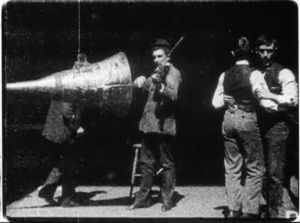
In our first month, I’ll be exploring the The Dickson Experimental Sound Film (or TDESF), the monumental start of sound-film itself by inventor William Dickson under the employment of Thomas Edison during the late-19th century. Not only was the experimental project the first attempt at unifying sound and film together, but it also used opera, marking the first time opera was used in cinema before the establishment of the trend itself. Thus, TDESF is important to remember among opera fans because in only 23 seconds, an entire subgenre was born as beginning in the early 1900s, the trend of opera as a plot and opera music in film would begin in earnest.
A Film with Sound Before Sound-Film
Firstly, the development of sound-film (“talkies“) is largely a European invention, although having US roots. But I wish to foreground the point that TDESF was not technically sound-film but rather sound and film.
The music used, Dickson’s solo violin arrangement of the Act one barcarolle, ‘Va, petit mousse,’ from Robert Planquette‘s 1877 comic opera, ‘Les cloches de Corneville,’ was recorded on what is called a phonographic (or wax) cylinder, the predecessor to the record. Next, the film portion was captured independently, and played together through the use of proto-headphones (tubes connected to the phonograph) through a machine called the Phonokinetoscope (or Kinetoscope, kinteo-phonograph) although this went out of fashion. Shortly after, the Phantoscope (or projector) was the next thing given the improved convenience, and the Kinetoscope fell out of fashion with the rise of Eugene Lauste’s sound-on-film celluloid technology. This too proved a relatively dead end, and during the 1910s, the rise of the sound film would displace the silent film era and usher in a new cinematic age.
Regarding TSDESF, it was shot at the famous, Black Maria, Edison’s film studio in West Orange, NJ, where clips of everything from productions to everyday life were creating a new medium of art itself. Some of the first experiments like ‘Blacksmith Scene‘ (1893) and the famous dance by Annabelle Whitford (1894) were made contemporary with TSDESF. But while they were silent, TSDESF had a musical attachment. Interestingly, the nitrate film and the wax cylinder’s relationship was not understood until the late 1990s when restoration was conducted on the split cylinder. The novelty of the opera at the heart of TSDESF has not received as much of the limelight as the project itself, although there’s scant information. Interestingly, in scholarship, Dickson’s solo is called a waltz, with its source omitted as film scholar James Wierzbicki’s account notes. Thus, the connection of TSDESF to the history of operatic cinema (or opera cinema, opera film) has not been facilitated as it ought to.
Other early experiments with the Kinetoscope also included opera like in ‘Hear me, Norma,’ but generally the project was framed as increasing the egalitarian nature of leisure, but also the aspects of life that film could not capture, like bugs and microscopic organisms. Effectively, the entire paradigm of life was changing as aspects of life were able to be captured and played back, watched by anyone regardless of one’s bodily capabilities. But I contend the most important aspect, at least for opera lovers, was the opera portion of TSDESF, a key aspect of a comprehensive understanding of the early history of the subgenre we love today, namely opera cinema. As Edison predicted in 1894, and which infamously came true in 2018,
I believe that in coming years by my own work and that of Dickson, Muybridge, Marié and others who will doubtless enter the field, that grand opera can be given at the Metropolitan Opera House at New York without any material change from the original, and with artists and musicians long since dead.
The Operatic Grandfather of Opera Film
Dickson’s work with film during the late 19th century bore many types of fruit (Dickson Greeting, 1891) in many capacities (Sherlock Holmes Baffled, 1900). While not the earliest (Roundhay Garden Scene, 1888), for opera audiences, Dickson’s film-sound experiment marked the birth of a tradition. The opera at the heart of TDESF was the 1877 French comic opera, ‘Les cloches de Corneville,’ by Robert Planquette, specifically the chanson, ‘Va, petit mousse,’ from Act 1. Like so many examples of its time, Planquette’s comic opera was a European hit when it premiered, and while it was revived, it never again received the same mainstream popularity. The opera was also used as the plot of a 1917 eponymous film by Thomas Bentley using an early predecessor of sound-film technology. His next film, The Divine Gift (1918), was also based on Wagner’s Tristan und Isolde.
It bears mentioning that the first reported use of Richard Wagner’s operatic plot in film was 1904 (Parsifal), and it would not be until 1910 when the first composer was dramaturgically conveyed in film (Chopin e George Sand). This was quickly followed by the first documented use of Wagner’s music in film (The Birth of a Nation, 1915), and from that point, the double trend of films based on opera plots and films using opera music began in full force! We’ve looked at many notable examples like Thais (1917) and The Glass Mountain (1949), but it was Dickson’s use of opera that started the trend in the first place. All this to say that TDESF is historically novel for many reasons, and it’s worth looking a little deeper into the grandfather of the opera-cinema convergence, and why this opera was selected. Of all the choices available, a highly melodic barcarolle was what they chose.
Within Dickson’s extant archive of autobiographical materials like letters, it’s known his mother (Elizabeth Kennedy-Laurie) was a scholar-musician who, in her own autobiographical work, noted she was musically educated in the German tradition. His sister was also a lauded, and highly erudite, musician who gave lecture concerts to critical praise. This confirms Dickson was surrounded by music and had a close relationship to it, but it doesn’t yet explain the choice. Given Planquette’s opera was premiered only 17 years earlier, it’s entirely possible its popularity was still being felt and had made its way to the US consciousness somehow, and in fact history confirms this to be true. In October, 1877, the opera premiered in New York City under the title, ‘The Chimes of Normandy,’ and its US fame continued through the late 19th century up until 1931. Whether Dickson saw it is uncertain but it was at least within the public consciousness of East-Coast urban dwellers at the time.
The review of the 1909 production at the Manhattan Opera House (or the old Metropolitan Opera) remarked that the songs themselves were memorable but the performance was all-together dull given the orchestra’s lack of unity. What this seems to suggest is the melodies were popular and well-received. Was Dickson among the crowd that found them favorable? As noted by US musicologists Judith Tick and Paul Beaudoin, American writer Willa Cather’s 1929 reminiscences of US travelling opera companies Westward included Planquette’s opera. In her words, “What good luck for a country child to hear those tuneful old operas sung by people who were doing their best: The Bohemian Girl, The Chimes of Normandy, Martha, The Mikado.” It’s possible Dickson was among those who got exposed to opera by one means or another. Continental-touring companies during the late-19th century and early-mid 20th centuries provided the opportunity for rural communities to be exposed to both American and European operas, one example being the American Opera Company (1886-1950).
It’s also worth noting that in connection to William’s mother, people have speculated on the nature of his sister’s contribution to the legacy of the Kino-phonograph. As feminist media scholar Jane Gaines notes, Antonia was an incredibly gifted musician and toured England, Europe, and America. However, her role in co-writing what is essentially the first texts of cinematic history marks her as particularly important to the history of cinema, and therefore the history of opera on film as well. Did she have a part to play in the musical choice? We don’t know, but donning a “counterfactual” hat could birth an exciting answer to the ambiguous beginnings of opera film.
Overall, TDSEF is a fascinating, and unexplored/unconnected, part of opera cinema history, and one all fans of the subgenre should remember when they see a live screening of the MET at your local theatre. Opera on the screen, opera in film, and films about opera effectively began with a humble violin solo from a largely forgotten comic opera.
Watch