Opera Meets Film: A 1960s Thriller Born Anew in Stephen Schwartz’s ‘Séance on a Wet Afternoon’
By John Vandevert(Photo: David Bazemore)
Now that 2025 has come and gone, and we are facing a new year of possibilities, it’s best to take a quick review of the stories we’ve explored together in the last years before 2026 really begins. While there has been a good deal of historical articles like the cinematic presence of Maria Callas and Wagner, there’s also been interviews with people like Dr. Joseph Attard and opera singer Miriam Gordon-Stewart. But other topics were also explored.
Two main themes in these monthly articles have been opera in films and films featuring operatic stories, either adaptation-based or merely inspired narratives. From Max Nosseck’s Yiddish-language film, “Overture to Glory“ (1940) and Carl Froelich’s “Fire At The Opera“ (1930) to Chuck Jones’ “The Cat Above and the Mouse Below“ (1964) and John Irvin’s “The Moon and the Stars“ (2007), opera and film align in surprising ways.
But we’ve also explored experimental projects. From Herzog’s “Lessons of Darkness“ (1992) and Niklas Paschburg’s “Opera“ (2020) to Daron Hagen’s “9/10: Love Before the Fall“ (2024), Mario Bergmann’s operatic music video (2023), Erick Oh’s short film (2020), and Benjamin Orlow’s 24-hour opera film (2022). As Michel van der Aa’s “A Theory of Flames“ shows, however, opera and cinema can blend together in service of a story.
In this vein, during this spring term, Opera Meets Film will explore a new trajectory, namely operas based on films, focusing on the relationship’s inverse, namely the screen to the stage. In recent years, operas like Thomas Ades’ “The Exterminating Angel,” Missy Mazzoli’s “Breaking the Waves,” and Kevin Puts’ “The Hours,” have led the charge in this regard but I wish to explore five equally as brilliant film-to-opera alternatives.
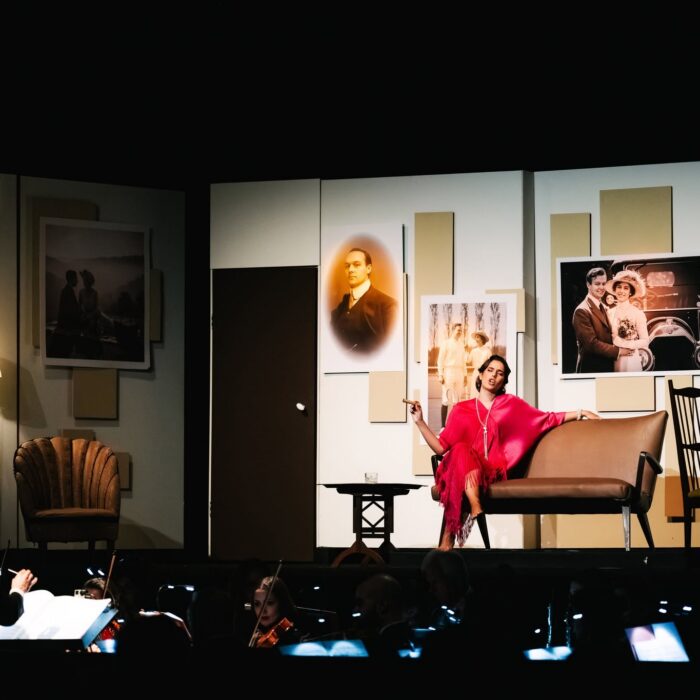
In our third opera of 2026, I wish to explore Stephen Schwartz‘s only opera, “Séance on a Wet Afternoon“ (2008). Despite favourable critic reviews which suggested a “shelf life,” his opera never took off as the populist opera it wanted to be, with its 2011 performance terminated. Despite this, the opera is a great example of how a more cerebral and sober film plot is transformed into an enjoyable alternative without losing its essential parts.
From Novel to Thriller
The story of Schwartz’s opera begins with Australian author Mark McShane‘s 1961 novel. Written early in his career, “Séance on a Wet Afternoon” would be the title his legacy is most attributed to despite his full oeuvre extending into the early 2000s. Known for his spirited mixture of the crime, suspense, and thriller genres, his third novel would ultimately cement his literary fame.
The following year, the novel would succeed in moving into the annals of cinematic translations, a kingdom so vast it requires a lifetime to get comfortable within. Produced by Beaver Productions, a joint project of Richard Attenborough and Bryan Forbes, the film was to be a project which saw collaboration from those within the highest tiers of post-war British cinema. The script was handled by Forbes who went through several iterations due to the sensitivity of the child kidnapping at the center of the story.
It’s important to note here that McShane’s novel and its film adaptation share the same plot. Myra Savage (a medium) and her husband, Billy Savage, live meagerly, supported only by the weekly séances Myra puts on for wealthy patrons. However, Myra is haunted by the spirit of her departed son, Arthur.
To raise funds, Myra has Billy kidnap Amanda, the child of the wealthy Mr. and Mrs. Charles Clayton, sneaking in and confining her to a room. Asking for a £25,000 ransom, Myra goes to the couple and offers her services, but they are doubtful of her abilities. Once getting the money, Billy realizes the cops will follow them and thus, he brings Amanda to their home, only to realize she has developed a fever. Myra commands Billy to kill her but, unbeknownst to her, he renders her unconscious instead. Myra conducts a seance with the police where she states Amanda is dead but senses she is alive. Billy confesses and returns the money and child.
Despite the plot, both the book and the film are focused on Myra’s psychological suffering and its effects on her. Her proximity with death, the strain of poverty, her dependence on exoticizing her abilities for the apathetic elite, her wish for societal inclusion, and the continual torment brought about by her son’s passing, and the film becomes less the story of unscrupulousness than a fight to restore lost virtue, purpose, and societal respect.
The film’s ending suggests this as Myra channels both Amanda and Arthur simultaneously, breaking down in tears as she coddles her son whilst seeing Amanda alive, blurring the boundaries between both her desires and her reality and the living world and the world beyond. Living fundamentally between these worlds, Myra has no place in life but does not belong to the world beyond despite her burning longing for her son. Effectively, she has lost her place within human society after the death of her son, remaining alive but at the fringes of society wishing to again be seen as human, and going so far as crime in the hopes a sense of purpose can be restored.
From Thriller to Opera
Naturally, if one wishes to make a family-friendly opera based on the film, some of the plot points would need to be edited and drastically changed to lessen the film’s underlying psycho-ethical conflict. And this is exactly what occured, Schwartz taking liberties to change the McShane/Forbes plot to fit the sensibilities of feel-good opera.
In his version, the detached exhibitionist nature of postwar British cinema, think Alfred Hitchcock, is turned all the way down, something critics thought greatly inappropriate and musically starved. The plot now focuses on Myra’s desire to achieve fame for her abilities. An interview given in the late 2000s revealed a bit more on Schwartz’s thinking concerning the plot. As he noted, “Just as in musical theatre, I actually think it’s the ‘book’ that is key to the success or failure of the piece. Of course, good music is vital, but I have seen contemporary operas with excellent music totally flounder because their story‐telling is a mess.” In a later interview, he further specified the dynamics,
“[…] for this project I would say that the music exists to tell the story, rather than the story providing an excuse for the composition of the music.”
As noted, the critics thought the lighter musical texture and more musical theatre-styled melodicism did not mesh well with the plot’s heavier tone and complex nature. To this, Schwartz noted, “I’m really trying to stay true enough to myself to bring something different to the opera while remaining within the tradition.” He noted that while others have noted the influences of Strauss, Puccini, and Britten, he never intentionally sought to replicate nor include focused references to their styles. Ironically, these influences, specifically Britten and the post-Schoenberg school like Berg, could have enhanced the opera by complimenting the film’s psychological undertones of an elderly woman fighting for respect in a world where her position, her purpose, and her humanity are lost.
However, later interviews demonstrated that Schwartz woefully misunderstood the operatic audience from the musical theatre audience, and wrote for the latter but not the former. He had hoped that his opera would have escaped the pit of irrelevance and become standard repertoire but as history has shown, his opera soon joined it. Moreover, he assumed that the audience wanted a good story rather than a more complete work, “Critics are more interested in the form and audiences are more interested in the content.” Further still was his failure to realize that despite opera having “tunes,” these so-called “tunes” do not operate the same way as musical theatre, instead requiring continuity in its context, with much of the work done on the sound level, not the text.
One can speculate why the opera never took off but based on his musical comments, one gets a sense that he was writing opera not for an opera audience but a musical theatre one, echoing the alienation Myra felt from the world, living and the dead. Finding no home in musical theatre, yet no place in opera, Schwartz’s experiment was just that, an experiment. Since then, he’s written nothing in the realm of opera, and despite a desire to make a “real opera,” it was clear his compositional process was ill-suited for the world of opera, “I couldn’t just get a tune in my head.” But what Schwartz did create is a work which lives between two worlds but belongs to neither, just like Myra.
Watch