Remembering Her Voice in Virgil Thompson’s ‘The Mother of Us All’
By John VandevertPhoto Credits: Hudson Opera/RB Schlather (2017)
Within contemporary American opera, there are many works whose lifespan betrays its contents. Even historical significance can’t save opera from being forgotten if it fails to find its audience. Works like Carlisle Floyd’s ‘The Passion of Jonathan Wade‘ (1962), Thea Musgrave’s ‘Simón Bolívar‘ (1994), Dorothy Moore’s ‘Frederick Douglass‘ (1985), Stewart Wallace’s ‘The Bonesetter’s Daughter‘ (2008), and even Robert Bradshaw’s ‘.Gabriel‘ (2010) are examples of topical operas without an audience. While impactful, after one or two accompanying revivals, they fell from attention.
The topic must therefore be raised, namely the speed of the United States’ marketplace, and the fight to find a place at the table. Is the American scene just too interested in box office sales than a resonant message? Do we need more opera, or is it better to revisit past operas, and find ways to observe the present through them? To me, the latter is more important. While AI, virtual reality, social media integration, posthumanism, digital integration, and transmedia, are the new darlings in American opera, hardly anyone knows what came before, much less what was important.
During these summer months, we will look at three operas that epitomize the ways opera creates space to think about intersectional discussions and overlooked topics concerning three themes, namely race, feminism, and indigenous rights. In part two, we’ll briefly explore Virgil Thomson’s 1947 feminist opera, ‘The Mother of Us All.’
-
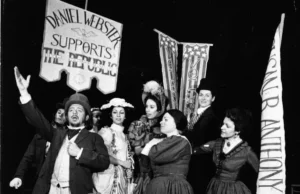
- The Mother of Us All | Encompass New Opera Theatre (1976)
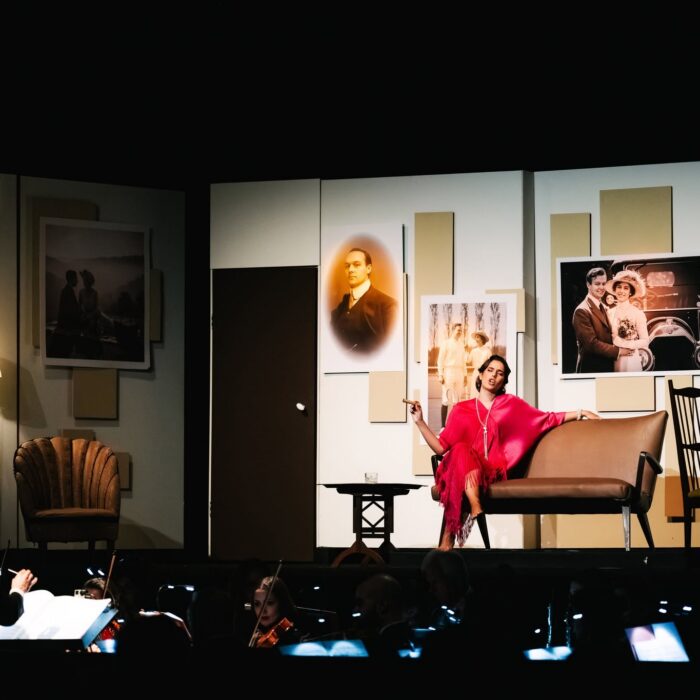
The opera centers around the life and legacy of pioneering American suffragist, Susan B. Anthony, between two acts, and effectively weaves a tale displaying the complexities of Anthony’s mission, experience of life as a woman, and the lives of women around her. Act one is focused on the mediation between her political and personal life, ending in a celebratory marriage. Part two is more overtly focused on her Congressional petition for voting rights, and concludes with the unveiling of a statue and Anthony’s soliloquy about her work. With a principle cast of over 30, the opera’s neo-Wagnerian use of melody, pared down orchestration, and slight hints of serialism had greats things going for it.
In Thomson’s oeuvre, ‘The Mother of Us All’ came at a rather inopportune time, that is, two years after the start of World War II, but more importantly, a year before a well-loved work, the ‘Suite from Louisiana Story‘ (1948) which the year after, won the 1949 Pulitzer Prize. Moreover, Barber’s groundbreaking work, ‘Knoxville: Summer of 1915,’ Copland’s, ‘In the Beginning,’ Weil’s, ‘Street Scene,’ Menotti’s, ‘The Telephone,’ and Britten’s, ‘Albert Herring,’ were premiered the same year. What this practically means is that there was steep competition for the public’s attention, and while there were winners, there were also losers. That same year, as history reminds us, the controversial premiere of Georgian composer Vano Muradeli’s, ‘The Great Friendship,’ occurred which, while favored by Shostakovitch, was diminished by Stalin, and hopes in the great Soviet opera temporarily dashed.
Thomson called the opera a, ‘pageant,’ rather than an opera based on the aggregated nature of the acts rather than being a directional narrative. Additionally explorative was Thomson’s assemblage mentality regarding his use of influences, from chant and folk music to serialism and Wagnerian impulses. In the titular role during the 1947 premiere was soprano, Dorothy Dow, best-known for her work with late-Romantic/early-Modern works of Wagner, Strauss, Berg, Bartok, and Schoenberg. Marvelously equipped to handle Thomson’s vocabulary, it had everything going for it, and yet failed to dominate as others of its time did. Whether the work will be recovered is anyone’s guess, but as a piece of history, it pushes us to think about what history is worth remembering, and whose voice worth listening to.
Watch
Categories
Special Features