Opera Meets Film: When Justice Becomes A Curse in Poul Ruder’s ‘Selma Ježková’
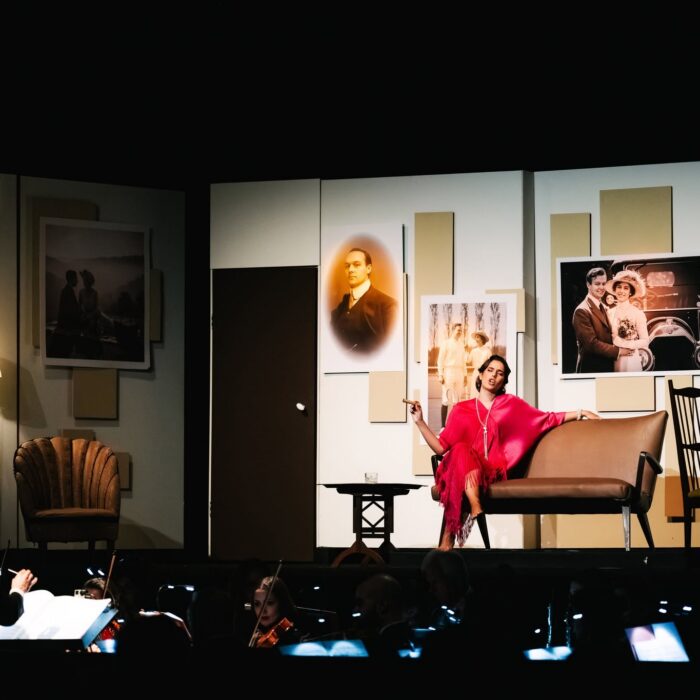
By John VandevertPhoto Credit: Miklos Szabo/Lincoln Center (2011)
Having composed the internationally celebrated work, ‘The Handmaid’s Tale‘ (1988), an opera which has gained a truly canonical spot in theatrical repertoire thanks to its global embrace, Danish composer Poul Ruders was and remains on the cutting-edge of opera today. With five operas to his name, among them ‘The Thirteenth Child‘ (2016) and ‘Kafka’s Trials‘ (2005), Ruders has successfully integrated himself into the operatic discourse of our time.
Yet, among his operas, it is ‘Selma Ježková‘ (2007) which stands out. Not only is it his shortest opera—only being 70-80 minutes, but it’s the opera whose cinematic origins are by far the most well-known. In this Opera Meets Film, following this semester’s trend of exploring operatic adaptations of films, I wish to explore Ruders opera and find out how the opera works and the discussions contained within. It was shelved in 2015 but there must be a reason, no?
A Rather Complicated Adaptation
Ruders’ opera is based on the third film of the trilogy, ‘Golden Heart,’ by Danish filmmaker Lars von Trier. If one isn’t familiar with the cinematic trilogy by name, then they surely are by the 2016 operatic adaptation of its first film, ‘Breaking the Waves,’ by American composer Missy Mazzoli. The film, ‘Dancer in the Dark,’ whose central figure is Selma (played by Icelandic singer Björk Guðmundsdóttir), was adapted by Ruders, although choosing to cut the run time down by focusing on five particular scenes and generally omitting the musical element.
In the film, the way Selma deals with her collapsing world and impending loss of sight is through envisioning herself as in a musical, Björk’s 2000 album (Selmasongs) featuring one of the most widely recognized songs of the film, ‘I’ve Seen It All.’ She also partakes in a musical, ‘The Sound of Music,’ although her participation is cut short as she is quickly apprehended by the police for the crime of Communist sympathies and healthcare fraud.
One can argue that the near complete erasure of the musical part from Ruders’ opera was an actually harmful step and starved his operatic adaptation of a key element of Trier’s film. The episodic nature Ruders chose follows Selma from the factory to the gallows but greatly omits imaginary and non-imaginary musical activities. In the first scene, Selma is in the factory and uses musical theatre to escape the monotony of her job and the disconcerting realities of her condition, her son’s condition, and the threat of poverty.
Whilst the film focuses on the blurring contortions of Selma’s inner and outer worlds, Ruders’ opera instead focuses on Selma’s life as a mother, her protective selflessness, and the sacrificial nature of being a parent. Anastasia Tsioulcas of NPR noted that, “Selma’s motherhood is always front and center — and her child is literally never far away…Gene is always onstage. He hovers just outside the circle of conversation, listening but not speaking.” Thus, the opera follows the maternal discussion as instigated by operas like Sebastian Fagerlund’s ‘Autumn Sonata.’
According to online discussions of the opera’s US premiere in 2011, the work had many limitations, none the more apparent than the quickly deadening effect of the score’s intensely somber character and ostensible lack of dimensionality, along with the underdeveloped element on blindness and overarching enigmatic purpose. As one person wrote, “The disembodied grey eye, with its suggestion of a kind of cold cartoonish deism, does not provoke, and you’re happy when, after an hour, the stage finally goes dark.” Pictures of the 2011 set convey the harsh morosity of the opera, whilst documentary reviews note how the opera began and its portentous quality.
Ruders’ opera deviated in many ways from the film but one of the most brazen is how the opera begins. Taking place in the ruins of the choir section of a Medieval cathedral, the opera starts as a wake for Selma, featuring her in a coffin surrounded by black-cladded individuals following her execution. And yet, this is where the opera takes off from, an example of the postmodern device of prolepsis. As another person wrote about that night, “I have never heard an audience grow so quiet so quickly. Finally in all of that silence and stillness, Gene walked to the coffin and pulled Selma into a sitting position and embraced her.” It’s clear Ruders chose to foreground the themes of fate, sacrifice, death, motherhood, family, duty, and inevitability by starting with denouement.
In 2022, the open question of why contemporary opera composers reach for films as sources of inspiration was researched by João Pedro Cachopo, with his thesis being, “this new repertoire bears witness to a change in how the relationship between opera and cinema is perceived in the 21st century.” This changed relation actively “reflects the overcoming of cinema’s ‘anxiety of influence’ and operas ‘anxiety of survival,’ which eliciting more playful displays of the ‘elective attraction’ between the two genres.” The transition from screen to stage may be a result of the growing diversification of the polymediality of opera itself, yet not so much in the work itself as the nature of how the work is created. To this, Bert Cardullo’s words on the film script speaks to Cachopo’s ideas,
The success of a movie script—not unlike that of an opera libretto—depends, not only upon its quality as a piece of literature but also, or even more so, upon its integrability with the events on the screen.
Too Many Issues To Count
The question of why this opera didn’t have a longer lifespan is up for debate considering Ruders’ 1988 opera has taken the world by storm and remains in regular performance (Detroit Opera, 2026). There have been many operas whose themes were seminal and seemingly complimentary of the prevailing social discourse. Operas like Matt Boehler’s ‘Fat Pig‘ (2020), Eric Sawyer’s ‘The Scarlet Professor’ (2017), and Tarik O’Regan’s ‘Heart of Darkness‘ (2011) reflect many of the salient themes circulating in our contemporary world.
From discrimination based on bodily composition and sexual attraction to biopolitical critiques of European colonialism, one must ask why ‘Selma Ježková’ didn’t gain a more long-lasting place in contemporary opera? Unlike ‘The Handmaid’s Tale,’ this opera is far less dystopic and far more realistic, potentially fueling its fate. Additionally, there is no real justice to be had in ‘Selma Ježková,’ with Selma receiving neither mercy nor understanding. While one can chide the audience for their desire for closure and the many justified failures of the contemporary operatic public’s taste, what this opera provides contrasts even the most dismal of endings like Verdi’s ‘Aida’ or Puccini’s ‘La boheme.’ Although finishing with death, they first weave a story to get there.
Another possible obstacle towards the longevity of ‘Selma Ježková’ could have been the lack of built-in breaks like narrative digressions, levitous moments, crowd scenes, or even instrumental intermezzi. As a result, the opera’s five scenes progress as a more or less one-tone path of austere drudgery, no matter how pathotic the music or visceral the dramaturgy. Yet another error is also the failure of the opera to conform to the structure of any one type of opera, being too small for grand opera but not contemporary enough to be one of the newer forms like the CNN opera. Effectively, it’s neither reflective of a neo-lyric orientation but far from a Wagnerian recit-based alternative, yet equally as far from the Britten style but also far from Menotti, Hindemith, and Adams.
The question then becomes, where does this opera live and who is this opera for? As Zachary Woolfe for the New York Times noted, “Its [Selma Ježková] issue is not simply a lack of fidelity to Mr. von Trier’s film; it’s that the opera fails to persuade you to consider it on its own terms.” He goes onto specify what he means, “Deep characters are flattened,” and, “Selma’s reveries are indicated merely by little ariosos in a lyrical style that halfheartedly evokes early Bernstein.” Effectively, “In its abridgment of the film, the opera has removed not just musical numbers and subplots, but also the characters, the story’s emotional core. It’s hard to tell what’s left.”
The project that was ‘Selma Ježková’ came from a promising place but effectively failed to understand what made the film what it was. While Ruders brought his voice, he lost not only Selma’s but von Trier’s as well, with the opera becoming a simulacra of the original, yet missing the mysterium of the Scandinavian touch to film-making. In other words, while promising, there was no distance or moral complexity, but only horizontality, flatness, and sound.
Watch