The Fight for Rights in Anthony Davis’ ‘Wakonda’s Dream’
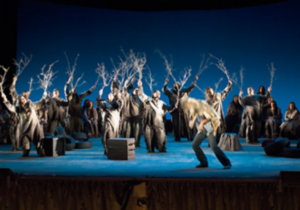
By John VandevertPhoto by Jim Scholz/Opera Omaha
During these summer months, we looked at three operas that epitomize the ways opera creates space to think about intersectional discussions and overlooked topics concerning three interconnected themes, namely race, feminism, and indigenous rights. In part one, we looked at race in Daniel Sonenberg‘s 2017 opera, ‘The Summer King,’ finding out how the complexities of race interacted with American baseball in the early 1900s. In part two, we looked at feminism in Virgil Thomson’s 1947 opera, ‘The Mother of Us All,’ which took a fictionalized perspective to tell the harrowing story of American suffragist, Susan B. Anthony. In this final part, we’ll complete this summer series by examining the topic of indigenous rights through Anthony Davis‘ 2007 opera, ‘Wakonda’s Dreams.’ While the name, Wakonda, is now most associated with Marvel Comics and Ryan Coogler’s Hollywood film, the term’s real origins are uncertain but they are undoubtedly connected to indigenous cultures, both African and non-African in nature.
The use of opera to talk about topical issues is hardly a new cultural phenomenon. From Verdi and Puccini, Mozart, Lully, and Hadyn, Donizetti and Rossini, to Shostakovich, Glass, Adams, and beyond, opera has always interacted with politics in one way or another. What is new, however, is subject matter, and the treading of new ground, among such pathways being indigenous rights, lands, and injustices. Early American operas on the subject were obviously crude in their depictions, although insensitive depictions and use of materials is not unique to America alone as in the case of Harry Somers’ 1967 opera, ‘Louis Riel.’ But the topic has grown since then, the birth of both academic and non-academic work, and inventive new works like Brent David’s ‘Interplanetary Opera‘ are pushing ideas about what indigenous opera looks like farther than ever before. The growing place of Indigenous stories within opera is an important development, and operas like Ian Cusson’s ‘Empire of Wild‘ are promising opportunities to learn and grow.
Davis’ opera concerns the infamous 1879 court case in Nebraska, Standing Bear v. Crook, which concerned the forced (then legal) removal of the Ponca tribe from their ancestral land. The United States’ history of forced removal is well-documented, extensive, apathetic, merciless, and brutal in nature, with many of the treaties dishonored, and atrocities never apologized for. The result was that Indigenous Americans were now considered protected persons under the United States Constitution, but as recent events show, that means little. The tribe’s Chief, Standing Bear, gave his famous monologue during the court case whose applicability still rings true today all those decades later,
This hand is not the color of yours, but if I pierce it, I shall feel pain. If you pierce your hand, you also feel pain. The blood that will flow from mine will be of the same color as yours. I am a man. The same god made us both.
To prepare for the opera, Davis visited the annual Ponca pow-wow, and talked with those for whom this story was not just a story but living history. A great emphasis of his work was to create an opera which took an artistic side to show a deeper level rather than go down a more historically-oriented road. He combined Indigenous music with jazz and African-African musical traditions to create a synthesis of minority musical experience, with rhythm being a key element within the work. The work premiered on March 7, 2007, at the Orpheum Theatre, but has not been seen since. Despite its success, and poetic libretto by Yusef Komunyakaa, a revival is unlikely. Despite this, Davis’ recent works (‘The Central Park Five‘, 2019) and past works ( ‘X: The Life and Times of Malcolm X‘, 1985) are well beloved. No official recording was made, no formal video of the premiere has been published, and there are only a few photos available.
Watch
Categories
Special Features