Harry Somar’s ‘Louis Riel’ And The Celebration of A Leader
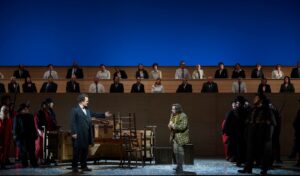
By John VandevertPhoto Credit: Michael Cooper/Canadian Opera Company (2017)
Generally absent from contemporary musical discourse, performance repertoire, and the operatic stage today, the name Harry Somers still carries considerable weight in Canada. He was instrumental in creating many of the musical institutions Canada now enjoys, such as the Canadian League of Composers (1951-), Canada Council (1957-), and the Canadian Music Centre (1959-). Bringing postwar Canada into a new era of artistic flourishing, Somers’ music and activities took him around the world, from Rome and France to the USSR and back.
The student of the equally lauded Canadian composer John Weinzweig, Somers began working for the CBC in the mid 1960s, having already earned a name for himself in the Canadian musical world. His contribution would only expand further during the Canadian Centennial: a year-long celebration of the formalization of the Canadian federation. As part of this, Somers wrote the opera “Louis Riel,” the first in his oeuvre, based on the real politician and rebel leader Louis Riel, best known as the founder of the province of Manitoba.
To celebrate Canada’s Louis Riel Day, I wish to explore Somers’ opera and the figure behind it. Not only was Riel Manitoba’s founder and a staunch advocate for his indigenous community — the Métis — but he led anti-government resistance campaigns that ultimately led to his execution. Despite this, his revolutionary efforts laid the groundwork for the decolonial fight for rights amongst Canada’s indigenous populations.
Premiered at the O’Keefe Centre for the Performing Arts in downtown Toronto on September 23, 1967, the same year Samuel Barber arranged his famous choral work “Agnus Dei” and Steve Reich composed “Piano Phase,” Somers’ work was well regarded by critics. The opera features a sizable cast of 34 soloists, with three full acts, and sung in both French and English. The opera’s sound harnesses the brash and dynamic style often heard in operas by Britten, who was leading in the opera world at the time of its composition. Both cacophonic and focused, the themes that the opera deals with are reflected in its sound.
The opera has enjoyed many revivals over the years, further demonstrating its continued relevance to Canada and the wider discussion surrounding indigenous sovereignty and state-led coloniality. The 2017 production by the COC replaced one of the arias written by Somers, the “Kuyas aria” from Act Three, as it was based on an indigenous song that was originally recorded not for the purpose of performance. But it is not the only traditional song used.
Interestingly, the opera has also spurred the creation of what could be called a post-Riel generation of operas, including the recently premiered “Li Keur: Riel’s Heart of the North,” by Neil Weisensel and Alex Kusturok. Since 2019 Somers’ opera has not been performed, but this is largely because there is a contemporary move to program Indigenous-composed operas and their perspectives, as “Li Keur” demonstrates. Other projects such as “Shanawdithit” (Tapestry Opera, 2019) and “Canoe” (2023) represent the ongoing push to foreground the Indigenous voice in opera and examine life and history from this point of view. The pioneering contribution by Somers has served its role well. Now it is time for new contributions to take the stage and carry his work forward.
Watch
Categories
Special Features