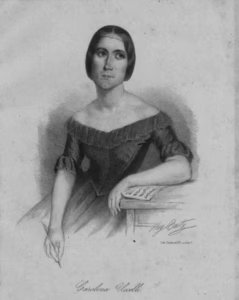
You Know Rossini and Bellini. What About Carolina Uccelli?
By Stacy Jarvis
Ask an opera audience to name composers working in the 1820s and 1830s, and the answers will come readily: Rossini, Bellini, Donizetti, Meyerbeer. Ask the audience to name a woman writing opera in those same decades, and the conversation may become quieter.
Carolina Uccelli belongs in that conversation. In 1835, her “Anna di Resburgo” reached the stage in Naples with leading singers. Rossini had praised her earlier work. Yet those professional achievements never developed into a lasting operatic career.
Now Wexford Festival Opera has announced a production for October 2027, offering audiences an opportunity to hear a composer whose disappearance raises questions about how the repertoire took shape.
“Anna di Resburgo” will open Wexford’s 2027 festival on October 14, conducted by Sieva Borzak and directed by Rodula Gaitanou. Artistic director Rosetta Cucchi has placed it in a season celebrating women’s courage and creative work, alongside Smetana’s “Tajemství” (The Secret) and Saint-Saëns’s “Déjanire.” Further performances are scheduled for October 19, 22, 27 and 30 at the festival.
Uccelli’s operatic ambitions were already evident in 1830, when her “Saul” was performed at Florence’s Teatro della Pergola. Rossini attended and praised her music. Giovanni Simone Mayr, Donizetti’s teacher, also recognized her abilities, commenting favorably on her orchestral writing.
Those endorsements were valuable professional currency. An opera required a theater, an orchestra, singers and an impresario prepared to take a financial risk. Admiration from established composers could help persuade the people controlling those resources to listen.
Uccelli understood the importance of that network. Her correspondence with the impresario Alessandro Lanari, discovered through Teatro Nuovo’s research, records the negotiations behind her theatrical ambitions. Her career was shaped by practical questions of access as well as musical invention.
With Anna, she secured an impressive cast. Fanny Tacchinardi-Persiani sang the title role, alongside tenor Napoleone Moriani and baritone Giorgio Ronconi. Their participation placed her music before the public with some of the finest voices available.
The timing, however, was unforgiving. That same autumn, Tacchinardi-Persiani created the title role in Donizetti’s “Lucia di Lammermoor.” Uccelli’s Scottish drama found itself sharing a season with an opera that would become one of the century’s defining successes.
According to Teatro Nuovo’s account, Anna received four performances at the Teatro del Fondo and a further performance at the San Carlo, possibly early the following year. Its disappearance should not be compressed into a convenient story of instant failure.
Nor was Uccelli merely following fashionable formulas. She substantially revised Gaetano Rossi’s libretto, previously set by Meyerbeer as “Emma di Resburgo.” Cori Ellison’s account in Opera describes structural alterations and a new final scene: evidence of a composer actively reconsidering how an inherited drama should work.
After “Anna,” Uccelli continued composing and performing, later appearing with her soprano daughter Emma. She remained musically active. But she did not regain a foothold in opera.
There is a parallel in France. Louise Bertin reached the Paris Opéra in 1836 with “La Esmeralda,” setting a libretto by Victor Hugo. Her family’s influential newspaper, the Journal des débats, connected her to leading cultural figures, including Berlioz.
Yet those connections also attracted hostility. As the Library of Congress recounts, Berlioz described opponents of the family alleging that he had written part of Bertin’s score. He denied it. Access to powerful supporters had not protected her authorship from being questioned.
The two careers were different, but both show why a premiere tells only part of the story. Getting an opera staged was one achievement; securing further productions and opportunities to develop was another.
Wexford’s announcement matters because this is already a second chapter in Anna’s modern recovery. Teatro Nuovo performed the opera in both New Jersey and New York City in July 2024, bringing it back before audiences after its long absence.
There is evidence that audiences were willing to take the chance. In its 2025 program, Teatro Nuovo reported a sold-out house for the revival. Reviewing the New York performance for Opera Today, Andrew Moravcsik also described a full house and an enthusiastic reception.
One sold-out performance cannot establish demand across the industry. It does, however, challenge the assumption that an unfamiliar name will necessarily leave seats empty. Here, audiences turned up for an opera they could scarcely have known.
Uccelli deserves attention as a composer, with theatrical ideas and musical choices worth hearing. Her gender helps explain the obstacles she encountered; it cannot settle the artistic judgment. That requires performances, discussion and the freedom to find both strengths and weaknesses.
Wexford can help move that discussion forward. Another production allows different interpreters to test the score and gives listeners something more substantial than an invitation to celebrate a neglected name.
The aim should be to make Uccelli familiar enough that audiences can discuss what her opera does, rather than simply express surprise that a woman wrote it. The music carries that argument.
Categories
Special Features