A Little Opera Reappraisal, Pt.2: R. Murray Schafer’s ‘The Princess of the Stars’
By John VandevertPhoto Credit: Scott Rowed
In this new four-part series, we’ll be taking a look at four significant, and greatly underperformed, operas within opera history from early-mid 20th century but outside America and Central Europe. The normal Opera Film reader may be acquainted with a breadth of opera’s expressive diversity. In part one, we explored Miguel Bernal Jiménez‘s only opera, ‘Tata Vasco‘ (1941), a rather controversial opera for its time given its whitewashing of the theocratic colonization of the indigenous peoples of Michoacán by Spain in the 16th century.
Although it has become a national favorite, performed relatively regularly, with the protagonist having become a quasi-hero in the region, it’s best to remember that bishop Vasco de Quiroga was a colonizer, worked for a colonizing force, and perpetuated a colonial system. But what happens when those colonized peoples are foregrounded instead?
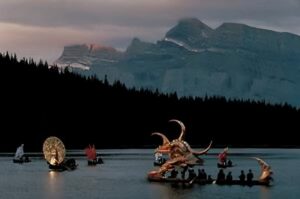
In part two, we’ll take a look at Canadian composer R. Murray Schafer’s 1981 experimental plein air opera, ‘The Princess of the Stars.’ Generally overlooked in post-WWII opera’s historical record, this opera was one of the early progenitors of indigenous opera. This trajectory has now been normalized by operas like ‘Wakonda’s Dream,’ the White Snake Projects, ‘Louis Riel,’ most particularly, ‘Sun Dance Opera,’ and most recently, ‘Li Keur,’ and, ‘Empire of Wild.’ It must therefore be remembered that the telling of indigenous stories, knowledge, and histories on the operatic stage, and through the operatic artform, is not a new development in the history of opera.
What is new is the ways in which narratives are crafted, communities involved, and performances handled. In Schafer’s opera, indigenous stories, opera, and the natural world merge in aleatoric and non-aleatoric ways, and involve the natural world in an opera which wakes with the rising sun. That didn’t save it from controversy, however.

-
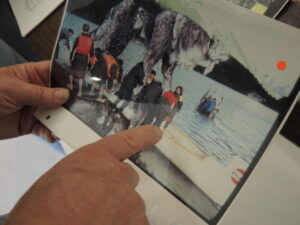
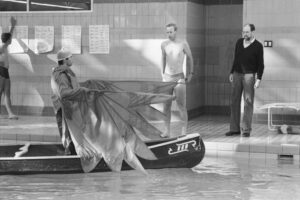
- Photos by Ed Ellis (BANFF Center, 2015)
The Story
Schafer’s opera is inspired by the Ojibway/Anishinaabe story of the Sun Disk and his daughter, and the Three Horned Enemy. The Sun Disk’s daughter, the Princess, was taken hostage by the Three Horned Enemy, and was held at the bottom of a lake. With the help of birds, Wolf pursues the enemy and a fight emerges, stopped by the Sun Disk. However, they order the birds to stop singing and the lake to be frozen over until Wolf saves his daughter. This is the opera’s general story, but it’s worth diving into its roots a bit more and the symbolism.
As musicologist Tyler Kinnear notes, much of the opera’s narrative corresponds to different natural phenomena which is mythologized by indigenous stories, and which the opera uses as its central plot. Elements of the story can be found in the origin stories of the Ojibway/Anishinaabe peoples, particularly in the way water is used and centralized in stories. Additionally, relationships between human, animal, and non-human/non-animal beings is a constant theme, and storytelling was tantamount with preserving their relationship with the natural world, and Mother Nature.
From what can be understood through Anishinaabe stories, ‘the Princess of the Stars’ could be understood as either a creation story, a story of the underworld like that of Persephone, or even the natural battle between good and evil as it’s personified through the continual battle between the Sun and the Night.
-
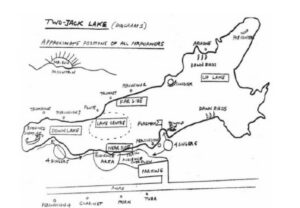
- Layout for the 1985 production of Princess at Two Jack Lake (Kinnear 2018, p. 36)
A Bit of Controversy
However innovative Schafer’s opera was, for it was as Kinnear demonstrates in his analysis of Schafer’s sound art through acoustics and integrative soundscape practices, it can’t be denied nor overlooked that Schafer had a very complicated relationship with indigenous culture. His opera, ‘The Princess of the Stars,’ is the preface of the project, ‘Patria,’ an 11-part series of operas on indigenous themes.
But despite its eco-acoustic approach and interest in working with indigenous culture on a more equitable level, as Lukas Sawatsky noted, Schafer’s approach hadn’t always been scrupulous nor respectful. The series upheld the notion of the terra nullius, or the untouched land whereupon the native peoples become everyone’s ancestors instead of a sovereign people with real concerns that deserve to be heard.
In Dylan Robinson’s 2020 book, Hungry Listening: Resonant Theory for Indigenous Sound Studies, he noted Schafer’s questionable comments on how he saw post-colonial Canadians and their link to pre-colonial native peoples. In Schafer’s own words, “When you finally realize you come from Canada (with no strings attached) you find yourself brother and sister of the Indians and the Inuit.”
Outside of his disdain for Inuit throat singing, remarking that there was a “marked similarity between an Eskimo singing and Sir Winston Churchill clearing his throat,” ‘Patria’ is also particularly difficult to accept as a work for the entire project emits an air of disrespect. This is most evident in the project’s syncretic approach towards the blending of mythologies, stories, temporality, kingdoms, and peoples, essentially cannibalizing the indigenous stories of the Ojibway/Anishinaabe people. This is on par with how Schafer sees himself in relation to these communities, as a so-called brother of these people which gives him permission to do what he pleases with these stories.
Kinnear argues ‘The Princess of the Stars’ was Schafer’s attempt to, “to create an all-sensorial wilderness experience that can be utilized as a method to invite a return to an idealized past where humans become part of a larger, truly grand Canadian landscape.” In light of Schafer’s views, it must be stated that ‘The Princess of the Sun’ is an indigenous story and belongs to indigenous peoples. Everyone else are only guests, and should always remember that.
Watch
Categories
Special Features