Artist of the Week: Rosie Aldridge
Mezzo-Soprano Makes her Role Debut in ‘Lady Macbeth of Mtsensk’
By Francisco Salazar(© Martin Sigmund)
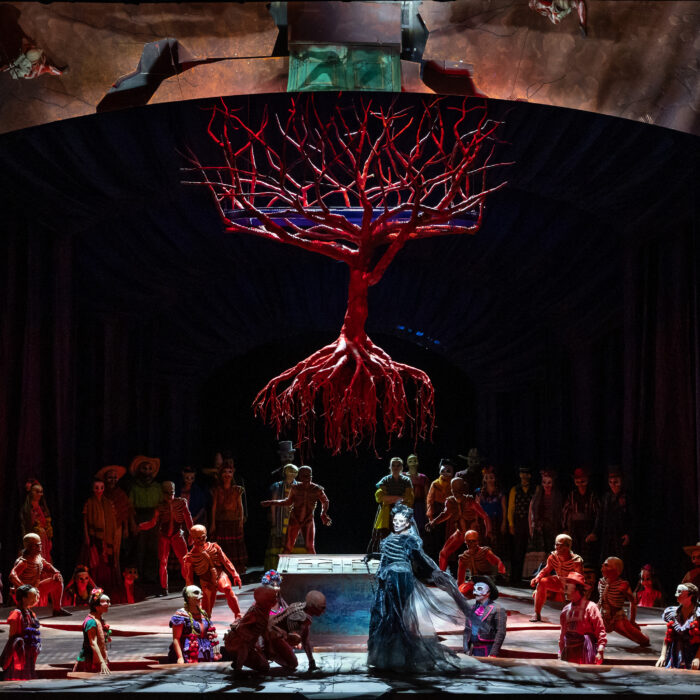
This week, the Staatsoper Stuttgart is set to open a new production of Shostakovich’s “Lady Macbeth of Mtsensk,” one of the most controversial and beloved contemporary operas of all time, with an all-star cast. Among the headliners is Rosie Aldridge who will star as Katerina.
Aldridge has increasingly become recognized for the breadth and depth of her repertoire, ranging from Wagner, Janáček and Stravinsky to Sondheim and Turnage as well as major dramatic force on stage.
In anticipation for her role debut, OperaWire did a short interview with Aldridge.
OperaWire: What attracts you to the character of Katerina? How do you view her?
Rosie Aldridge: Roles like this don’t come along very often… Katerina is passionate, sensual, lonely, dangerous, vulnerable and capable of terrible violence… to be entrusted with the dramatic engine of an entire evening – to play someone neither good nor bad, but contradictory and completely three-dimensional – is a huge privilege.
OW: How does Shostakovich’s music differ from the other composers you perform? Tell me about how Shostakovich structures the vocal parts?
RA: When I first began working on this Shostakovich score, I felt a strong connection with Janáček, particularly in the relationship between text and rhythm. But the more I sang the role, the more I found myself thinking of Judith in Bluebeard’s Castle. There is something similarly concentrated and psychologically active in the writing, although Katerina ultimately has a much broader musical journey.
I’m also incredibly glad that I have sung Kundry. In retrospect, she was wonderful preparation for Katerina. With Kundry I learnt that you have to be fearless – to trust the extremes of the writing and commit to them completely. That has certainly been one of the keys to unlocking Katerina musically – this score – and the character herself – demands that you take risks.
OW: What are the biggest challenges of this piece both musically and physically?
RA: There is an extraordinary energy in this opera. Shostakovich gives you that, and if you manage to tap into it, it carries you – perhaps even forces you along, like a kind of jet plane.
In Ulrike Schwab’s new production I am in every scene; I never leave the stage. I get to inhabit every pore of the production, and for a director to give you that level of trust with a role of so many dimensions is a special opportunity.
There is so much beautiful music to sing; it’s remarkable. But I think the key to singing Katerina successfully is to approach her through the drama and the emotion. I’ve lived with this character and this music for two years now. I haven’t been singing it every day, of course, but I feel absolutely connected to where she is at every moment.
OW: Why is Stuttgart the best venue to debut this?
RA: I feel enormously comfortable in this house, and this is actually my fourth role debut here. My first Kundry in Parsifal, Kostelnička in Jenůfa and the Witch in Hänsel und Gretel all happened in Stuttgart, so there is something very special about adding Katerina to that list.
I would trust our conductor Nicholas Carter with my life. He has been beyond supportive, and we’ve had quite a ride together recently! We have just done Reimann’s Lear together with Barrie Kosky in Berlin, and performances of that production actually overlapped with the first two weeks of rehearsals here in Stuttgart. So we have developed a fantastic understanding of each other musically, but I think emotionally too. With something as demanding as Katerina, having that trust between singer and conductor means an enormous amount. It’s also a real privilege for me that this will be Nick’s very first production as Music Director here in Stuttgart. It somehow makes the whole experience feel even more special.
OW: Katerina can be viewed as a villain. Do you think this is the case and if not why?
RA: By the end of the performance I want the audience to have retained compassion for Katerina. I find the notion of her as a “villain” sexist and old-fashioned. It reduces a remarkable character to her terrible actions while ignoring everything that has brought her to that point.
I believe this perception of Katerina as a villain owes much to centuries of male-dominated tradition that has taught us how to judge such women. I am more interested in asking what choices were actually available to her.
OW: Why is this the right time to debut this role?
RA: I’m ready to meet this character now – musically and dramatically. My agent, Oliver Clarke, and Boris Ignatov, the Casting Director here in Stuttgart, hatched this plan together for me to sing Katerina. I think somewhere in the back of my mind I had always thought that I might be able to do something with this remarkable role, but with roles like this you can only ever hope that somebody will see that possibility in you and give you the chance.
Recordings
For more on Rosie Aldridge, listen to excerpts from “Parsfial” and “Hansel and Gretel.”