Royal Ballet & Opera 2025-26 Review: Samson et Dalila
Aigul Akhmetshina as Dalila & SeokJong Baek as Samson Lead Stellar Cast
By Mike Hardy(Photo: Mihaela Bodlovic)
I made a promise to myself that I wouldn’t again mention this year that opera should always be more about the music and the singing than the staging. Alas, I find myself having to break that promise after sitting through the revival of Richard Jones’s 2022 production of “Samson et Dalila” at the Royal Ballet and Opera.
Given that composer Saint-Saëns intended it to be an oratorio, rather than a staged opera, it was always going to present problems for any director seeking to pull it off with any degree of conviction. However, the staging is devoid of any real sense of direction or purpose.
Based on the Biblical tale of Samson and Delilah found in Chapter 16 of the Book of Judges in the Old Testament, it tells the story of Samson, Hebrew leader endowed by God with superhuman strength, and how he rouses his demoralized people to rise and take arms against their oppressors, the Philistines, in Gaza. He subsequently falls in love with Dalila, a Philistine woman, which leads to his betrayal and loss of power, before he finds ultimate redemption by bringing destruction to all.
(Photo: Mihaela Bodlovic)
Production Details
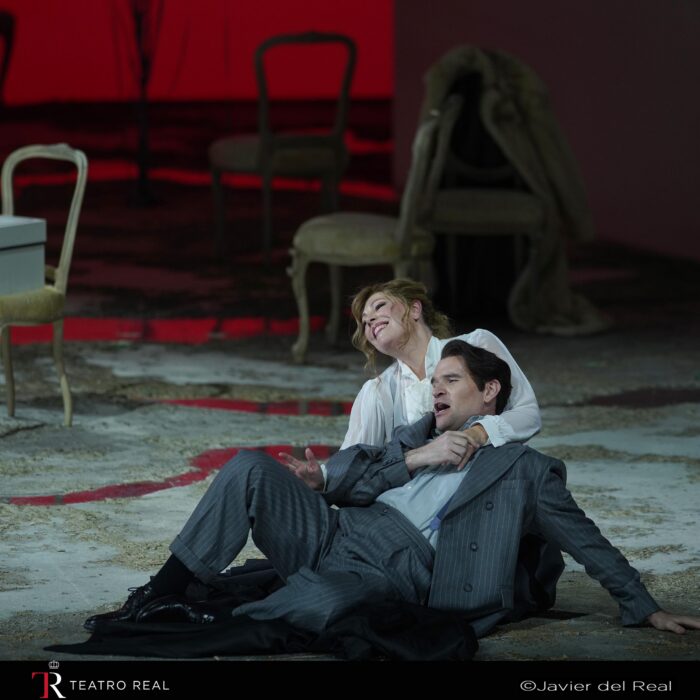
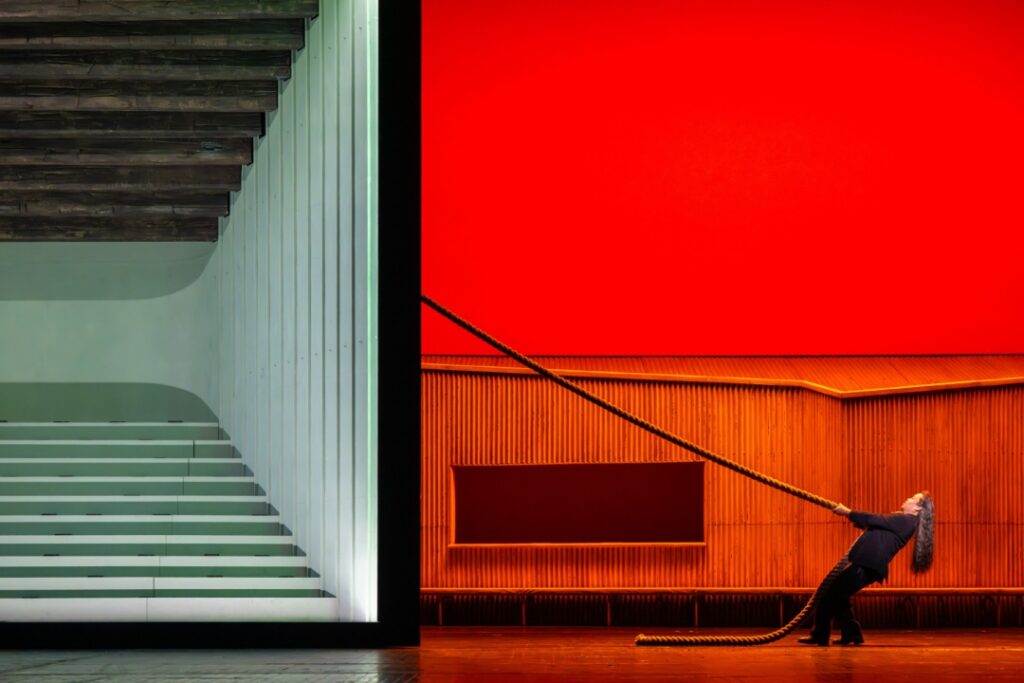
Set designer Hyemi Shin opted for a bizarre blend of monochromatic art, avant-garde and cubism, the main set featured walls washed with blood red crimson, on to which is pulled, in turn, a mobile staircase-cum-stage-cum-temple where at one point, the entire opera chorus takes up position; and an angular wooden facade representing Dalila’s abode that periodically gets spun around to reveal its ‘interior.’ The sets that do work well are when small, illuminated partitioned ‘boxes’ serve to represent the staircase displaying the dying Abimélech in the first act, and the final act where Samson is imprisoned in his cell, although these have more to do with the clever silhouetting and spotlighting, courtesy of lighting director Andreas Fuchs.
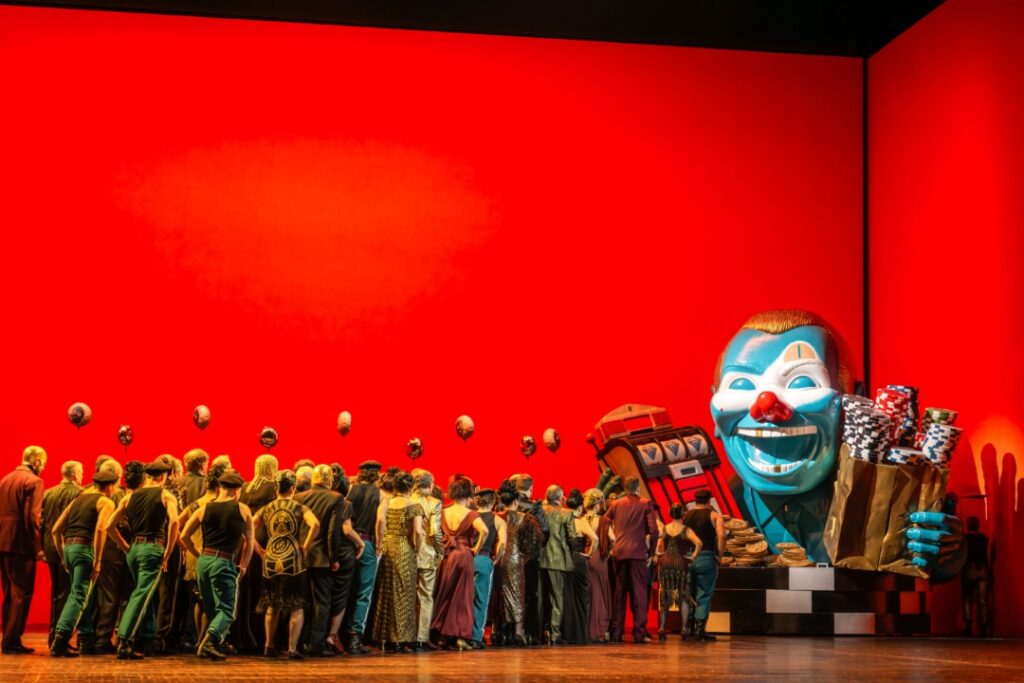
The god that the philistines worship is Dagon, here represented by a giant, blue, red nosed ‘clown’ effigy with gleaming golden hair, carrying a slot machine with one arm and golden gift/carrier bags of casino chips in the other. I’m sure someone more perceptive than I can come up with a feasible interpretation of this analogy, but I must confess, it was beyond my reach. Neither gambling nor wealth strike me as having any predominance in this tale, although I’m sure some will conjure up some tenuous link between religion and materialism in the nebulousness. Whatever it is, I reserve the right to argue that, irrespective of the message, the time and money needed to create the gargantuan hideous effigy that makes a (thankfully) brief appearance in the final act was a waste.
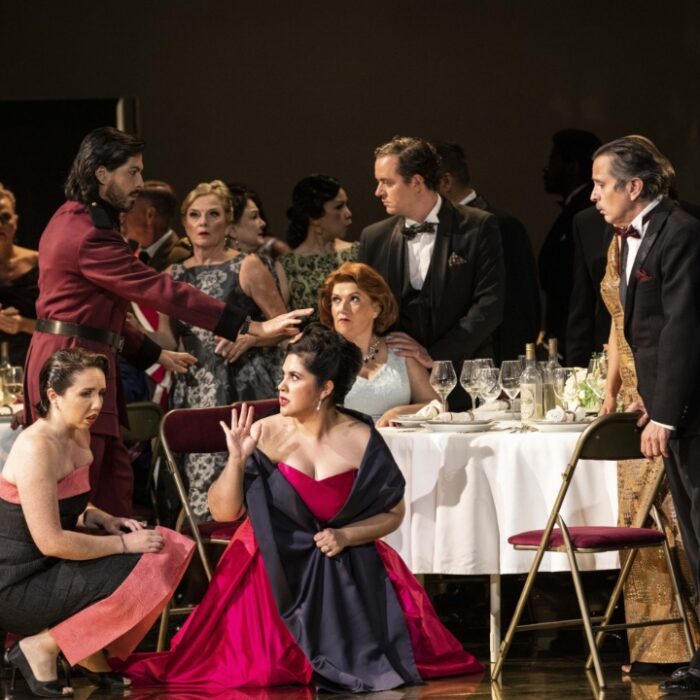
Likewise, neither the costumes nor the staging suggests what period this is supposed to be set in. Costume designer Nicky Gillibrand opted for the 20th Century, I should estimate, without feeling the need to specify or hint at a decade. Grey or monochrome drabness for the Jews while the authoritarian, rather brutish Philistines are attired in what looks like the uniform of the African soldiers of the Cameroon Schutztruppe.
(Photo: Mihaela Bodlovic)
These mildly confusing asides, however, pale in insignificance compared to the antics enacted by the chorus members and dancers. In the early stages, Dalila’s attempts at the seduction of Samson are initially thwarted by a series of interceptive dance moves and maneuvres undertaken by the Hebrews, designed to prevent her from reaching her intended target. This was somewhat reminiscent of one of those lame dance routines that were the staple diet of 1970’s Saturday night entertainment shows where the showgirl gets passed from hand to hand. In the final act, the chorus gets to undertake a celebratory line dancing sequence as the backdrop to a group of cavorting and acrobatic dancers whose performance appeared devoid of any structure or semblance of purpose. Again, perhaps the aims of choreographer and movement director Lucy Burge and revival choreographer Róisín Whelan are too esoteric for my perceptive prowess.
In fact, much of the stage direction appeared at odds with the gravity of the story unfolding. The occasional pantomime behavior of the Philistine messengers, dancers and occasional chorus member seems entirely at odds with the seriousness of the plot, their mildly comedic antics only serving to add to the overall confusion. How much of this is down to director Richard Jones’s original vision and how much is the work of revival director Benjamin Davis may never be known.
So far, not so good.
Stellar Musical Moments
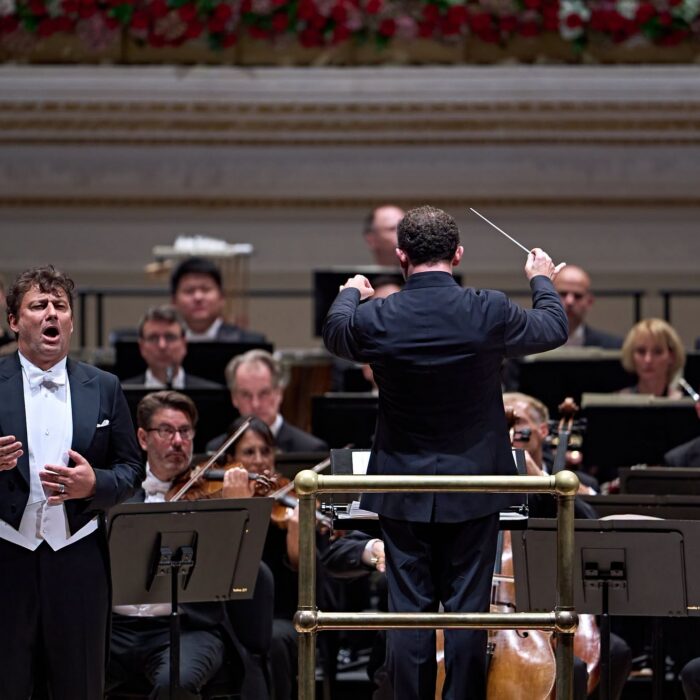
Fortunately, Camille Saint-Saëns’ work is infused with some gorgeous music for conductor Alexander Soddy to get his teeth into, and he did so with aplomb, coaxing exquisite sounds from the Royal Opera House orchestra.
I was also fortunate enough, earlier in the day, to sit in on a rehearsal of the Royal Opera Chorus to see the astonishing levels of work and meticulousness they put in, under the guidance of Chorus Master supremo William Spaulding. Not just vocally replete, but gifted in their story telling abilities, their performance and contributions in this opera are pivotal in making it work at all. I have alluded to the somewhat crassness of the ‘line dance’ performed in the final act; the wild, pulsating ‘Bacchanale’ dance sequence, but that did not detract from the sheer levels of dedication and hard work that must surely have been required of them to learn it. Their opening ‘Dieu! Dieu d’Israël!’ where they gather to pray for salvation, establishing the base story line was exemplary, as was their reminiscing ‘Nous avons vu nos pères’, but their finest moment, for me, was their all too brief but divine ‘Hymne de joie.’
They truly were deserving of the all too infrequent plaudits and praise that they received and if a finer chorus exists anywhere, I’d pay every penny to hear it.
(Photo: Mihaela Bodlovic)
Aigul Akhmetshina as Dalila
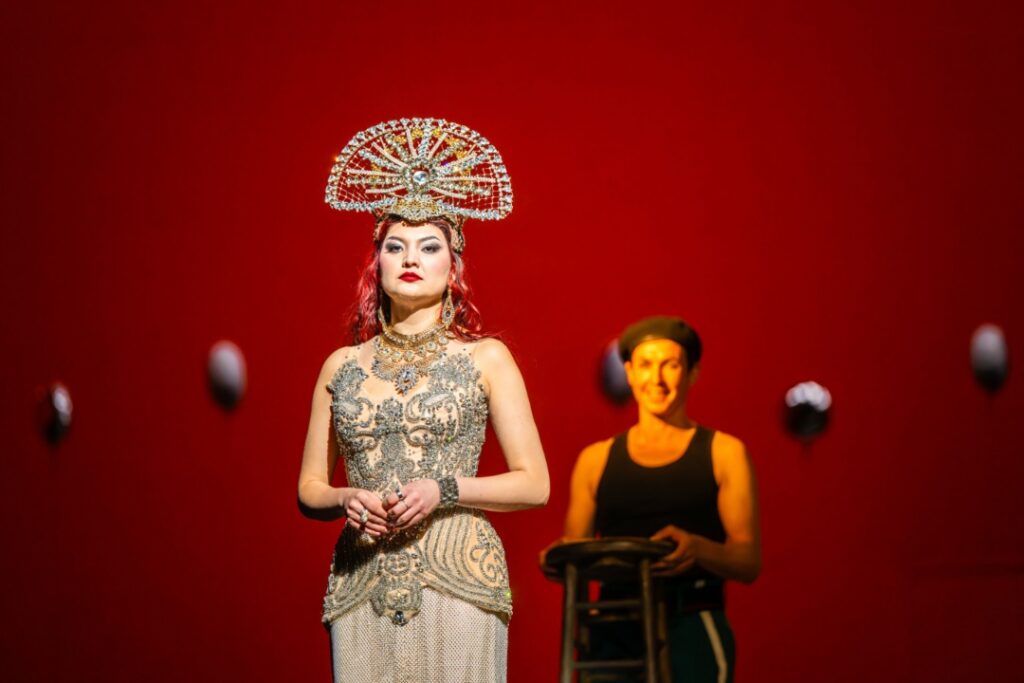
“Evil has sent this woman to lead you astray,” sings Samson’s Rabbi. And whilst this could ostensibly refer to Bizet’s temptress Carmencita, he is in this instance referring to the altogether different femme fatale, Dalila, here sung by the world’s predominant Carmen, mezzo-soprano Aigul Akhmetshina. No doubt observers and critics will make comparison of her role here to that which has helped propel her to near superstardom, but that would be somewhat disingenuous because whilst one could argue that in some ways the roles have distinct similarities, it is to Akhmetshina’s credit that she managed to infuse this character with an altogether different entity. Gone is the whimsical, lascivious coquettishness of Bizet’s minx, to be replaced with a steely, way more potent and chilling Circe.
Certainly, the gorgeous enveloping colors of her vocal palette were present here in all their seductive glory, together with the clarion top register which she soared into, seemingly effortlessly. But this material allowed her to work more in the lower register where she infused her tone with a smoldering, all-enveloping compelling richness, something which sets her apart from most other mezzos. Additionally, she is growing all the time as an artist. Her French is improving as well as her acting abilities. She has accrued a discernible stage presence with her magnetic aura. This was most evident in the final act where, dressed in a shimmering, radiant costume, her singing and involvement was comparatively minimal, and she spent much time isolated in the corner of the stage surveying the unfolding merriment and mayhem whist still managing to impart presence and remain instrumental.
Her “Printemps qui commence” was alluringly proficient where she lamented her loneliness and drew the attention of Samson. Her “Amour! viens aider ma faiblesse!” was powerfully emotive where she called upon the god of love to help her seduce Samson and learn the secret of his power. Her keynote “Mon cœur s’ouvre à ta voix” was absolutely sublime, the line ‘Ah! réponds à ma tendresse!’ particularly endearing.
(Photo: Mihaela Bodlovic)
SeokJong Baek as Samson
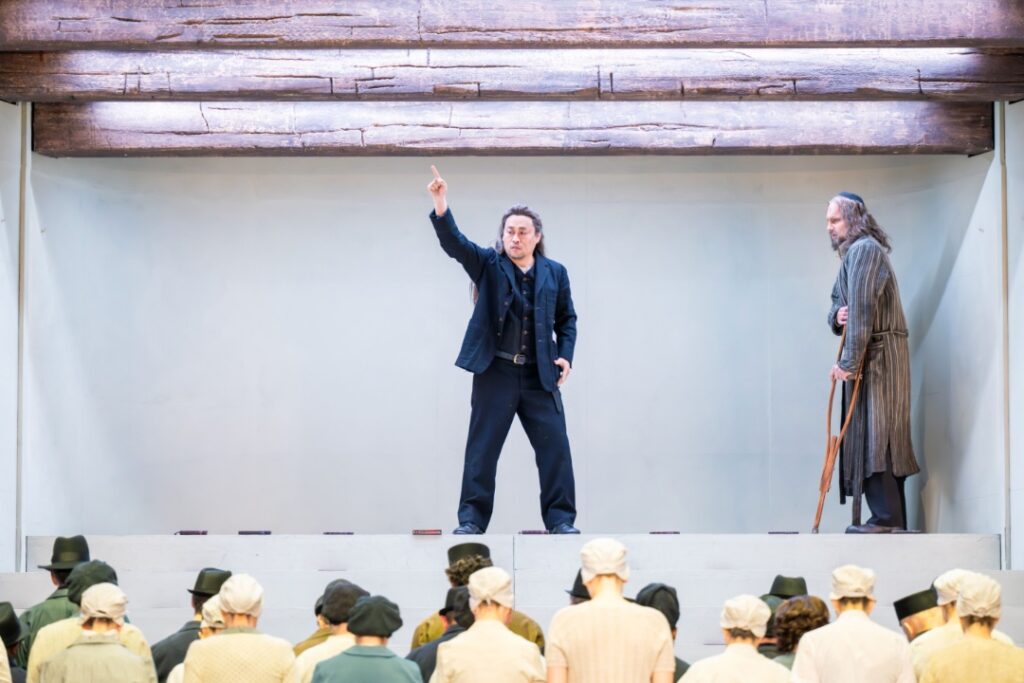
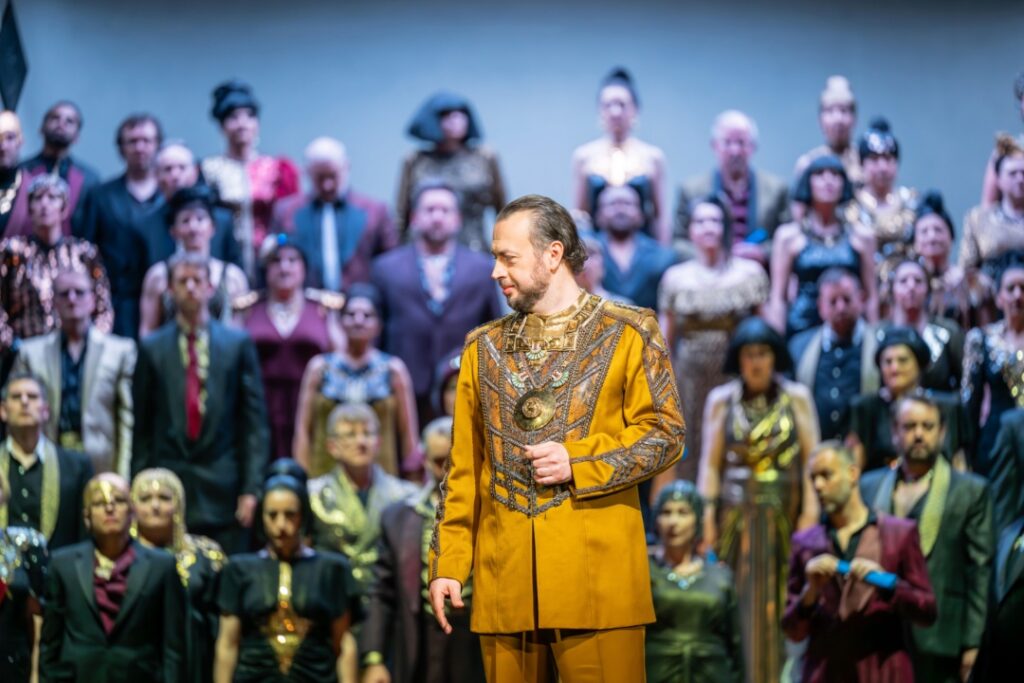
South Korean tenor SeokJong Baek was already signed to the San Francisco Young artists program as a baritone in 2019 just before the Covid pandemic shut down proceedings for much of everyone. He spent the period of lockdown training and pushing himself to develop a tenor voice which, proved so rapid and successful that he was awarded a debut in this very role in this very opera house in 2022. His rise to the top was meteoric and, on the strength of this performance, it’s easy to see why. He still possesses the dark, resplendent qualities of a baritone in his lower and middle registers, yet soars effortlessly into the upper register with a shiny, bright, convincing ping. Described by Sondra Radvonovsky as “the tenor of this generation,” his demeanor as Samson was suitably pious and restrained. His first act aria “Arrêtez, ô mes frères” where he calls his brothers to arms against the oppressive Philistines was proficient if seemingly cautious. However, his sotto voce ‘Je t’aime!’ at the cessation of “Mon cœur s’ouvre à ta voix” was beautifully controlled and potent.
His stellar work was reserved for the third act, where he infused his “Vois ma misère, hélas!” aria with huge emotional guttural sobs, where he lamented his fallen state, presenting a most cogent, broken character. He made a heartbreaking prayer asking for God’s forgiveness and pity for his weakness. He is an astonishing tenor who continues to enthrall in every role he undertakes.
(Photo: Mihaela Bodlovic)
More Cast Highlights
Another artist whose craft is growing exponentially is bass-baritone Łukasz Goliński, here performing as the High Priest of Dagon. He was most commanding in his aria “Maudite à jamais soit la race” where he curses the Hebrews for slaying Abimélech, and he especially shone in his duet with Akhmetshina, “Il faut, pour assouvir ma haine,” in the second act where they plot Samson’s downfall. I have seen him sing a number of times in this house, and rank this as his best performance yet.
Also, at the top of his game here was Ossian Huskinson as Abimélech, sadly an all too short role. Huskinson performed with a maturity beyond his years. I would love to hear him in something more substantial.
I recently reviewed William Thomas as Sparafucile in “Rigoletto,” and this role as Samson’s Rabbi cements, in my opinion, his position as a top class bass, both vocally adept and a gifted actor.
Emyr Lloyd Jones is the pick of the Philistine messengers-cum-thugs, along with Emmanuel Fonoti-Fuimaono and Siphe Kwani, who got to ham it up beautifully and along with the afore-mentioned Huskinson, are Jette-Parker artists surely destined for glittering careers.
So yes. I’m afraid this is a celebration only of a wonderful cornucopia of voices that combine to create a worthwhile event. Not just the standout principals, but also the remarkable wave of beauty that is the Royal Opera House chorus.
Any real kudos for the staging belongs to lighting director Andreas Fuchs, whose isolating spotlights and lightning-storm effects, combined with the cast’s relentless rotating, fetching, pushing, and pulling of the minimalist set pieces, maintained a brisk enough pace to keep the slow developing story from stalling entirely.
The final scene proved to be ironically symbolic, with Samson summoning one last surge of strength to destroy the temple along with himself and his enemies. Although the graphics, lighting, and stage design cleverly suggest a collapsing structure, the effect ultimately feels cheap and serves to illustrate its failure in bringing the house down. (Pun intended)