Bregenz Festival 2026 Review: The Excursions of Mr. Brouček
Yuval Sharon’s Production Trusts Opera’s Humanity Rather Than Forcing Contemporary Political Parallels
By Ossama el Naggar(Phot0: Bregenz Festival / Daniel Ammann)
Leoš Janáček’s “The Excursions of Mr. Brouček” has long been overshadowed by “Jenůfa,” “Káťa Kabanová,” “The Cunning Little Vixen” and “The Makropulos Affair.” This curious, episodic satire has never fully secured its place in the repertoire, perhaps because it occupies an awkward territory between affectionate comedy, political allegory and biting social critique. Yet it fitted Bregenz’s admirable commitment to neglected masterpieces perfectly, and under Yuval Sharon, together with set and costume designer Jon Bausor, it emerged as an intelligent, visually captivating evening, even if the production occasionally stopped short of exploiting the work’s full satirical potential.
(Photo: Bregenz Festival / Anja Köhler
Production Details
Initially, I dreaded seeing a staging by Yuval Sharon after having endured his production of “Lohengrin” at Bayreuth last year, in which Elsa and the people of Brabant were portrayed as moths rather than human beings. Mercifully, his staging of “The Excursions of Mr. Brouček” proved surprisingly delightful. Where “Lohengrin” seemed to succumb to conceptual whimsy for its own sake, here Sharon demonstrated a much surer instinct for Janáček’s peculiar mixture of absurdity, social observation and melancholy. His direction allowed the opera’s eccentricities to register without making eccentricity itself the point.
Janáček’s anti-hero was no operatic titan but an obstinately comfortable bourgeois whose universe extended little beyond beer, sausages, rent collection and the reassuring glow of the television. Sharon wisely resisted turning Matěj Brouček into a grotesque caricature. Instead, he presented him as an unsettlingly recognizable everyman, a complacent opportunist whose cowardice and narrow-mindedness were less monstrous than painfully familiar—perhaps so familiar that many might recognize themselves or those close to them in him. The concept worked best because it trusted the opera’s humanity rather than forcing contemporary political parallels upon it. Brouček’s small-mindedness consequently became more disturbing precisely because it was not presented as exceptional: his moral failings belonged to the ordinary world rather than to some safely caricatured realm of villainy.

(Photo: Bregenz Festival / Anja Koehler)
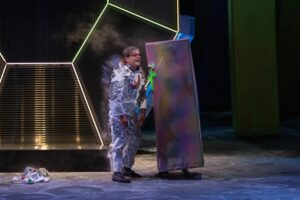
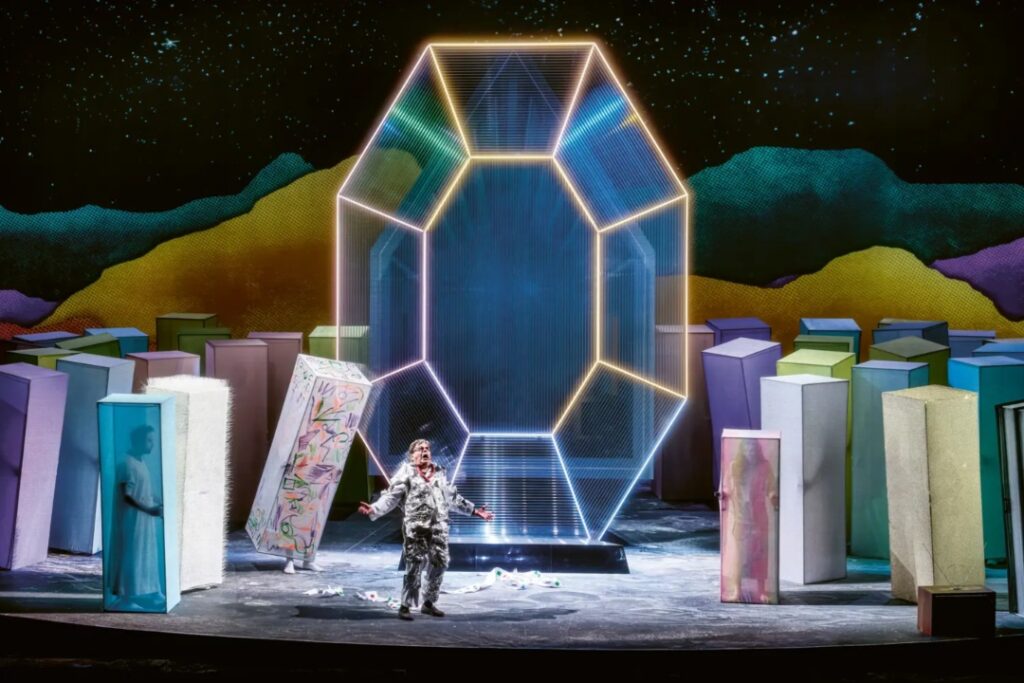
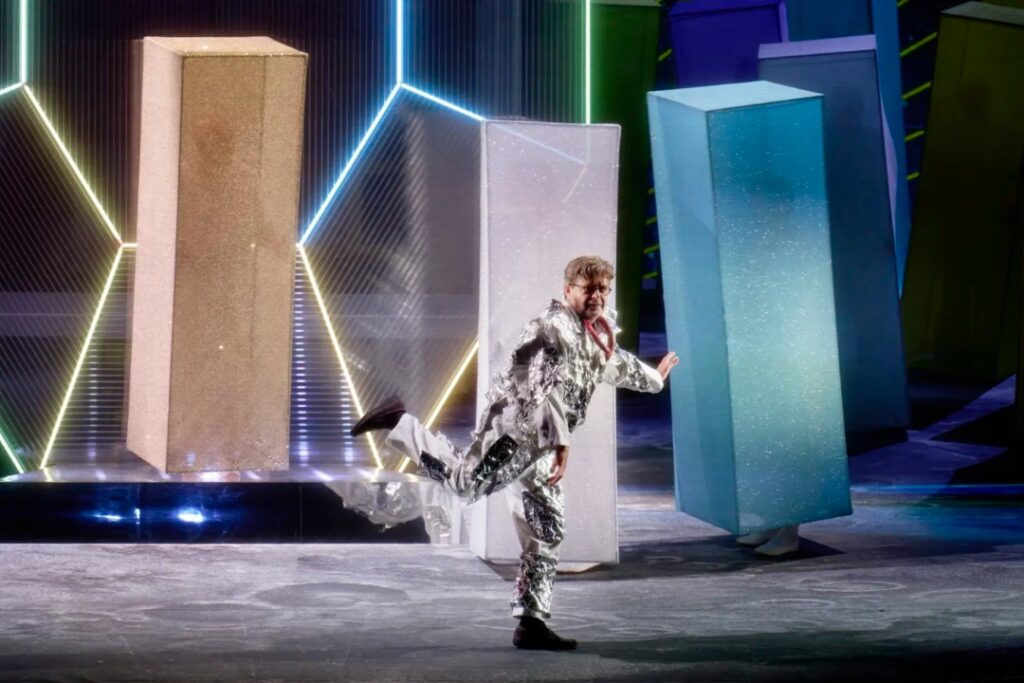
Jon Bausor’s designs proved the evening’s greatest visual asset, combining magnificent invention with an almost childlike delight in theatrical transformation. Brouček’s drab Prague home, with its pointed rooftops and faded domesticity, ingeniously transformed into a whimsical rocket that floated towards a Méliès-inspired moonscape populated by geometric, Cubist creatures imprisoned inside brightly coloured sculptural cubes. The imagery possessed genuine theatrical magic, aided by Hannah Wasileski’s discreet video projections and Crispin Lord’s stylized choreography. Rather than merely decorating the stage, the visual language gave concrete form to the opera’s abrupt transitions between the banal and the fantastical.
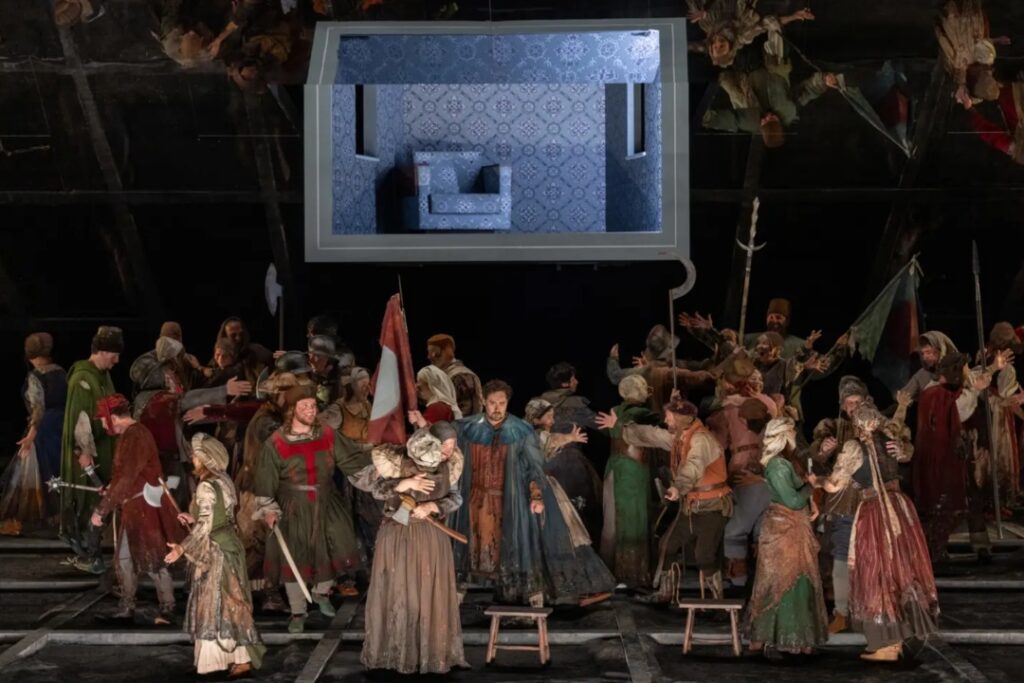
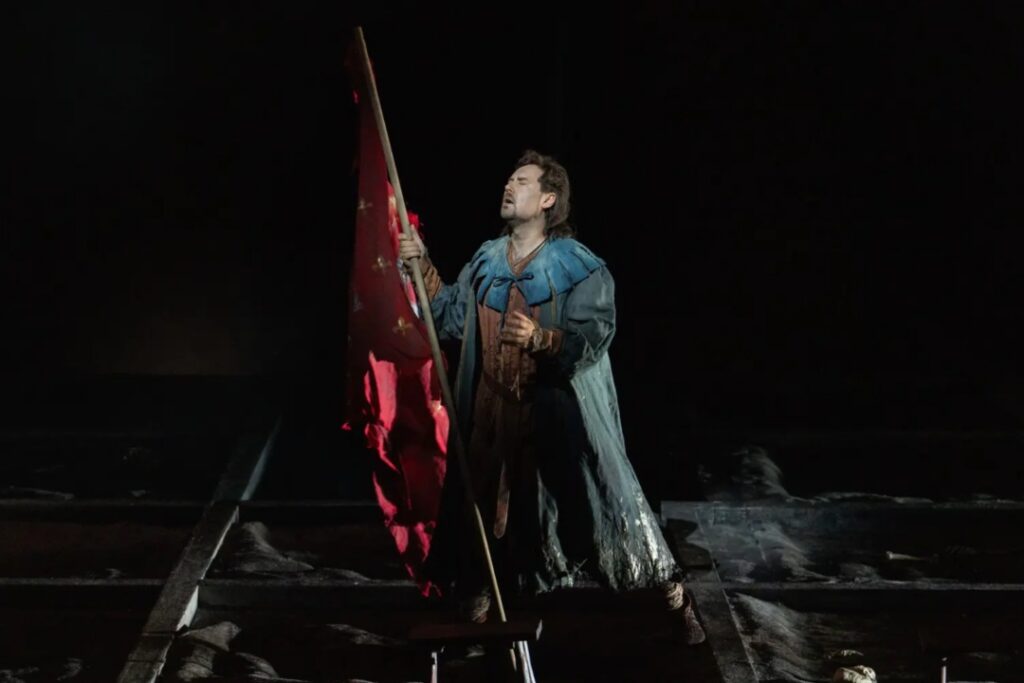
The second half, descending into fifteenth-century Prague during the Hussite wars, revealed another coup de théâtre as the stage opened into a weathered medieval underworld populated by richly textured costumes of remarkable archaeological detail. If the lunar fantasy delighted through invention and elegance, the medieval tableau was visually impressive without always achieving the savage absurdity the satire arguably demanded. Sharon occasionally remained too respectful of historical illustration when a greater measure of Dadaist irreverence or anarchic slapstick might have sharpened Janáček’s mockery. The production was at its most successful when fantasy and social criticism collided; when the imagery became merely picturesque, some of the opera’s corrosive absurdity inevitably dissipated.
(Photo: Bregenz Festival / Anja Koehler)
Musical & Cast Highlights
Musically, however, the evening rarely put a foot wrong. Czech conductor Robert Jindra conducted with complete idiomatic authority, drawing from the Vienna Symphony Orchestra a reading of remarkable rhythmic precision, luminous transparency and vibrant colour. Janáček’s mercurial score unfolded with irresistible momentum, every instrumental detail clearly etched without sacrificing dramatic sweep. The orchestra brought an almost tactile immediacy to the composer’s jagged rhythms and sudden changes of mood, while Jindra maintained an admirable equilibrium between the score’s grotesquerie and its moments of unexpected tenderness. If one occasionally wished for greater dynamic extremes and moments of more dangerous silence, Jindra nevertheless sustained the sprawling structure with admirable coherence while allowing Janáček’s bittersweet lyricism and sardonic wit to emerge naturally.
(Photo: Bregenz Festival / Anja Koehler)
British tenor Peter Hoare delivered a superb assumption of the title role. Avoiding easy buffoonery, he portrayed Brouček as an ordinary man whose mediocrity became oddly fascinating. His agile, characterful tenor combined stamina, textual clarity and effortless projection, while his nuanced acting made the anti-hero simultaneously exasperating, amusing and strangely sympathetic. Hoare never relied upon vocal or physical exaggeration to secure the laughs; instead, he found the comedy in Brouček’s complacency, self-importance and persistent inability to comprehend the worlds into which he was so unwillingly propelled. Rarely had Brouček appeared so completely human—and therefore so uncomfortably recognizable.
(Photo: Bregenz Festival / Anja Koehler)
The supporting ensemble, largely Czech and frequently assuming multiple roles, contributed with impressive stylistic assurance. Mihails Culpajevs sang brilliantly in his various incarnations, Tatev Baroyan brought gleaming soprano tone and theatrical versatility to her contrasting heroines, while Károly Szemerédy and Jan Stáva supplied sturdy vocal foundations throughout. The Prague Philharmonic Choir, magnificently prepared by Lukáš Vasilek, emerged as another principal protagonist, producing thrillingly idiomatic singing whose patriotic fervour lent genuine weight to the Hussite scenes. The collective standard was particularly gratifying in an opera whose success depended so heavily upon the rapid delineation of contrasting characters and worlds.
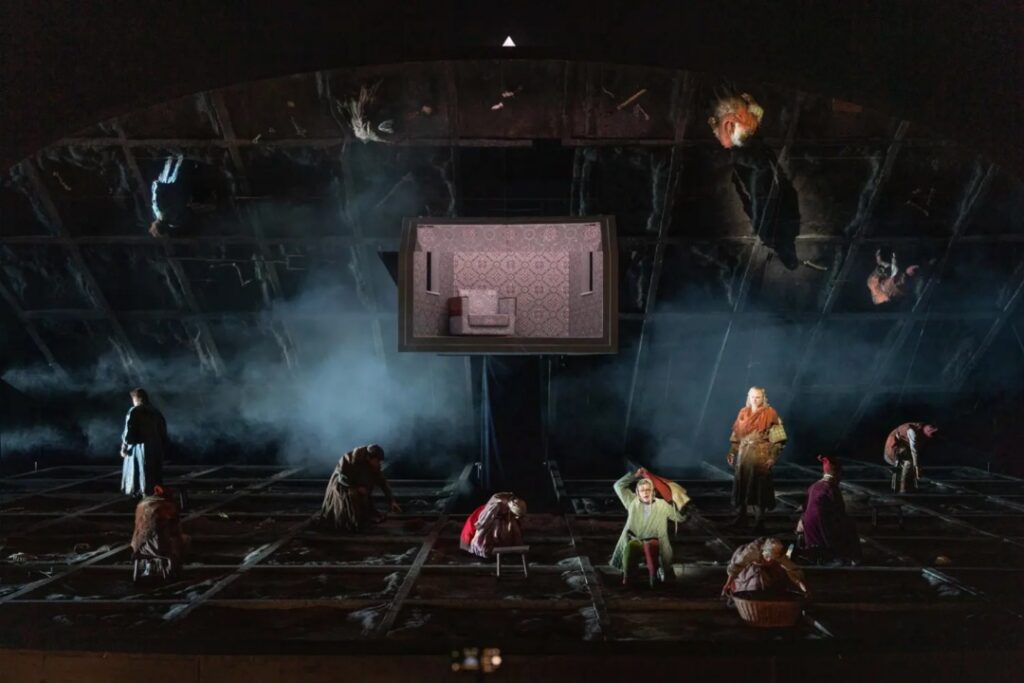
(Photo: Bregenz Festival / Daniel Ammann)
Whether “The Excursions of Mr. Brouček” ultimately possesses the dramatic inevitability of Janáček’s greatest operas remained debatable. Its episodic construction and fluctuating tone inevitably blunted some of its satirical edge, and the work occasionally seemed to wander when a more ruthless dramaturgical economy might have intensified its impact. Yet Bregenz demonstrated that, in the right hands, this neglected curiosity became far more than a historical footnote. Sharon’s production may occasionally have been gentler than the work’s corrosive humour warranted, but Bausor’s inspired visual imagination, Jindra’s authoritative conducting and Hoare’s outstanding portrayal transformed this unlikely “beer opera” into one of the festival’s most satisfying artistic achievements. More importantly, the evening revealed that Janáček’s eccentric outsider could still speak with surprising immediacy: Brouček’s world of petty comforts, reflexive cowardice and smug self-interest proved uncomfortably close to our own.