Greek National Opera 2025-26 Review: La Traviata
Dimitra Kotidou & Konstantinos Klironomos Shine in this Dramatically Satisfying Rendition of the Verdi Masterwork
By David Salazar(Credit: V Isaeva)
To close out its summer season, the Greek National Opera revived its historic Nikos S. Petropoulos production of “La Traviata.”
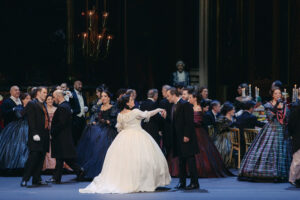
The mise-en-scene, which premiered in November of 2001, is a traditionalist’s dream. There are essentially two sets for the production with one utilized three different times (Act one, Act two scene two, and Act three). This main set features too large archway entrances toward the back, adorned with hanging candelabras. A long table dominates on stage left with a circular chaise dominating the opposite side. These will switch for the Act two scene two sequence with the table used for the card game. In the final act, the main furniture is the bed, situated stage right. Lighting in the opening act is warm with a bit more contrast in the second act to heighten the drama and cooler in its effect in the final act.
The set for the first half of Act two is far less imposing to emphasize the intimacy, but its golden walls contrast nicely with the blue netting in the background. These two competing colors create a special juxtaposition of warmth and coolness that comes to dominate this entire part of the act.
The staging is naturalistic and hues closely to the intentions in the libretto. There isn’t anything all that surprising, but it never needs to be to be effective. In fact, it seemed to provide a level of freedom to performers to create with their interpretations of the characters. The results here were of the highest order.
At the forefront of it was soprano Dimitra Kotidou as Violetta. A coloratura soprano, her approach to this role seemed dubious in the initial going. She sounded a bit overpowered in middle and lower registers throughout the brindisi, even if the highs always blossomed and boomed into the space. Most concerning was when, throughout “Un dì felice,” she was overpowered by her partner and the impact of her fluid coloratura during this duet was minimized.
But everything started to come together starting at the famous “È strano” and the ensuing “Ah, fors’è lui,” where her delicate phrasing was allowed ample space to sculpt. The soprano’s more gentle timbre and lighter voice gave the aria greater elasticity, explored best during the transition from minor to major key. After the softest of piannissimo on “se destando mi all’amor” she delivered a massive crescendo on the ensuing F natural on “A quell’amor,” giving the note tremendous breadth. There was a similarly glorious diminuendo on the “misterioso” D flats a few measures later leading into another crescendo up to “Croce, croce delizia.” It was here also that Kotidou presented what would become one of her vocal signatures throughout the night – in lieu of a straight portamento to a higher note, she instead added a few coloratura grace notes from the lower note up to the top note. Most of the time (and perhaps because I’ve never heard anyone do this before), it came off as out of place musically. I even questioned whether it might a technical way to facilitate the portamento, but the inconsistency with which it was employed and the appearance of portamenti in other moments, made it unclear. Nonetheless, her singing in the aria was fluid and mesmerizing, with the soprano adding in her own cadenza at the close.
Kotidou was at her very best on “Sempre libera,” the coloratura fluid, the high Cs and D flats bright and imposing. It felt like her voice was made to shine in this piece. The final interpolated E flat was pure vocal gold.
In Act two, the soprano not only delivered vocally, but was increasingly committed physically, her presence dominating every moment of this thrilling dramatic tour-de-force. Her initial tête-à-tête with Germont saw her physically and vocally imposing, her lines depurated at ever turn. She didn’t attempt to darken her voice in the more dramatic moments, which obviously exposed her at times, such as “Voi sapete” or “Morrò,” where she lacked punch or pointedness in her delivery, but also allowed for the youthfulness of the character to shine. “Dite alla giovine” was sublime, with Kotidou delivering gorgeous pianissimo singing, every line fluidly connecting as if in one breath. To top off the duet, her repetitions of “Conosca il sacrifizio” were delivered with increased delicacy that revealed Violetta’s pain extraordinarily.
Her ensuing exchange with Alfredo, which climaxes with the heart-rendering “Amami Alfredo, quant’io t’amo,” was beautifully sung though the soprano milked the tempo and the orchestra clearly receded into the background after punctuating chords at the start of phrases to give her space. While the singing was spotless, the dramatic effect was lessened because the softer and slower approach of the passage didn’t have a cumulative effect.
In the ensuing Act, Kotidou delivered beautifully in her “Pietà, gran Dio, di me!,” the tempo slowing down to allow space for her legato line to flourish. Each one felt softer than the last, and the effect was of feeling that Violettà was losing faith. She delivered more vocal elegance during the ensuing concertato, though here again, the coloratura-portamento gesture was used during “Alfredo, Alfredo di questo core non puoi comprendere tutto l’amore” on the jump from B flat to G on “del tuo disprezzo.”
Act three was her finest of the night with “Addio, del passato” delivered with delicacy, the singing always intimate and soft. Her reading of the “allargando e morendo” was spotless with Kotidou diminuendoing on the final lines, giving the sense of Violetta running out of strength before delivering a gorgeous crescendo on the final high A, the “fil du voce” transforming into one of her most thunderous notes in the entire night. The effect of this aria was truly cathartic. Instead of going for vocal effects sometimes employed in this aria (effectively I might add), Kotidou’s approach was in line with the vocal elegance she portrayed throughout the night, but the cumulative effect of slowly dimuendoing her sound throughout allowed that final eruption on the crescendo to hit viscerally.
The ensuing duet, “Parigi, o cara,” marked a major shift from “Un dì felice” in that Kotidou and tenor Konstatinos Klironomos were perfectly balanced with both potent, the soprano perhaps at her most intense on the entire night, furthering the notion that Violetta had regained vitality and strength. For the final ensemble of the night, “Prendi: quest’è l’immagine” saw the soprano at her softest, the singing forcing you to lean in and listen. She also added some ornaments here, but they kept in line with the fluidity of the vocal line. To cap off a strong performance, she delivered her most visceral singing on those final lines, capping it with a booming “O gioia,” the note sounding as fresh and vibrant as any other she sang on the night. On the whole, this was a strong interpretation of the role full of vocal and musical integrity.
Taking on the role of Alfredo, Konstantinos Klironomos displayed a bright and potent sound throughout with tremendous squillo in his upper range. From his opening lines in the “Brindisi” and throughout the duet, he was imposing and vocal vigorous. But he really turned things up in the second act.
“De’ miei bollenti spiriti” featured beautiful legato singing with the upper tessitura managed heroically, the tops ringing, and the tempo propulsive, conveying Alfredo’s youthful and naive energy. It was rather surprising that he didn’t sing the cabaletta as his was precisely the kind of muscular lyric tenor that would shine in this piece.
But his most impressive bit of singing came in the second scene of Act two where there was increased vocal aggressiveness in the card scene, his imposing stature particularly striking in his brief exchanges with Baron Duphol. The musical tension here was palpable. This was even more notable during the ensuing confrontation with Violetta, the tenor’s singing increasingly stentorian. He threw caution to the wind during “Ogni suo aver tal femmina,” the singing reverberant throughout, capping with generously held “Che qui pagata io l’ho.”
He sang gloriously throughout “Parigi, o cara,” scaling back to delicate tones to match Kotidou but then springing forth in the forte sections of the duet. His potent voice was perfect for the pained “No, non morrai, non dirmelo,” the singing allowed to flourish in the space with abandon.
Tenors don’t generally make their marks as Alfredo. Klironomos was one of those rare exceptions. He has listed roles as Alvaro in “La Forza del Destino,” Cavaradossi in “Tosca,” and Edgardo in “Lucia di Lammermoor” among his repertoire. I would love to hear him in those.
Dionysios Sourbis was a solid Germont. His baritone, with its quivering vibrato, was strong and forceful in his initial entrance before revealing a much softer edge throughout the duet with Kotidou. His “Di Provenza il mar, il suol” was eleganty sung, though the low notes of the first verse sounded unsteady, unable to match the intensity of his middle and upper range. He sang the second verse, “Ah! il tuo vecchio genitor – tu non sai quanto soffrì” with piano sound and the overall line was even and refined. Right before the cabaletta, the tension between him and Klironomos was at its height with the baritone towering over his stage partner and preparing to slap him, only to hold back at the final instance. The image of these two men frozen, staring eye to eye with the former’s hand raised to slap the other, is one of the finest dramatic moments of the entire night. Most productions have Germont complete the action, but the choice to hold back spoke with even greater depth about the relationship, the tension, Germont’s restraint, but also his remorse of even considering it. The ensuing cabaletta “No, non udrai rimproveri” was finely sung and well-articulated; it had a gentle quality but also a sense of urgency that, following the prior confrontation, felt like a man attempting to make amends.
Sourbis’ appearance to launch the cabaletta was dramatic potent, the baritone’s “Disprezzo degno,” matching the intensity Klironomos displayed in “Ogni suo aver tal femmina” in its harshness. Yet, his firm stance furthered the sense of Germont’s sense of restraint and class.
The remaining cast members, including Sophia Kyanidou as Annina, Chrysanthi Spitadi as Flora, Nicolas Maraziotis as Gastone, and Christos Rammopoulos as Baron Douphol, gave strong turns in their more limited roles. Maraziotis was charming and confident in his brief interventions, playing a perfect foil for Klironomos. Same goes for Rammopoulos who was more brusque and aggressive. Kyanidou was particularly memorable in how she played off Kotidou, emphasizing the feeling that Violetta was leaving people behind that loved her.
The ensemble of dancers in Act two scene two were also fabulous and were showered with much-deserved ovations.
In the pit conductor Lukas Karytinos led a fine performance of the beloved opera. He elicited a glorious crescendo from the violins in the rising sighs near the beginning of the prelude, the crescendo overwhelming in its presence before dying down to nothing so that the cellos could take over the main melody. It was on these extremes of dynamic range that the conductor operated at his best on the night, with the ensemble able to explode at moments with cataclysmic sound on the most dramatic of chords before receding into the softest of echoes and whispers. One such example would be the violin crescendo that catapults us into Violetta and Alfredo’s confrontation in Act two scene two. The same goes for agitation of Alfredo’s arrival in Act three or the heaviness of the repeated pattern that forms under the opera’s final ensemble. This allowed the opera to feel more riveting in its musical tension with moments of unexpected gestures giving the drama greater dimension.
Nonetheless, there were curious choices and musical mishaps. The chorus and orchestra couldn’t find each other for much of the opening choral sections. Violins sounded a bit off at the close of the prelude. While understandable, there were cuts to the score (Alfredo’s cabaletta, most of “Parigi, o cara”) that were awkwardly implemented. And the choice to do multiple violins over Violetta’s letter scene in lieu of a solo violin, also didn’t fully work.
Ultimately, however, this was a satisfying musical and dramatic performance of one of the greatest operas ever written.