Theatro Municipal do Rio de Janeiro 2026 Review: Salvator Rosa (Cast A)
By João Marcos Copertino(Photo: Daniel Ebendinger)
It is always worth seeing the opera “Salvator Rosa” by Antonio Carlos Gomes and Antonio Ghislanzoni. Gomes’ most popularesque incursion into the genre of grand opera, “Salvator” contains some of his catchiest tunes. Theatro Municipal do Rio de Janeiro’s production was energetic and historically important. For the first time in roughly a century, the audience was presented with the opera in its entirety, through a new critical edition. The problem is that, despite all the energy and enthusiasm, one wishes the performance were a little more ambitious.
Antonio Carlos Gomes
There is so much to say about Carlos Gomes’ work that, were one to do justice to it, this review would be as long as a novel. The reception of the Brazilian composer’s work—when there is any—often gets lost either in sensational, and frequently mythical, biographical accounts or in the urge to emphasize how strange his music is. For most contemporary critics—especially those writing for the press—Gomes’ music sounds like a mixture of very different trends within late nineteenth-century Italian and French opera.
Jan Neckers, for example, once wrote of “Salvator Rosa:” “One irresistibly thinks of a mixture of late Donizetti, middle Verdi and early Ponchielli, though the melodies of Gomes are just pleasing and do not get under the skin like Verdi’s best ones.”
The pedantry of such an assertion invites further pedantry. Why “early” Ponchielli? What Ponchielli other than “La Gioconda” is ever performed? Judgments like this abound in the Anglophone reception of Gomes’ work. The truth is that Gomes is an amphibious figure, inhabiting in two different realms, even in the musical sense.
According to Lorenzo Mammi, part of Gomes’ success lies precisely in the fact that he did not feel compelled to position himself either as a Verdian or a non-Verdian composer at a moment in history when the composer of “Aida” towered over the Italian musical landscape. Gomes worked with Ghislanzoni, the librettist of “Aida” and the revised version of “La Forza del Destino,” but he also cultivated a relationship with Arrigo Boito in the 1870s, when, in a series of polemical articles, Boito was criticizing his future collaborator on “Otello” and “Falstaff.” Gomes therefore occupied a liminal space and consequently sounded uncanny to many critics. His music blends solutions from composers whom we are now taught to think of as fundamentally distinguishable from one another (Verdi is not Donizetti, Donizetti cannot be Meyerbeer, and so on).
The result of this need to classify Gomes’ music by using other composers as points of reference has usually been a disregard for the Brazilian’s work and a certain unwillingness to listen to his operas on their own terms.
But what are Gomes’ own terms? At least in the case of “Salvator Rosa” (as in “Il Guarany”), he is a composer drawn to an adventurous conception of melodrama. “Salvator Rosa” is profoundly melodramatic. In fact, it is so melodramatic that calling it a “melodramatic melodrama” would hardly be pleonastic. The plot makes “Il Trovatore” seem almost uneventful. Nevertheless, “Salvator” works—in fact, it thrives—because of its pathos. It blends the grandeur of French grand opera with the restlessness of a James Fenimore Cooper novel, while placing towering demands on both the singers and the orchestra, especially its woodwind and brass sections.
There is so much to say about “Salvator Rosa’s” score that I will postpone that discussion to a later essay. And I have a good reason for doing so. While Rio de Janeiro’s production had its quirks and flaws, one of its greatest achievements was the performance of the complete score without cuts. This also means that, sometime soon, the institute “Musica Brasilis” will release a thoughtfully revised edition of the score online, under the guidance of Luiz Fernando Malheiro, hopefully making it easier for other companies to stage the opera in the near future. Since this edition has yet to be released, I think it is best to postpone a broader discussion of the opera as a work of art and, for now, to focus instead on the performance itself.
(Photo: Daniel Ebendinger)
Illuminating Production
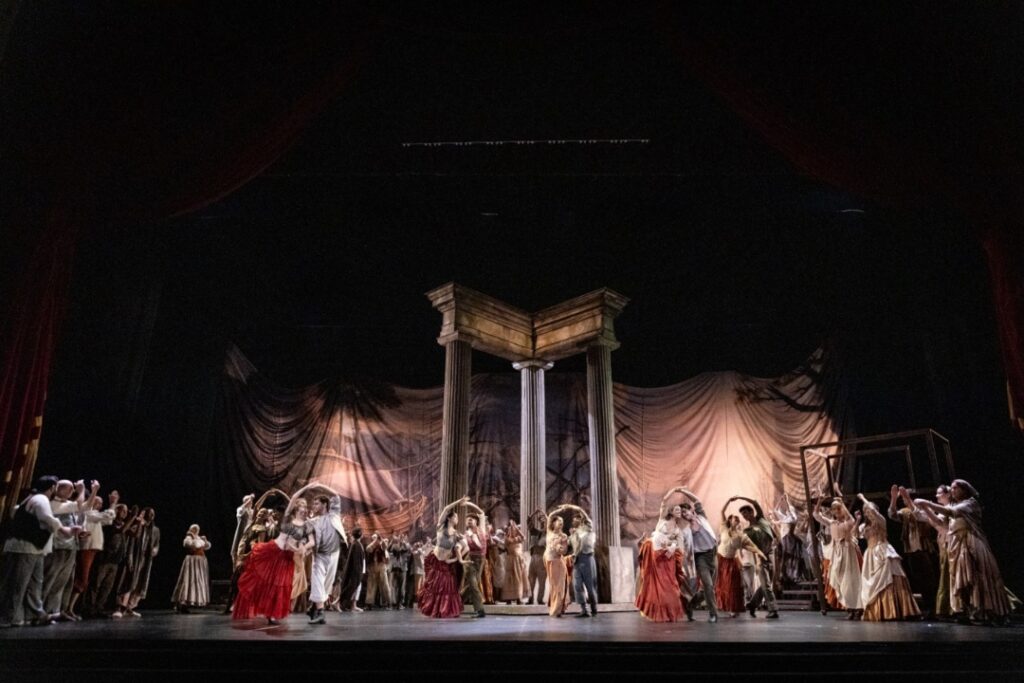
Director Julianna Santos’ production was conventional in the most elementary sense of the word. In many ways, it dismisses any possibility of an authorial appropriation of Gomes’ work. Santos neither imposed a reading nor established a coherent aesthetic vision; she approached her task in the most functional way possible. The lack of uniformity in the performers’ gestural language is particularly noticeable. While Isabella and the Duchess of Arcos seemed to have graduated from the Norma Desmond Academy of Bugging Eyes, Gennariello came across as a parody of a teenage rock-star wannabe.
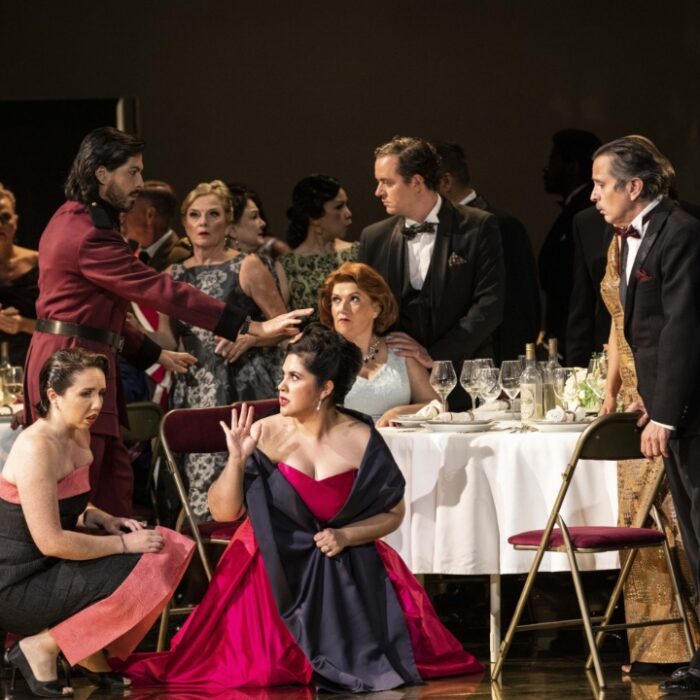
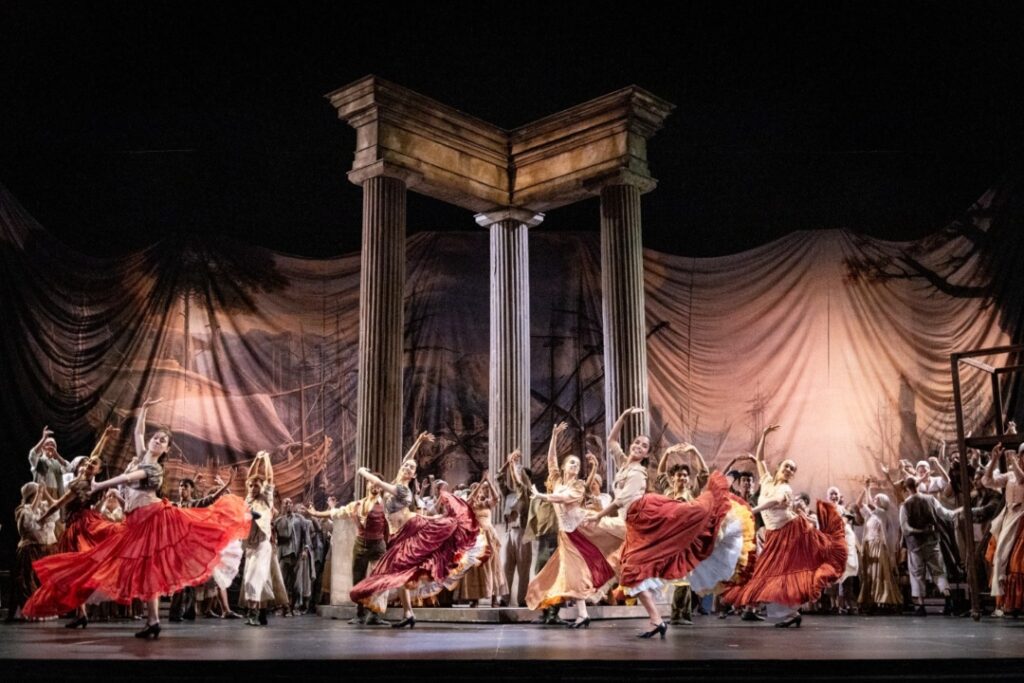
The scene changes were also consistently rough around the edges. The curtain at the end of Act one should have been closed, and during the transition between the first and second scenes of Act three. Nevertheless, after seeing so many “Carmens” wearing Yuja Wang dresses and so many “La Bohèmes” relocated to the present day, there is something deeply rewarding about watching an opera production that actually tried to remain in the 17th century. It may be a little provincialist, but it hardly matters. Once I accepted that Isabella was going to stab herself cartoonishly while wearing a gown that made Scarlett O’Hara’s green curtain dress look like Dior, I found myself enjoying the production much more. In fact, I would argue that, in moments like these, the opera worked surprisingly well.
(Photo: Daniel Ebendinger)
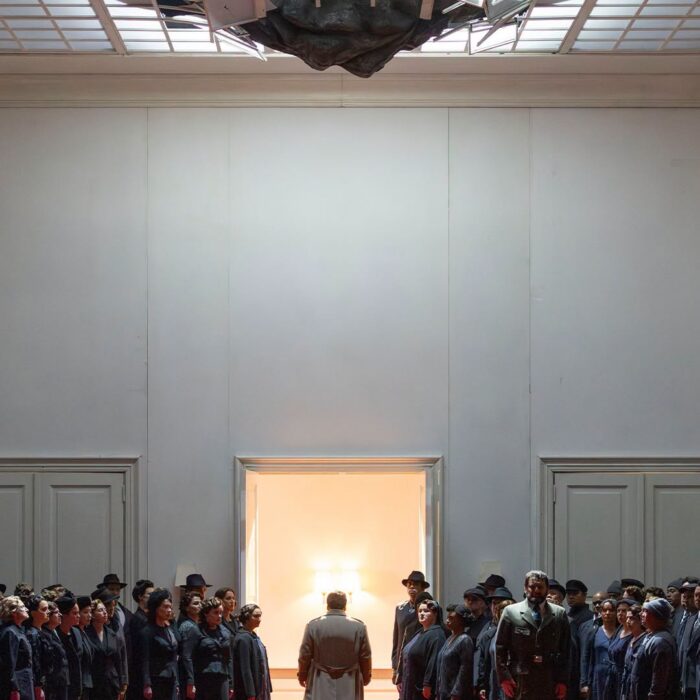
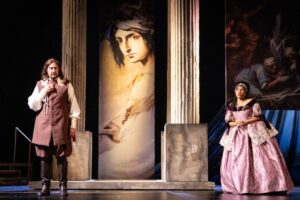
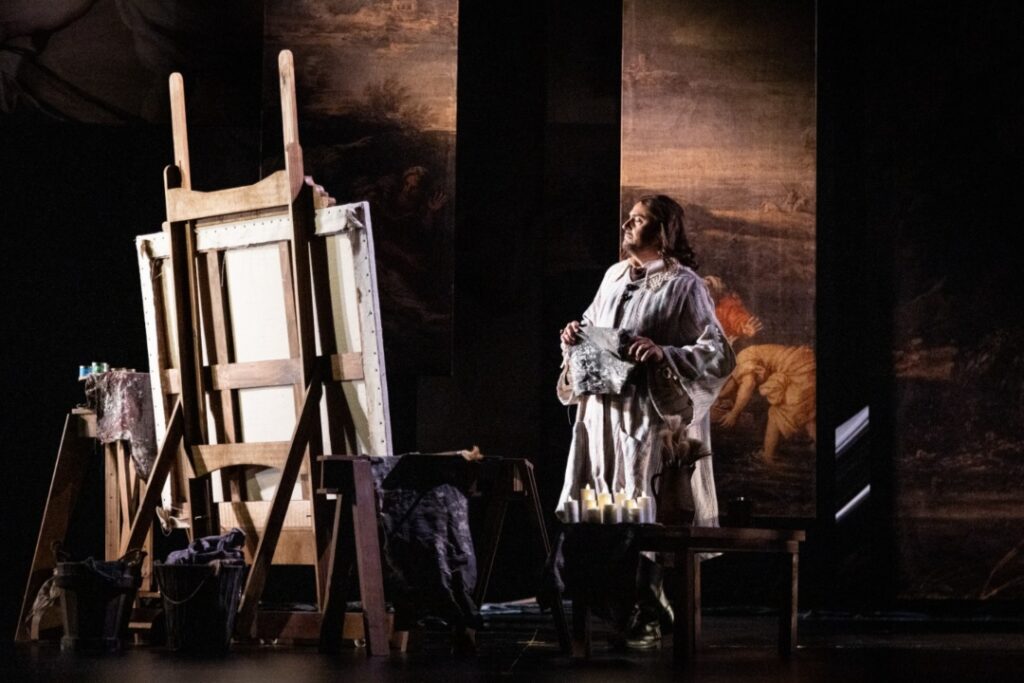
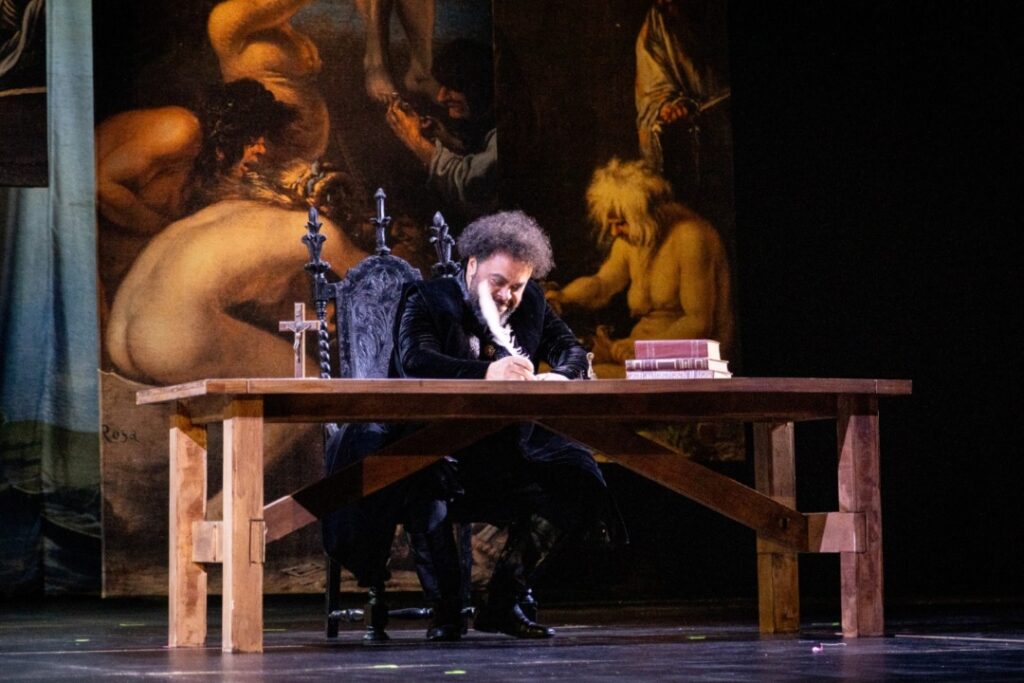
Santos’ boldest decision was to stage the opera using large reproductions of Salvator Rosa’s paintings instead of simulacra of Neapolitan buildings. These “sceneries,” so to speak, designed by Renato Theobaldo, sometimes worked beautifully (particularly in the second scenes of Acts two and three) but made little sense elsewhere. I fear that, although Gomes chose Rosa as his protagonist (probably to avoid having his opera confused with Auber’s “La Muette…”), the Neapolitan painter’s aesthetic often does not resonate with the opera’s music. There is a certain mismatch between Rosa’s pale blues and Gomes’ orchestral palette. Even so, the result is never unpleasant, and I would much rather look at an enormous canvas reproducing a fine painting than at the three random Roman columns that occasionally wandered onto the stage.
Musical Highlights
In contrast to the “soft” stage direction, the musical interpretation embraced the “strong” features of the score. “Salvator Rosa’s” soundscape exudes a certain masculine, militaresque quality that, if taken too earnestly, can verge on the ridiculous. At least in the first two Acts, there are moments that border on “Top Gun’s” volleyball scene. The first duet between Salvator and Masaniello, for example, works best when they sing: “Mi abbraccia, / Vieni al mio cor, Fratello./ Fratelli in un pensiero,/ fratelli in un desir:/ Di liberar la patria,/ di vincere o morir!” (“Embrace me, / Come to my heart, my brother. / Brothers in one thought, / brothers in one desire: / to free the homeland, / either to triumph or to die.”) All of this is followed by a series of descending figures in the brass that makes the scene all the more stirring. Even the opera’s prelude opens with an allusion to Gennariello’s description of battle, mimicking the firing of muskets and cannon.
The compelling aspect of the opera, however, is that, while in the first two Acts this pompous musical bellicosity functions almost as a redeeming quality—demonstrating the strength of a fragile political alliance between good-hearted artists (Salvator and Gennariello) and the proletarian masses (Masaniello and the chorus, including the mercenaries) against the aristocracy—Acts three and four depict the undoing of this partnership. The second duet between Masaniello and Salvator, for example, conveys an almost unbearable sense of the incommunicable between the two men. While the revolutionary fisherman, under the effects of poison, utters ideas that are actually quite sensible, Salvator barely listens to him, focusing instead on recounting his own struggle to find his beloved Isabella. The chorus, which in the first half of the opera had embodied a vast, frolicsome community, now represents the oppressors: both the aristocrats disgusted by the plebeians and the nuns who imprison Isabella, separating her from Salvator.
Luiz Fernando Malheiro’s musical reading of the score seemed fully attuned to this tonal shift, emphasizing the orchestral nuances that transform the opera’s bright, sunlit opening acts into its final, taciturn ones. At first, it was evident that the Rio de Janeiro orchestra and chorus have their limitations. The orchestra—especially the brass section, though not exclusively—often struggled to play softly while remaining in tune, while the chorus seemed to ignore every dynamic marking below mezzo forte. This shortcoming caused the second scene of Act two to lose much of its dramatic tension, reaching too many “finales” long before they were actually earned. After all, if every fortissimo is delivered with the same intensity, dramatic tension has nowhere to build or subside, and the sense of timing is inevitably lost. To be fair, this is a common problem in performances of French grand opera; one need only think of the challenges encountered in performances of “La Juive” or “Le Prophète.”
Yet, when I compared my notes from the performance with the available recordings of the opera (and the rather questionable score currently available online), it became clear that Malheiro found solutions far more elegant than anything one can hear on Spotify today. To give just one example: in Act three, when the chorus of aristocrats vehemently curses the plebeians (“Guai se la plebe il capo estolle!” [“Disgraced are the plebeians when they raise their heads!”]), the text is usually shouted more than sung. I was therefore surprised by the way Malheiro preserved the “martellato” indicated in the score without sacrificing musical phrasing. As a result, what is often little more than a mass of cries becomes a genuinely remarkable musical moment. One only wishes that the performance had displayed a little more technical refinement on the part of the performers.
The cast, composed entirely of Brazilian singers, displayed many of the strengths and challenges of making opera in the tropics. Nevertheless, the performances exhibited a level of musicality that was consistently pleasing. When faced with a “national” cast performing a “national” underdog composer, it is very difficult for Brazilian audiences not to convince themselves that they are witnessing the resurrection of Maria Callas and Franco Corelli. I heard such comparisons more than once during the intermission from people whose intellect I deeply admire.
(Photo: Daniel Ebendinger)
Cast Details
The fact that we were in the middle of the World Cup, with all of its nationalist fervor, only reinforced this jingoistic Zeitgeist. The uncomfortable truth is that, despite the performers’ best efforts, the results were mixed. To be fair, Gomes had access to a truly extraordinary group of singers when he composed this opera. The original cast of “Salvator Rosa” included the legendary dramatic soprano Romilda Pantaleoni as Isabella and Leone Giraldoni—the original Simon Boccanegra and Renato in “Un Ballo in Maschera”—as Masaniello. Those towering vocal and dramatic demands remain, even for the best-funded opera houses, exceptionally difficult to meet.
What I encountered in this production were, on average, two casts composed of very different kinds of singers, some of them possessing exceptional voices (especially among the men), who, despite their heterogeneous levels of technical accomplishment, all seemed committed to shaping every phrase as musically as possible.
As is common practice in Brazil, the opera was performed with two casts. The first was noticeably superior to the second, especially in the smaller roles; nevertheless, I found both performances enjoyable. Also following Brazilian custom, most of the singers are tenured members of either the Rio de Janeiro or the São Paulo Municipal Opera chorus.
One of the great advantages of working with what might be called a provincial cast is that the singers share an almost familial relationship with their audience. It is therefore difficult not to feel a certain affection for—and to cheer on—artists who have accompanied their local audiences through such a wide range of repertoire over the years.
(Photo: Daniel Ebendinger)
In that regard, “Salvator Rosa” was sung in the first cast by the tenor who introduced me to virtually every major Italian and French role: Marcello Vannucci. Although something of a peripheral figure on the world’s major stages (despite being ubiquitous in Latin American opera houses), Vannucci is a remarkable representative of the Italian spinto tenor tradition, having preserved his instrument in admirable condition for nearly three decades. Although he showed some discomfort in his opening aria, “Forma Sublime,” he possessed a gorgeous timbre and displayed exceptional musicianship in the duets. He never sang over his colleagues and always tried to make the ensemble work whenever possible.
Perhaps the most impressively sung role of the evening was Masaniello. In the first cast, baritone Vinícius Atique brought a remarkable sense of refinement to the role. During his praises of the sea and the waves (especially in Act two), one could almost imagine him as an idyllic Romantic hero.
The role of the Duch of Arcos contains what may be one of the opera’s greatest highlights: the aria “Di sposo.” Lício Bruno aimed for a certain correctness in his singing. His Italian was carefully articulated and precise and through a deliberately understated stage presence, he sought to lend the character a measure of psychological depth.
By the end of the performance, it became evident that Isabella must have been the most difficult role to cast. On the one hand, it demands a highly skilled spinto or dramatic soprano, both vocally and dramatically. Much of the opera’s success—especially in its final two Acts—depends almost entirely on Isabella’s ability to carry the performance. On the other hand, it is also true that her romanza, “Volate, o libere,” though beautiful, is far from the evening’s most immediately memorable musical number, while presenting the kinds of challenges that Gomes frequently imposes on his heroines in “Fosca,” “Lo Schiavo,” and “Maria Tudor:” a declamatory vocal style, extended passages in the middle and lower registers, and the need to project through a dense orchestral texture.
I was glad to see that soprano Marly Montoni genuinely tried to preserve the sublime pianissimi at the dramatic climax of the romanza. Montoni possessed a large voice, but also a very wide vibrato—especially in the upper register—combined with occasional intonation problems that could not be overlooked. Nevertheless, she had a stage charisma that was difficult to explain: sometimes it was simply a pleasure to have her on stage, even when one cannot fully embrace her singing.
The most frequently performed aria from “Salvator Rosa” is Gennariello’s “Mia Piccirella.” Although written for a light soprano, it is often remembered because of Enrico Caruso’s famous recording. In practice, however, the role calls for a singer in the mold of “Un Ballo in Maschera’s” Oscar. Despite the misguided gestural characterization of the part, Carolina Morel acquitted herself well. Morel offered a richer and fuller sound in the role.
Tenor Ricardo Gaio showcased a promising instrument in his portrayal of Fernández. I regret to say, however, that—especially in the second cast—the supporting roles were less consistently successful. Even so, none of these performances compromised the production in any significant way.
More Details
A final note must be devoted to the audience’s behavior. I have been to opera houses on more than three continents; I have seen operas staged in active train stations and on soccer fields. Still, never have I experienced the level of noise and poor etiquette that I encountered during the two performances of “Salvator Rosa.” And this was true on both evenings I attended. In one sense, it is wonderful that the Theatro Municipal has become such a popular attraction, selling out the house with affordable tickets. But is it really so difficult for people not to talk during the performance? The constant murmuring was so conspicuous that I scarcely knew where to direct my sternest glare. On the first evening, there were more than two babies crying in different parts of the auditorium. And, as the icing on the cake, the inevitable cellphone ringing every five minutes or so. Somehow, I found myself transformed into a cranky old man who simply wanted a little silence in order to appreciate music that I will probably never have the opportunity to hear live again.
Given the mostly critical nature of my remarks, one might imagine that I did not enjoy the performance, which is far from the truth. The fact is that, when dealing with a rarely performed yet immensely demanding work, there is genuine pleasure in seeing it undertaken, especially when everyone involved approaches it with such earnest commitment. If anything, this production makes a compelling case for more frequent performances of Gomes’ music, fostering greater familiarity with these works while allowing dedicated performers to grow into the many musical demands of the score.
By the end of the evening, I found myself genuinely moved. It was gratifying to hear Gomes’ music performed with full orchestral richness, free from the nonsensical piano reductions that so often diminish its effect. More importantly, one hopes that the conversation surrounding Gomes’ legacy will gradually shift away from his biographical curiosities and toward a deeper appreciation of his music itself. I would even venture to say that, if we actually listen to Gomes—and try to understand his operas on their own melodramatic terms—“Salvator Rosa” reveals itself to be a genuinely remarkable work. For that, I am deeply grateful to have attended Rio’s production.