Gabriela Lena Frank: Pipelines to Cultures, Stories, and Becoming the First Latina Opera Composer at the Met
By Xochitl Hernández(Credit: © Erik Castro)
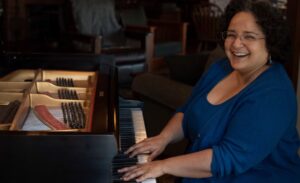
As music can travel through time, space, and lands, Gabriela Lena Frank has traveled through a multitude of worlds that now brings her to the Metropolitan Opera debuting her Spanish-language opera “El Último Sueño de Frida y Diego,” May 14th.
Recent winner of the 2026 Pulitzer Prize for Music, the 25th anniversary Heinz Award, and the prestigious Guggenheim Fellowship for her work in breaking music industry ceilings of gender, diversity and disability, Gabriela Lena Frank’s compositions have been lauded as “crafted with unself-conscious mastery” (Washington Post), “brilliantly effective” (New York Times), “a knockout” (Chicago Tribune), and “glorious” (Los Angeles Times). Frank’s music weaves through indigenous, mestiza, folkloric and Latin sounds united together as beautifully complex as her cultural diaspora. Works like “Conquest Requiem,” a large choral piece in Spanish, Nahuatl and Latin, “Pachamama Meets an Ode” about Peru’s colonization during Beethoven’s lifetime, and “Picaflor: A Future Myth” regarding the composer’s personal experience with the California wildfires, are just three of many pieces that bring to life the composer’s unique eye for cultural and, at times, magical realist storytelling. Her latest magical take on two internationally-renowned icons in Latin American history will mark Gabriela Lena Frank’s Met debut as the house’s first Latina composer.
“El Último Sueño de Frida y Diego” translating to “Frida and Diego’s last dream” would be a dream first envisioned in 2007 that now comes to The Met nearly 20 years later.
“To be honest, I think at the time opera companies still felt the language of opera needed to be Italian, German and French, not Spanish.” explains Frank, “And we’re an all brown team that hasn’t been seen before.”
Frank and Pulitzer Prize winning playwright Nilo Cruz did not give up on the opera. Working on other projects the last 20 years, Frank believes the past two decades prepared her for this moment.
“We agreed we didn’t want to do a biopic on Frida,” said Frank, “But I had told him about some music I composed about Day of the Dead and his eyes lit up.”
Thus the magical and darkly fantastical story of “El Último Sueño” was born.
“We decided we’d bring back Frida as a spirit and she and Diego would have this story of remembrance and forgiveness.”
Though the idea began in 2007, it didn’t go into contract until 2017.
“El Último Sueño de Frida y Diego” had its world premiere at the Chicago Lyric Opera in 2022. Since then, a seemingly unknown opera that secretly cooked in the wings for a decade, Frank describes as now having stratospheric success.
“I cannot praise The Met enough. Nobody is treating us like exotic little curios. We’re being treated with respect and love and it’s not always that way.”
A daughter of a New York father with Lithuanian/Jewish descent and a Peruvian/Chinese mother, Gabriela Lena Frank grew up in Berkley, California to an eclectic sound as diverse as her cultural background.
“Growing up my mom often made Peruvian Chinese food.” laughs Frank.
The composer credits her mother as one of her inspirations. An indigenous woman from Chimbote, a small Peruvian coastal town, Frank’s mother grew up hearing both Chinese and Quechua–the official indigenous language of the Incan Empire. Frank recalls her parents filling their Berkley, California household with Peruvian music and exposure to Peruvian poets.
“We learned the culture of Peru as purveyors. It was something I always longed for.”
Frank would find the Peruvian homeland she longed for in the music clubs of her Bay Area hometown. One in particular, La Peña, would host Andean music groups.
“I was seeing people for the first time that looked like my mother: asian and indigenous. And I was seeing their Andean instruments that fascinated me so much that I would go home and imitate these instrumental sounds on the piano.”
Songs that Frank could easily memorize. The first songs she remembers as a child. The songs that made her mother smile.
“I am fascinated by the idea of what happens when the cultural pipeline travels a different path.”
Music was Frank’s way of traveling through time and space to meet those ancestors she never knew. Frank wouldn’t visit Peru until her mid 20s along with her mother who spent decades away from her native land due to Sendero Luminoso. Translating to “The Shining Path,” Sendero Luminoso was the 1970s Maoist guerilla organization at the center of Peru’s internal political conflict marked by violence and terrorist acts throughout the country. The Truth and Reconciliation Commission attributed over half of the country’s 70,000 deaths, spanning the 20-year insurgency, to the Shining Path guerillas.
Meanwhile, Frank would have to travel to her ancestral lands through her natural gift: music.
“I went to the piano as a toddler and I’m just sort of playing notes and my paternal grandmother, who had perfect pitch just like me, told my mom, ‘oh, she has it.’”
That “it” would turn into Frank starting private piano lessons with a political refugee from South Africa, a teacher who gave Frank’s first taste of world premieres before her music graced international stages.
“She loved the fact that I improvised on the piano. I would always improvise something for her annual student recitals.” says Frank, “I realize now those are world premieres that she would give me every year.”
The summer before college, Frank saw an advertisement for a music program, walked into a building, and fell in love with the symphony of practicing musicians around her. New to classical music, she instantly saw a lack of representation.
“I was often the only woman of color in these conservatory spaces. I remember thinking that the world needed me.”
She decided only two days later that she would be a composer, one who would use her cultural heritage to tell stories through new music. A graduate of both the University of Michigan and Rice University, Frank remembers those encouraging her to further her composition studies in Europe, as most great composers have. Instead, Frank knew exactly where she needed to go. Peru.
“It became very personal because every time I would go to Peru I would take my mom. And it’s amazing to see how much she transforms.”
A body that perfectly fits into the Peruvian landscape, as Frank explains.
“I fit right in because I looked like everyone around me. But all the ways I did not fit in the U.S. I thought I would fit into Peru, only to realize how much I am not native Peruvian.”
Precisely why Frank states she tells stories not as a Peruvian, but as a Peruvian American.
“I share the same ancestry with native Peruvians but my pipeline went to a different land.”
Pipelines into lands that she brings together through her music. A rebuilding and reclaiming of culture drawing inspiration from the diversity of her reality.
“Us children of immigrants are not incomplete. We are not little bits of this country or that country. We are a beautiful whole, and sometimes the world doesn’t know what to do with us so they feel the need to describe us a certain way or expect certain stereotypes. But when we produce art, we redefine that for them and for ourselves.”
It was very important to Frank to create her own composer sound. Sounds that she draws from her heritage, a diverse milieu of a cultural upbringing, and homages to others, such as her research of Mexican music, for Frida and Diego’s story.
“In ethnomusicology, when you look at the most remote parts of Mexico and their indigenous instruments made of clay, the tone is very complex; very rich. You’ll hear highs and lows that are mixed in, and they come in and out, with the highs and the lows around each other. I compose something like that,” says Frank.
Aiming at a non-western tone, Frank draws on Frida Kahlo’s experiences.
“Frida looked at folklore cultures and indigenous cultures, and then she ran it through the blender of her imagination, of her mind, and came out with striking new images that may have the DNA of Mexico, but are also her images that come from a very surreal, oftentimes strange, and dark, place,” says Frank, “I felt I had to approach my musical colors in the same way.”
Other ways she approaches her creative process include the opposite of music: silence. Frank was born with partial hearing loss.
“I can take off my hearing aids and be in absolute silence. And once I’m in silence, if I stay that way for two, three, four days, I get different ideas. Different things come to me that don’t come to me when I’m in sound.”
Turning her disability into a super ability, as such is the theme in most of her compositions, using her own existence to tell stories through sounds.
“I’ve gotten well-used to being a phenomenon just for existing.”
At one point, Lena Frank was a double major in composition and piano. Despite pivoting after an injury, Frank is a Latin Grammy winner while being nominated for other Grammys as both composer and pianist. There is no limit to what is next for the ceiling-shattering composer. Frank says it could be a book of piano sonatas inspired by indigenous music, or continuing to mentor the next generation of artists.
“My father always said that I stood on the shoulders of giants and that my job was to be part of this continuum.”
Through the Gabriela Lena Frank Creative Academy of Music which she founded in 2017, Frank has mentored almost a hundred emerging composers. More recently, the academy’s partnership with the University of Pacific gives back to her native state to establish the Inclusive Music Initiative at an officially designated Hispanic-serving institution.
“I tell them they are supposed to go further than me. I am here now to open doors for others.”
Opening doors now with this historic debut as the first Latina woman and woman of color to debut her opera at the Met.
“I think I underestimated how powerful this would be for people of color and people who may not be considered the right demographic to become an opera singer, concert pianist, conductor or a composer,” says Frank as she recalls looking at all her past casts, hailing from Cuba, Colombia, Mexico, and Puerto Rico, all having tears in their eyes while in rehearsal. The composer encourages artists, especially emerging young artists, to create their own opportunities.
“Build the repertoire you want to sing. If you meet a composer, help each other and build music you want to sing with them. Don’t be passive and wait for opportunities. Offer to workshop or debut their works. We don’t do this work by ourselves.”
Frank’s music landed her a spot on the Washington Post’s list of the most significant women composers in history. But beyond composing, Lena Frank is also an artist dedicated to civic engagement.
“Things are so difficult in the world right now. But as an optimist, I always feel like things will pass and when they do pass, we will want to have felt that, all along, we were doing the work anyway.”
Frank is a climate activist, writing articles on climate action within the music industry for Chamber Music America Magazine and has extensively dedicated time to volunteering in hospitals and prisons. She is currently working to enhance music programs in rural, Latino populations like the Anderson Valley Unified School District in Boonville, CA, encouraging artists to be dedicated to both their craft and community engagement.
“Surround yourself with friends and family and rest to draw your strength, but then get back to work. The work is not just you sitting in your studio doing your music, it’s also teaching, giving talks, protesting in the streets, and supporting other performers. Ultimately, it is insisting that we exist.”
“El Último Sueño de Frida y Diego” runs from May 14th to June 5th.

Stories you may also like…
Q & A: China Now Music Festival Artistic Director Jindong Cai on Celebrating America’s 250th Anniversary Through Chinese-American Experience
Q & A: Victoria Frances Young on Her Fixed-Media Operatic Work ‘Breaking News’