Q & A: Sitar Player Rajib Karmakar on his INSERIES Debut & the Tradition of Indian Music in ‘The Song of Sakuntala’
By Arnold SaltzmanLong before the curtain rises on “The Song of Sakuntala,” a new opera set to premiere at INSERIES, the sitar has already been telling stories. For thousands of years, its shimmering, many-stringed voice has carried the weight of Indian classical music: its ragas, its spiritual longing, its intricate rhythmic cycles. Now that ancient voice will be at the center of this brand new opera by Timothy Nelson. “The Song of Sakuntala” is not only a love story but brings together cultures, uniting baroque instruments with Indian classical instruments.
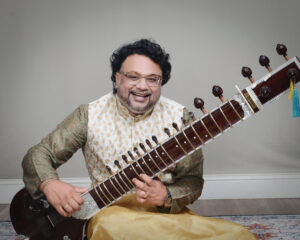
Leading the production is Rajib Karmakar, sitar virtuoso, cross-cultural collaborator, and a musician who has spent his life carrying one of India’s most storied instruments into unexpected and transformative spaces. Trained from childhood in the guru-shishya tradition, Karmakar knows better than most that great music is never just about the past.
In a recent interview with OperaWire, he commented on this collaboration with INSERIES and his belief that tradition continues to live, change, and speak to us today.
OperaWire: When did you begin studying your instrument?
Rajib Karmakar: My journey with the sitar began at a very young age. My parents gifted me my first sitar on my first birthday, so music has been part of my life from the very beginning. I began my formal training at the age of four under my first guru, my father, Pandit Durgadas Karmakar. I gave my first public performance at the age of six, and by the age of ten, I had already performed in many public concerts, including appearances on national radio and television.
OW: Would you say it’s a difficult instrument to play?
RK: Yes, the sitar is a challenging instrument, but it is also deeply rewarding. It demands physical strength, sensitivity, patience, and years of dedicated practice. The technique involves precise right-hand rhythm, expressive left-hand string pulling, ornamentation, and a deep understanding of melody, rhythm, and expression. Beyond the technical side, the greatest challenge is learning how to bring out the instrument’s true emotional voice, so that it feels as if the sitar itself is singing.
OW: Who did you study with and in which part of your homeland?
RK: My earliest training began with my father and first guru, Pandit Durgadas Karmakar, in the Maihar gharana (tradition) of Indian classical music. Later, I studied Indian classical vocal music with Ustad Ghulam Akbar Khan of the Rampur-Sahaswan gharana, which deeply shaped my sense of melody, phrasing, and emotional expression.
I continued my studies with Pandit Ram Dass Chakrabarty of the Senia gharana on the Veenkar style at Banaras Hindu University. During that time, I lived and learned in the traditional guru-shishya Parampara, or teacher-disciple tradition. Banaras, also known as Varanasi, is one of India’s great cultural and spiritual centers, and that period played an important role in shaping my musical identity.
OW: Is this the first opera you’re part of?
RK: I have worked in many large-scale collaborations, including opera, choral, orchestral, film, and cross-cultural productions, but this is one of the most special opera-theater projects I have been part of. My background has often involved bringing the sitar into spaces where it is not traditionally expected, including Western classical and contemporary settings.
OW: I know that there are composers in India writing opera. Have you been part of that in any way? Is orchestrating for sitar unusual?
RK: Although I have not been involved in Indian opera in India in the traditional sense, much of my artistic work has been centered around cross-cultural collaboration, where Indian classical music enters into conversation with Western classical music, jazz, film, theater, and global traditions.
Orchestrating for sitar is still somewhat unusual, and that is exactly what makes it so compelling. The sitar has its own musical language, shaped by raga, improvisation, ornamentation, and subtle microtonal expression. It is not simply another plucked string instrument: it carries a deep emotional and spiritual identity.
When the sitar is placed within an operatic or orchestral setting, it requires great sensitivity from both the composer and the performer. The challenge is to allow the instrument to remain true to its own tradition while also becoming part of a larger dramatic world. For me, that balance is where the beauty of the collaboration truly lives.
OW: Is your work mainly improvised or have you planned it out and kept it notated so it is coordinated with the singers and dancers?
RK: It is both. Indian classical music has a very strong improvisational tradition, but in a staged work with singers, dancers, and an ensemble, everything has to be coordinated. So I work with planned structures, cues, and composed material, while still keeping space for the sitar to breathe and respond in the moment. That balance between discipline and spontaneity is very important to me.
OW: What meters did you use in working with composer Timothy Nelson
RK: In working with Timothy Nelson, I approached rhythm through both Indian tala concepts and the needs of the dramatic structure. Some sections feel freer and more atmospheric, almost like an Aalap, while other sections use more defined rhythmic cycles such as 8, 11, 12, 13, or 16 beats, depending on the emotion of the scene. The goal was not just to show rhythmic complexity, but to serve the story.
OW: Would you say the work is exciting?
RK: Yes, absolutely. It is exciting because it is not simply a surface-level meeting of East and West. It is a real conversation between traditions, voices, movement, theater, and emotion. For me, that is the most exciting kind of work: when the sitar can remain rooted in its own tradition but still speak in a new dramatic language.
OW: Why is this a good story for people to come and see, and opera to listen to?
RK: This is a powerful story because it deals with love, memory, identity, separation, and transformation. These are human themes that everyone can understand. Even if someone does not know Indian classical music or opera deeply, they can still connect with the emotional journey. The music, the voice, the dance, and the storytelling come together to create an experience that is both ancient and contemporary.
OW: Does this work appeal to Gen Z and Millennials who currently only make up a small part of the audience for opera?
RK: Yes, I believe it can. Younger audiences are very open to hybrid forms, global sounds, and stories that cross cultural boundaries. This work does not feel like opera locked in a museum. It feels alive, visual, emotional, and connected to today’s world. The combination of sitar, voice, movement, theater, and contemporary composition can create a doorway for new audiences.
OW: If people would like to learn more about this work or other compositions that are similar, what do you recommend?
RK: I would recommend that people explore works where Indian classical music and Western concert traditions meet thoughtfully. A beautiful starting point is Ravi Shankar and Philip Glass’ “Passages,” especially pieces like “Offering,” “Meetings Along the Edge,” and “Prashanti.” I would also recommend Shankar’s “Sitar Concerto No. 2: Raga Mala,” which was closely associated with Zubin Mehta and the orchestral world.
In the modern generation, I would suggest listening to Reena Esmail’s “This Love Between Us: Prayers for Unity,” a powerful work for chorus, orchestra, sitar, and tabla, and Dinuk Wijeratne’s “Tabla Concerto,” especially for audiences interested in how Indian rhythm can live inside a Western orchestral framework. These works show how Indian classical ideas can enter a larger global conversation while keeping their emotional and spiritual identity.
OW: Why should people care about “The Song of Sakuntala” and attend the performances?
RK: People should come because this work offers something rare: a story rooted in Indian imagination, expressed through opera, theater, movement, and live music. It is not only about tradition; it is about how tradition continues to live, change, and speak to us today. For me, the sitar is not just an instrument from the past. It is a voice that can belong to the present and the future. This performance allows audiences to experience that journey.