A Little Opera Reappraisal, Pt. 3: Leevi Madetoja’s ‘The Ostrobothnians’
By John VandevertIn this four-part miniseries, I am examining four significant, and underperformed, operas in opera history from early-mid 20th century, but specifically from outside continental America and Central Europe. In part one, I took a deeper look at Mexican composer Miguel Bernal Jiménez‘s only opera, ‘Tata Vasco‘ (1941). In part two, I took a deeper look at Canadian composer R. Murray Schafer’s experimental plein air opera, ‘The Princess of the Stars‘ (1981). In part three, I will review Leevi Madetoja‘s groundbreaking opera, ‘The Ostrobothnians‘ (1924), an opera of considerable historical significance, and one of the pillars of Finland’s second generation of nationally-inspired opera after Richard Wagner.
A Narrative With A Pulse
Regarded as the star pupil of Jean Sibelius, Madetoja’s opera brought Wagnerianism into the Finnish orbit, and became a forthright declaration of Finnish national sovereignty from the yoke of the then-Soviet Imperialist overreach. However, the history of Finnish national opera did not start with Madetoja. Such a title is attributed to Frederik Pacius‘ 1852 opera, ‘Kung Karls jakt,’ although the topic was taken up and later developed during the late-19th to early-20th centuries by those like Oskar Merikanto, Selim Palmgren, and others. By the time Madetoja’s opera premiered, it should be remembered Modernism had thoroughly settled in, with 1924 being the year Ernst Krenek‘s first official opera, ‘Der Sprung über den Schatten,’ was premiered, with Ravel’s, ‘L’enfant et les sortilèges,’ and Schoenberg’s wonder pupil, Alban Berg, and his first opera, ‘Wozzeck,’ premiering the year after. Moreover, Puccini died in 1924, leaving his masterwork, ‘Turandot,’ unfinished. This is all to say, Finnish opera’s second-generation rebirth was but one piece of the tapestry of post-WWI Modernism, which revolutions like serialism and post-tonalism find their roots.
-
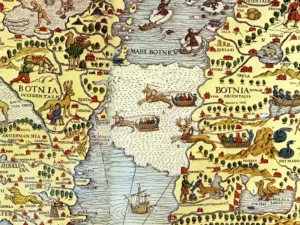
- Carta Marina by Olaus Magnus from 1539.
The opera’s story was taken from an eponymous 1914 play by Artturi Järviluoma, and was later adapted into two eponymous films, one in 1925 (dir. Jalmari Lahdensuo) and 1936 (dirs. Yrjö Norta and T.J. Särkkä). In short, the story charts the tribulations faced by Ostrobothnia (central Finland), and its war for independence from 18th-century Russian Imperial control during the ‘Great Northern War.’ Unfortunately, for the first time in the country’s history, Russia occupied parts of Finland. By the early-19th century, Imperial Russia succeeded in creating the Grand Duchy of Finland, but in 1918, Finland fought bravely for independence, and in 1919, the ‘Pax Finlandia’ was established which set the country up for internal stability for the first time in its history. It is worth also remembering that the Finns had to defend itself twice against Soviet intrusion, once in 1939-1940, and again in 1941-1944. Of course, Finland’s independence was also threatened by the Nazi regime, but this was galvanized by Soviet intervention. New research has shown the Soviets had Imperial ambitions. In the end, Finland had to cede land, much like other countries today.
This matters in the context of Ostrobothnia as its history is interlaced with Finland’s struggle for independence, and its strategic partnership with Germany to dismantle the WWII Russian war machine, if only temporarily. The idea of the Ostrobothnian ‘mentality‘ is one of cultural pride, integration, and fierce self-assuredness that cannot be broken. Understanding the plot of ‘The Ostrobothnians’ requires a keen ear towards Finnish 18th, 19th, 20th, and indeed 21st century history. There are two main ideas about the roots of Järviluoma’s play which, naturally, Madetoja’s opera followed. The first is the Finnish peasant-led revolt, the ‘Cudgel War,’ for (then Duke) Charles of Sweden to depose his nephew, Sigismund, King of Sweden and Poland. This led to the larger, ‘War against Sigismund,’ eventually won by (now King) Charles, but this win came at the price of many, many, many, deaths. The second connection was Imperial Russia’s attempted Russification of Finland as we looked at earlier, such attempts given the epithet the, ‘Russification of Finland.’ In many respects, ‘The Ostrobothnians’ is a record of what happens when Imperial ambition is taken seriously.
Listen
Categories
Special Features