Opera Meets Film: Recalling Cinematic Legacies, Pt. 3: Boris Godunov
By John VandevertDramatized history, both past and present, through operatically-inspired cinema is a historical phenomenon all of its own, and as such, it has covered considerable ground. From the political assassination of Queen Gertrude of the Duchy of Merania in the 13th century (‘Bánk bán’, 1861), and the 17th-century reforms abreast the birth of the Russian Empire (‘Khovanshchina‘, 1886), to the death of Leon Klinghoffer (‘The Death of Klinghoffer,’ 1991), to Tsar Peter I’s European travels (‘Zar und Zimmermann,’ 1837), history, opera, and cinema are inextricably intertwined.
Recently, Maxim Kolomiiets’ opera, ‘The Mothers of Kherson,’ was debuted at the Teatr Wielki, an apt fit for a cinematic adaptation. Ukrainian history has its fair share of film adaptations. Mykola Lysenko’s opera, ‘Natalkta Poltavka,’ was the subject of numerous adaptations as we previously examined. Other operas like Semyon Gulak-Artemovsky’s ‘Cossack Beyond The Danube‘ (1863), have gotten adaptations as well, although the opera is not widely known but is performed sometimes. In 2009, Vladimir Bortko’s adaptation of Lysenko’s, ‘Taras Bulba,’ added to the list of Ukrainian film adaptations, although the story was told from the questionable perspective of a Russian.
In this four-part series, we’ll explore four operas and their various film adaptations, taking into account how they relate and differ from each other. Part one explored the under-performed but not unknown opera, ‘Halka‘ (1854) by Polish composer Stanisław Moniuszko (1819-1872). Part two explored the many faces of Verdi on screen, Italian opera cinema, and the many versions of Verdi’s opera, ‘Rigoletto’ (1855). In part three, we’ll explore yet another facet of Russian opera-film relations, namely the three adaptations of Modest Mussorgsky’s opera, Boris Godunov’ (1874). I’ve previously explored pre-Revolutionary opera cinema in the context of late-Imperial Russia, and even Andrey Khrzhanovsky’s ambitious animated adaptation of Dmitry Shostakovich’s, ‘The Nose,’ with additional influence from the deeply polemical work, ‘Anti-Formalist Peep Show.’ And while other Russian operas like Rachminoff’s ‘Aleko’ (1893) have been adapted, this opera is a topical addition to the ongoing debates within our geo-political climate today.
The Abridged Plot
The opera takes place in the late-16th century Moscow amidst the coronation of Boris Godunov, the final voice of the Rurik Dynasty and the legacy rulers of the Kievan Rus’. However, dissent percolates among the crowd on the identity of this new Tsar. Act 1’s second scene essentially continues the tenuous relationship between the peasant crowd’s fanatic praise and collective aggression, and then-Prince Vasili IV praised Boris which is responded to with a zealous, quasi-violent, adulation of Russia’s rulers. This balancing act between passion and aggression, even love and violence, should be kept in mind as it is a running theme throughout the entire opera.
Act 1 concludes with the ideological dissension between Pimen and Grigoriy, monks of the Chudov Monastery (1359-1918). Pimen notes Boris’ inadequacy due to his crime of regicide, whilst Grigory sees himself capable of delivering Boris’ long-deserved karma, and taking the rulership for himself. He will become historically remembered as False Dmitry I. This interaction shows the complicated relationship between Godly devotion, a justification of violence, and personal ambitions. However, Grigory leaves without permission. Escaping to a bar with two companions, the police look for Grigory, but he escapes to the Lithuanian border, and then to Poland.
Act 2 shows another dynamic of the opera’s tensions, namely political ambitions and family life. His daughter, Ksenia, weeps for the death (possibly murder) of her betrothed, and is comforted and dismissed. Then-Prince Vasili IV comes, and after a quick tussle, states the appearance of a ‘pretender’ (or claimant to the throne). Boris becomes plagued with guilt, and like Hamlet, he sees the ghost of the killed Dmitry and petitions to him that it was the will of the Russian people, not him, that desired for his death. Act 3 provides background to the geo-political conflict between the Grand Duchy of Lithuania and Muscovy punctuated in the Polish–Russian War (1654-67). Kyiv became part of Muscovy as a result, although Ukrainian sovereignty was unsuccessful. There was another attempt made from 1917 to 1921, but it took 70 years for Ukraine to rid itself of Soviet occupation.
Act 4 is broken into two scenes. While some discuss Grigory’s recent excommunication, or anathema, from the Orthodox Church, others become excited at the thought of the soon-to-be-diposed Boris. The first scene concludes with a Holy Fool, or yuródivïy, having his only kopeck stolen by youth, his safety disregarded by the Boyars, or highest-ranking officials of the Imperial feudal system, but Boris asks for a prayer. The fool declines to pray for ‘King Herod,’ a nod to the Gospel of Matthew. The final scene is broken into two. Part one concerns the Boyars’ deliberation on the Pretender. In a guilt-ridden stupor, having found out a religious miracle had occurred concerning Dmitry, Boris dies. Part two begins with a vagabond group capturing a Boyar whilst Grigory’s companions sing about Boris’ crimes. The crowd turns against Boris, whilst two Jesuits pray for Dmitry. They are almost killed but the Pretender marches into town. His wife, Marina Mniszech, is a character all her own. The crowd adore him, but only the Holy Fool sees the truth.
Thus ends ‘Boris Godunov,’ a truly sordid tale where only the lowliest gain sight of the real state of things, where brutality is justified if taken in the name of God, where karma is purged of its value, and fact and fiction combine. In short, ‘Boris Godunov’ is about the impacts of unchecked ambition, false exceptionalism, and religious stupefaction.
-
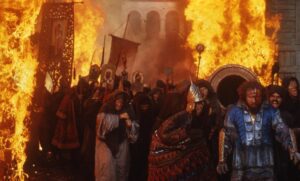
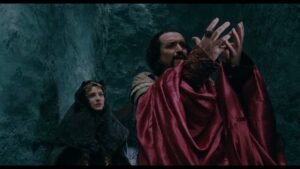
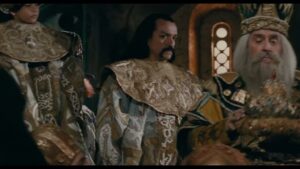
- Stills from Żuławski’s 1989 film.
Three Films Across 57 Years
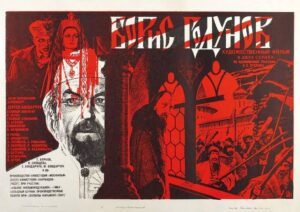
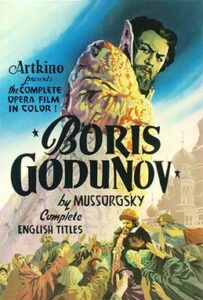
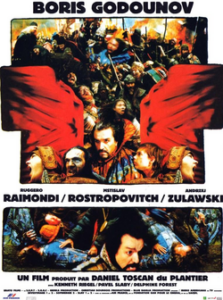
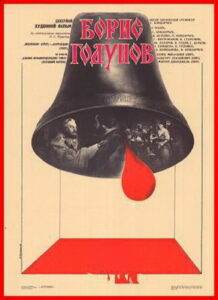
Mussorgsky’s ‘Boris Godunov’ was adapted three times for film, and once in a mini-series (2018-19), but I will overlook this. The first was produced in 1954 by Vera Stroyeva who, in 1959, also produced the comedy film, ‘Khovanshchina,’ based on another Mussorgsky opera. The second was produced in 1989 by Polish director Andrzej Żuławski, and it is this version where the controversies of opera-film adaptations manifested in its most brazen form. Discontent with Żuławski’s avant-garde approach, conductor Mtislav Rostropovich went so far as to sue him over his disagreements. Ultimately, it was settled but it exemplified Żuławski’s polemical approach to cinema at the time. The third was produced in 2011 by Vladimir Mirzoev, and followed the 1825 plot conceived by Pushkin rather than the opera. It followed Sergei Bondarchuk and his 1986 adaptation whose music was composed by Vyacheslav Ovchinnikov. Interestingly, his only opera, ‘At the dawn of a foggy youth’ (1974-78), was recently premiered in Voronezh.
These two (or fourish) films all tell the story, but in differing ways, and for differing audiences. Whilst Stroyeva’s approach was steeped in the traditional style, Żuławski’s approach was more adventurous, using innovative techniques like exposed film crew, a performance of ‘Boris Godunov’, and historical anachronism to critique the Soviet system. Bondarchuk’s film followed Stroyeva’s traditional approach, although critics later decried it as rather stuffy, whilst others saw it as a ruminative examination of the Soviet Russian state’s post-perestroika future. Mirozoev’s film, however, places the events in present day Russia, and used Pushkin’s original play as the film’s text. Realism was the main character Mirozoev sought for in order to erode the borders between the story and its experiential truths. These heterogeneous approaches followed three contrastive trajectories. First, Stroyeva and Bondarchuk followed what could be called the traditional style, followed the epic film genre and the Socialist Realist agenda. Żuławski followed an Auteur approach, placing his vision at the helm. Mirozoev followed a Realist agenda, although it could be read as a message picture, or morality play, if one takes into considering where Russia was in 2011 (i.e., the Snow Revolution).
It’s worth pondering a bit more on why ‘Boris Godunov’ received continual attention through Russian cinema’s history, from post-Stalinism to post-Perestroika all the way to contemporary times. Other Russian operas are just as politically affrontive. Nikolai Rimsky-Korsakov’s ‘The Golden Cockerel’ (1909) was a critique of Tsardom in the final days of its life, but also a critique of the nationalist religiosity which consumed 19th-century Russian art music at the time. Talking about Diaghilev’s 1914 staging in Paris, Simon Morrison noted, “he [Diaghilev] said goodbye to nationalism and welcomed…an updated aesthetic: neo-nationalism.” It should be remembered the year following, ‘Le Sacre du printemps’ was premiered, and yet, the year after, Rachminoff’s ‘All-Night Vigil’ was premiered, a seemingly regressive work attempting to revive the deadening, anachronistic, concept of the Russian nationalist mission. What ‘The Golden Cockerel’ represented was the formative end of an era, and the birth of a new, more precarious, one. In many respects, Żuławski and Mirozoev’s adaptations of ‘Boris Godunov’ do the same thing, namely punctuate the interstitial nature of the Russian world at periods of heightened points of change, where power and influence are the only currencies, and the only languages leaders and institutions are willing to speak. The choice to open La Scala’s 2022/2023 season with ‘Boris Godunov’ was certainly no accident, and it’s become a commanding symbol of Putin’s inexhaustible ambitions.
Watch