Opéra de Montréal 2026-27 Review: Turandot
By Ossama el Naggar(Photo: © Vivien Gaumand)
Puccini’s “Turandot” was his final and arguably greatest achievement: a work in which the composer who had perfected the sentimental lyricism of “La bohème,” “Tosca” and “Madama Butterfly” looked decisively toward the 20th century. Its harmonic sophistication, orchestral color and atmosphere were unprecedented in his theater, while its stylized orientalism was not merely decorative but fundamental to its fairy-tale architecture.
Contemporary Political Signifiers
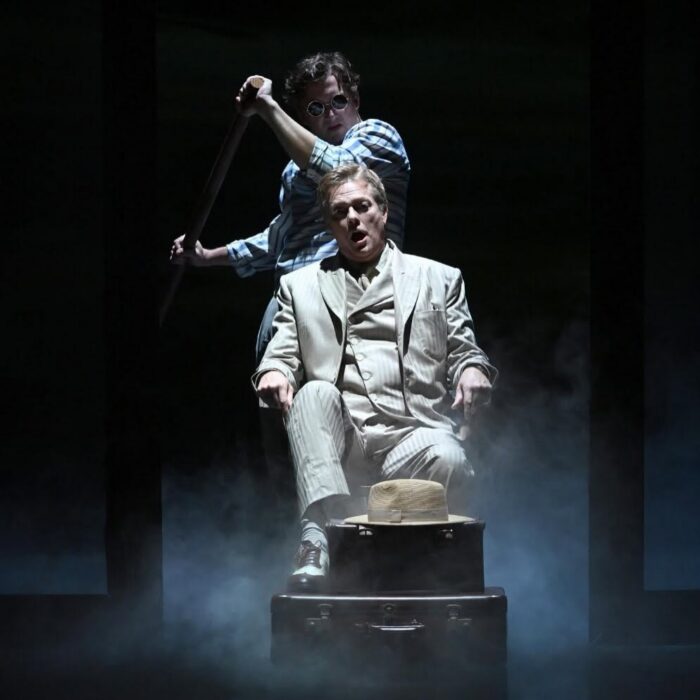
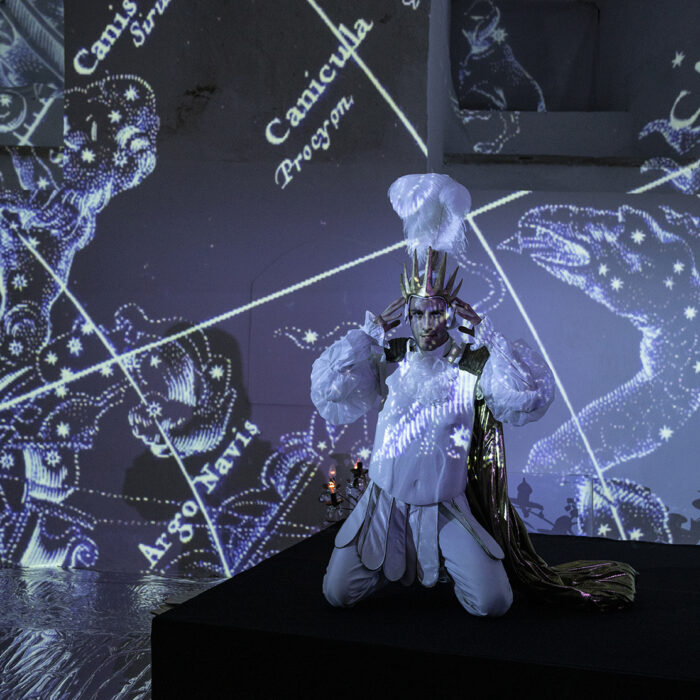
That architecture was largely dismantled in Francesca Zambello’s production (seen September 26), originally created for Washington National Opera and subsequently presented in Montreal as a co-production. The setting ceased to be the fabulous imperial China of Carlo Gozzi’s adaptation of François Pétis de la Croix’s “Les Mille et un jours” (1712) and became an anonymous dystopian totalitarian state. Wilson Chin’s industrial scenery—scaffolding, catwalks, metallic structures and oppressive architectural masses— deliberately replaced the sumptuous chinoiserie associated with the opera.
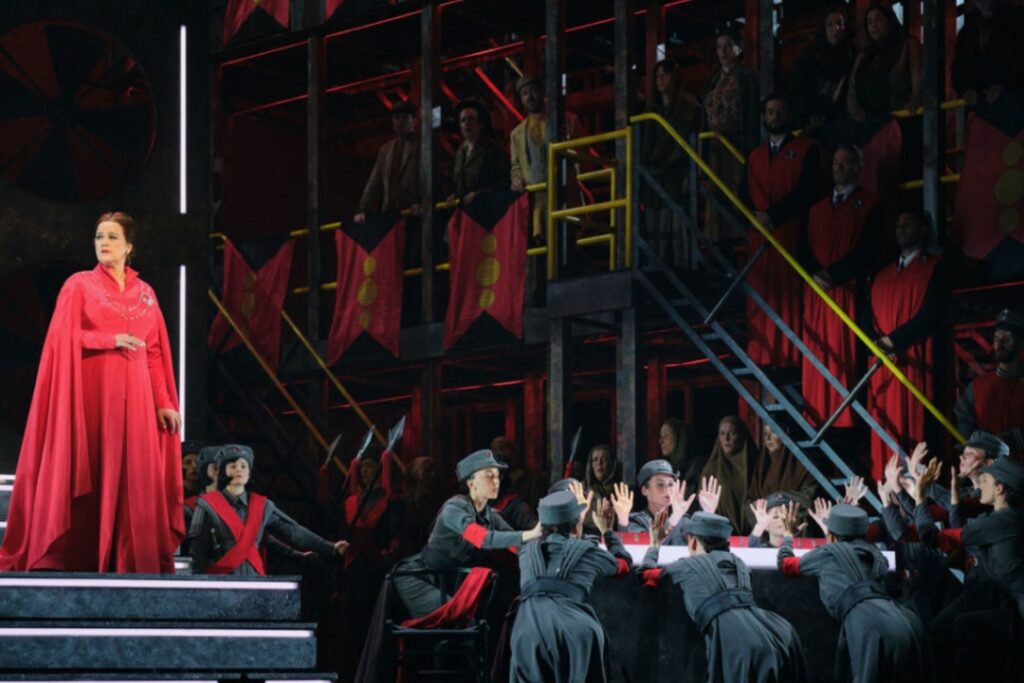
(Photo: © Vivien Gaumand)
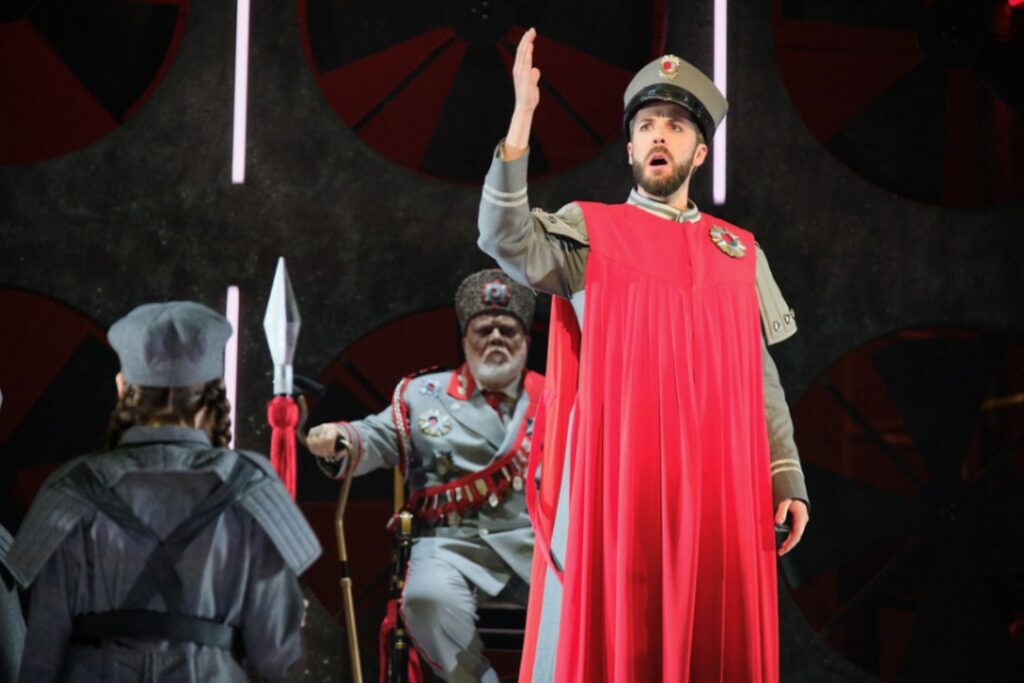
The intention was intelligible; Zambello transformed Turandot from a fabulously cruel princess into an authoritarian ruler, thereby making her violence a political rather than merely folkloric phenomenon. The execution, however, proved considerably less convincing. The production often appeared to be searching for contemporary political meanings in a work whose power resided precisely in its mythical unreality. The substitutions accumulated. The traditional Chinese crowd became a population of Central Asian migrants; the military and police forces were conspicuously female; Ping, Pang and Pong were transformed into early twentieth century bureaucratic functionaries. Even the ministers’ nostalgic trio, one of Puccini’s most delicate moments of lyrical relief, was subjected to this process of reclassification. The result was less a universalization of “Turandot” than an accumulation of contemporary political signifiers.
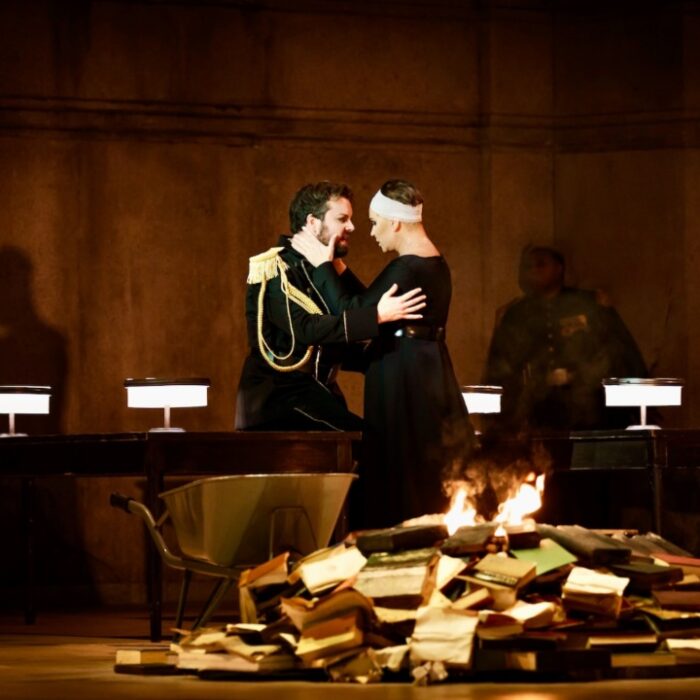
The production reached its most radical point in the final Act. Since Puccini left the opera unfinished, Zambello, librettist Susan Soon He Stanton and composer Christopher Tin used the composer’s unfinished state as an invitation to replace the traditional Alfano conclusion altogether. The new ending sought to resolve what its creators regarded as the opera’s fundamental problem: Turandot’s transformation from murderous ice princess to loving woman after Calaf’s kiss. Stanton supplied Turandot with an additional history of sexual violence, making her cruelty the consequence of trauma and her absolute power a defense against male domination. Her eventual transformation therefore became a conscious rejection of the cycle of violence rather than a sudden capitulation to romantic love.
The concept was intellectually defensible. Its theatrical realization was considerably less so. The new conclusion turned Turandot into a liberal empress who welcomed the displaced newcomers and renounced the authoritarian order she had inherited. Emperor Altoum died offstage before the final scene, leaving Turandot to assume power. Calaf became less the victorious suitor of the traditional fairy tale than the agent who helped persuade her to choose reconciliation. What had been a deliberately improbable fairy-tale transformation was consequently converted into an explicitly ideological one.
(Photo: © Vivien Gaumand)
Music & Cast Details
Christopher Tin’s music made the rupture still more conspicuous. His approximately eighteen-minute finale did not attempt to reproduce Puccini’s language with the discretion of Franco Alfano. Instead, it moved toward a hybrid vocabulary of contemporary verismo, Broadway and cinematic sentiment. The contrast with Puccini was particularly jarring precisely because the orchestra played it so well. Whatever its intentions, the new music sounded unmistakably like music written in the 21st century. The Alfano ending may be imperfect, but it at least attempted to inhabit Puccini’s musical universe. Tin’s finale announced its independence from it. The omission of the familiar reprise of “Nessun dorma” further emphasized that this was not simply a completion of an unfinished masterpiece but a rethinking of its final meaning.
Fortunately, the musical performance itself was considerably stronger than the production. Maida Hundeling dominated the evening as Turandot. Her dramatic soprano possessed precisely the steel, brilliance and dark tonal centre demanded by the role. She negotiated the formidable tessitura with remarkable security, never resorting to shrillness, while gradually exposing the vulnerability beneath the character’s icy exterior. If the production asked her to transform Turandot into a political allegory, Hundeling supplied something more valuable: an actual human presence.
Andrea Shin offered an elegant and carefully controlled Calaf. His lyric instrument was relatively light for a role that benefited enormously from the sheer vocal amplitude of Hundeling, and the imbalance occasionally made him seem dramatically underpowered. Yet he never forced the voice, and his “Nessun dorma” was beautifully phrased and crowned by thrilling high notes. Paolo Arrivabeni’s attentive balance ensured that Puccini’s orchestra never overwhelmed him.
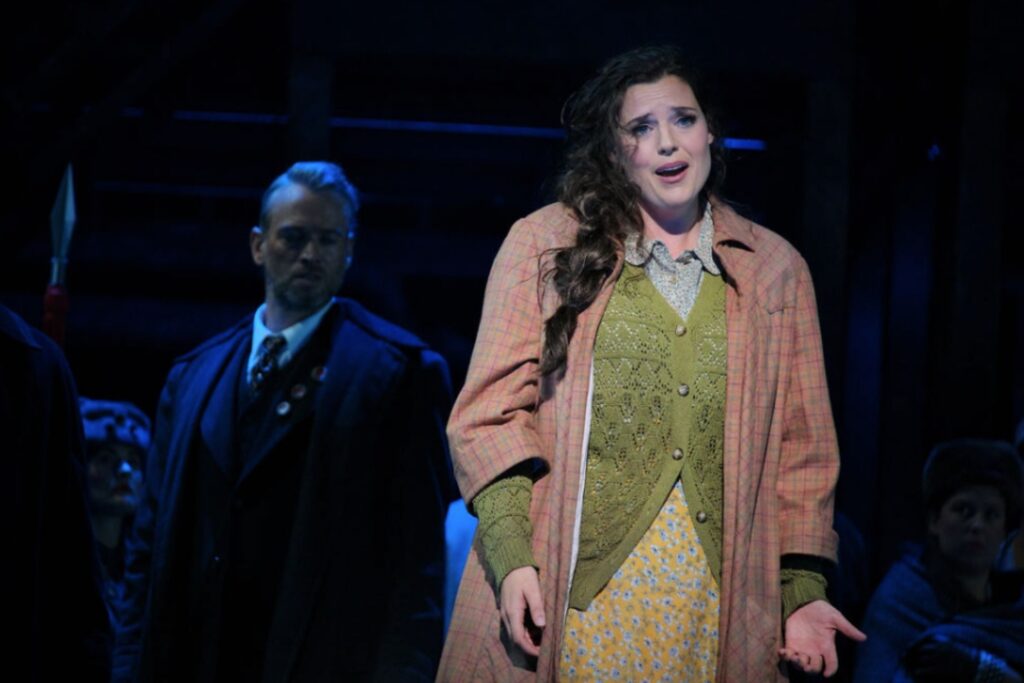
Kirsten MacKinnon was outstanding as Liù. Since her Countess in Montreal’s “Le nozze di Figaro” three years earlier, her lyric soprano has acquired considerably greater warmth, richness and sensuality. “Signore, ascolta” was movingly phrased, but “Tu che sei del gel sei cinta” became the emotional high point of the evening. MacKinnon’s luminous tone, generous phrasing and acute acting transformed Liù into the moral center of the opera. Her final exchange with Turandot, and especially the moment when her gaze shifted from the princess to Calaf, was genuinely shattering.
(Photo: © Vivien Gaumand)
Raymond Aceto brought sonorous authority and humanity to Timur. Nathan Keoughan, Rocco Rupolo and Angelo Moretti formed a well-characterized trio of ministers, providing welcome lyrical relief. Colin Mackey portrayed the Mandarin with convincing authoritarian severity, while Richard Margison was warmly dignified as Altoum, his veteran presence lending the emperor’s brief appearances unusual poignancy.
Paolo Arrivabeni conducted with authority and considerable sensitivity to Puccini’s extraordinary orchestration. He revealed a score already pointing beyond late Romanticism toward Expressionism, balancing massive climaxes with remarkable transparency. Harmonic details, shimmering colors and impressionistic textures remained audible even at full orchestral force. The Orchestre Métropolitain played superbly, while Claude Webster’s chorus displayed impressive rhythmic precision, dynamic control and sonic weight. The contrast between Puccini and Tin was consequently impossible to ignore. The orchestra demonstrated the inherent sophistication of Puccini’s score; it also demonstrated, with equal precision, how conventional and mediocre the newly composed material sounded beside it.
This “Turandot” therefore remained a memorable musical achievement surrounded by a deeply problematic theatrical experiment. Zambello’s production offered a determined attempt to rescue Puccini’s fairy tale from its Orientalist and patriarchal baggage, while Tin and Stanton sought to make its ending ethically compatible with contemporary sensibilities. Yet in doing so, they replaced one set of ambiguities with another. The fairy tale became a political allegory, the princess became a traumatized authoritarian, and the triumphant conclusion became a manifesto for reconciliation and open borders.
Puccini’s unfinished masterpiece survived an incomplete ending for a century. It proved less obvious that it needed rescuing from the fairy tale that had made it immortal.