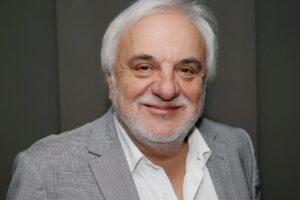
Q & A: Professor Plamen Kartaloff, Director of Sofia Opera & Ballet
Pioneering New Paths & Possibilities for Wagner’s Operas in Bulgaria
By Jennifer E. Pyron(Photo: Sofia Opera)
Professor Plamen Kartaloff’s legacy as the director of Sofia Opera is guided by his deep commitment to artistic integrity and the living spirit of music in the theater. This depth comes from years spent putting in the work, forging new paths and uncovering the musical possibilities “between the lines” for Bulgarian singers. While the Bulgarian opera tradition began in 1891-1892, Bulgaria’s first Wagner opera, “Der Fliegende Holländer,” was not staged until 1930. Most Bulgarian singers were trained primarily in Italian, French, and Russian repertoire. In short, Wagner’s music is a major undertaking for all.
Kartaloff invited Richard Trimborn, a long-time assistant to Wolfgang Sawallisch and Carlos Kleiber, to Sofia in order to work with around 50 soloists for eight years. Together they carved out a new understanding for Wagner’s music and how it relates to the body of the singer, not just the voice. While a specific vocal stamina and technique is required to perform these dramatic works, especially over the course of several hours-long performances, it is the soul of the singer that must reflect Wagner’s emotional palette. Thus, Kartaloff projects from the soul of Wagner’s intentions and continues his journey as the master of more than the music.
In an exclusive interview, OperaWire spoke with him and learned what it takes to tread this historic path.
OperaWire: What inspired you to become the director of Sofia Opera?
Plamen Kartaloff: Bayreuth determined my destiny to dedicate my life to opera theater. As a student in 1970, I took part in the Bayreuth Youth Festival. The performances at the Festspielhaus, created by Richard Wagner, gave me a powerful impulse to create a theater of my own, shaped by my personal artistic vision. After returning to Bulgaria, I organized the creation of the Youth Opera in Sofia. The Sofia Opera provided me with a rehearsal hall, I found a sponsor to finance the production of the sets, which were built in the Opera’s workshops, while the costumes came from the Sofia Opera’s wardrobe. At that time, the director of the Sofia Opera was the renowned tenor Dimiter Uzunov, who had returned from Vienna. He invited me to join the company while I was still a student. I declined because I wanted to follow my own path and make my own choices in the great art of opera theater. I never dreamed of becoming a member of the Sofia Opera; it seemed unattainable to me. But a new institution had already been born – the Youth Opera in Sofia. Our mission was to travel throughout the country, visit small towns and rural villages, and bring opera to stages where no opera performance had ever been presented, while performing with just a piano to accompany Mozart’s “Die Entführung aus dem Serail,” Haydn’s “Der Apotheker,” Gluck’s “Die Pilger von Mekka,” or Sutermeister’s “Seraphine oder die stumme Apothekerin.” We focused on the chamber opera repertoire, performing works by Monteverdi, Purcell, Galuppi, Pergolesi, Menotti, Stravinsky, and many others. As the years passed, I worked in various theatres in Bulgaria and abroad, gaining experience and developing my own artistic vision. Eventually, the time came when my work was recognized, and the Minister of Culture invited me to give a new direction to the development of the Sofia Opera. By then, I had acquired both the experience and the vision needed to undertake such a responsibility. I knew how the institution could evolve and flourish while remaining faithful to its artistic mission. Accepting this challenge allowed me to realize ideas that had been taking shape in my mind ever since my formative experiences.
OW: What is the greatest lesson you have learned over the past 16 years?
PK: Over the past 16 years of presenting the Wagner Festival at the Sofia Opera, I have learned that great achievements in opera are possible only when artistic vision is combined with perseverance, discipline, and collective dedication. The most important lesson has been that Wagner’s works are not merely operas; they are complete artistic universes that require long-term planning, exceptional teamwork, and a deep commitment from every participant. Through the festival, I witnessed how our singers, orchestra, chorus, technical teams, and creative staff grew together, developing the skills and confidence needed to perform some of the most demanding works in the operatic repertoire. I also learned that audiences are willing to embrace ambitious artistic projects when they are presented with conviction and high artistic standards. The success of our productions proved that even works once considered difficult or inaccessible can attract a wide and enthusiastic public. Perhaps the greatest lesson has been the value of continuity. Building a Wagner tradition does not happen overnight. It requires years of dedication, consistency, and faith in a long-term cultural mission. Looking back, I am proud that the Sofia Opera has established itself as an internationally recognized Wagner center, attracting artists, scholars, critics, and audiences from around the world. The Wagner Festival has confirmed my belief that opera must always strive for excellence while remaining open to new generations of performers and audiences. This balance between tradition and renewal is what ensures the future of our art form.
OW: Tell me about your process when working with singers.
PK: My individual process of working with singers is based on trust, precision, and a deep understanding of the dramatic truth behind the music. First, I always begin with the score and the text. For me, opera is inseparable from its dramatic meaning. I ask singers not only to learn their vocal parts, but to understand the psychological journey of their character. Every phrase must be justified dramatically, not just sung correctly. In rehearsals, I work step by step. We start slowly, often speaking the text before singing it to uncover its natural rhythm and emotional structure. I encourage singers to think like actors as well as musicians. Technique is essential, of course, but it must always serve expression. I also believe in individual approach. Each singer has a different artistic personality, vocal quality, and experience. My role is to help them find the most truthful and powerful version of their character within the overall vision of the production, rather than imposing a rigid interpretation. At the same time, opera is a collective art. While I work closely with individuals, I always keep the ensemble in focus. Balance between voices, interaction onstage, and dramatic coherence are crucial. A production succeeds only when every participant feels part of a unified artistic organism. Finally, I try to create an environment of simultaneous discipline and freedom. Discipline is necessary to achieve high standards, but freedom is what allows inspiration to emerge. When these two elements are in balance, singers reach their full potential, and the performance becomes alive and meaningful.
OW: When did you first discover Wagner’s works?
PK: I first discovered Wagner’s works during my formative years as a young musician, but the decisive moment came in 1970, when I participated as a student in the Bayreuth Youth Festival. Until then, I had studied opera in a more general sense, like any other part of the repertoire. I knew Wagner’s music intellectually, but I had not yet experienced its full theatrical and philosophical power in a living performance. Everything changed at Bayreuth. The experience of the Festspielhaus, with its unique acoustic space, its theatrical intensity, and its complete artistic unity of music, drama, and staging, revealed Wagner to me in a completely new way. It was not just music — it was a total work of art that demanded a different level of artistic thinking and responsibility. That encounter marked a turning point in my life. From that moment on, Wagner was no longer just a composer I admired; he became a reference point for how I understand opera as an artform and how I later approached my own work as a director.
OW: What makes your annual Wagner festival unique?
PK: What makes our annual Wagner Festival in Sofia unique is not only the repertoire we present, but also the path we have built over time, as well as the artistic identity we have developed through it. We approached Wagner not as a series of separate productions, but as a long-term artistic mission. This continuity has allowed us to grow step by step, to develop our own performance style, and to create a company capable of mastering some of the most demanding works in the operatic repertoire. Another key element is the ensemble spirit. In our productions, singers, orchestra, chorus, directors, set designers, and technical teams work as a single organism. Wagner himself believed in the unity of the arts, and we strive to reflect that ideal in practice. This creates a strong sense of artistic integrity and shared responsibility. The festival is also unique because of its location and cultural context. Sofia is not traditionally regarded as a Wagner center, yet we have transformed it into a place where these works are not only performed, but also studied in depth and continuously developed. This gives the festival a special energy — a sense of discovery for both the artists and the audience. Finally, what distinguishes our festival is its relationship with the audience. Over the years, we have built a loyal and curious public that follows Wagner’s works with increasing understanding and enthusiasm. Many spectators return year after year, becoming part of the artistic process themselves. In this way, the Wagner Festival in Sofia is not just a series of performances, but a living artistic tradition that continues to evolve.
OW: What are you planning for the next festival?
PK: Let us continue along our already established artistic path, creating an even more inspiring opportunity for our creative rediscovery and, for the audience, an even greater attraction for new spectators and their spiritual growth. In the coming year, we will focus our energy on consolidating our achievements with nine titles in the Wagner direction: “Der Ring des Nibelungen,” “Parsifal,” “Lohengrin,” “Tannhäuser,” “Tristan und Isolde,” and “Der Fliegende Holländer.” Only “Die Meistersinger von Nürnberg” remains. Thus, the Bayreuth canon will have been achieved and completed! An enormous undertaking, isn’t it? For the first time in Sofia — often called the Bayreuth of the Balkans — Wagner’s music dramas have been elevated and established! A living historical testament to the mastery of our ensemble! Our strength lies not in presenting a series of separate works, but in offering a philosophical journey shaped by my own directorial vision. Through an innovative approach that remains faithful to Wagner’s dramaturgical concept, we seek to uncover new layers in both the stage and musical interpretation, revealing even more powerfully the emotional and spiritual force of Wagnerian theater. At the same time, we look boldly toward new artistic horizons within Wagner’s universe. Alongside my priority of creating a Bulgarian Wagnerian school and tradition, we also invite guest artists with strong individuality and rich creative experience, representatives of different interpretative traditions. We seek collaborations with artists capable of bringing a fresh and contemporary perspective without compromising the profound essence and spirit of our understanding of Wagnerian theater. Our connection with the audience remains especially important to us. That is why we strive to expand the festival’s educational mission through inspiring conversations, discussions, and meetings in our newly established “Richard Wagner Club,” transforming every visit into a deeper and more personal experience of the richness, ideas, and emotional power of Wagner’s masterpieces. As always, I have the conviction, courage, and faith that the festival is a living and significant cultural endeavor that contributes to our identity. For this very reason, the next edition will continue along the path already taken, while at the same time opening new creative horizons and inspiring both the artists onstage and all those who share with us the magic of this extraordinary musical journey.
Stories you may also like…
Q & A: Jorge de León on ‘Manon Lescaut,’ the Canary Islands & Opera’s Human Values
Q & A: Baritone César San Martín on the Emotional Power of Zarzuela, Returning to “La Verbena de la Paloma” & the Global Nostalgia for Our Roots