A Whole Universe – Joe Davies on Performing Mahler’s ‘Symphony No. 8’ With the Leamington Sinfonia Orchestra
By Mike Hardy(Photo: Chris Tribble)
“Try to imagine the whole universe beginning to ring and resound. There are no longer human voices, but planets and suns revolving” wrote Gustav Mahler, commenting on his 8th Symphony.
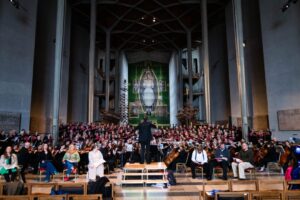
On 16th May, the majestic, (if not suitably astronomical), Coventry Cathedral hosted a remarkable and rarely performed work that received a rapturous reception at its cessation, much as it did on its opening night in 1910 at the Neue Musik-Festhalle, Munich.
Mahler’s massive choral work, “Symphony No. 8,” was performed by the Leamington Sinfonia orchestra, alongside no less than eight choirs and eight world class soloists, all supremely guided by conductor Joe Davies.
Mahler’s Eighth stands as one of the most monumental achievements in the orchestral and choral repertoire. Known as “Symphony of a Thousand,” it requires a massive orchestra, eight soloists, a children’s choir, and adult chorus divided into 16 parts, making it notoriously expensive and difficult to stage. Consequently, it is generally reserved for grand, celebratory occasions rather than any frequent programming, not least because of the difficulties involved in the requirement of so much rehearsal to achieve synchronicity of so many voices and instruments. The sheer scale of the numbers of musicians involved necessitate an auditorium beyond the scope of most concert halls.
This performance took THREE years to make, requiring astonishing levels of personal resolve and dedication.
Joe Davies is the Assistant Conductor of the English Symphony Orchestra and the Musical Director of the UK Proms in the Park Orchestra, alongside other musical directorships in many other orchestras throughout the UK.
“This project has been in the works since June 2023, immediately following our performance of Mahler’s Second Symphony (which involved over 250 performers),” Davies said in the Press Release before the performance.
“We were so proud of that concert, and naturally our attention turned to how we could do it again, but in an even bigger way! Bringing together the community to perform large-scale musical works is a huge undertaking, but one that will be worth everything once the concert day comes. It’s going to be huge!”
I asked him about the logistics of producing something of this size, and why it took three years to put together.
“To gather such monumental forces takes many hours and a lot of arm-twisting!,” said Davies.
“The singers and the players came from far and wide, and there were a huge number of rehearsals that Laura Bailie (Chorus Master) and I had to organize and lead. As well as this, funding applications, venue meetings, risk assessments, score hire, and stage logistics were all big tasks that needed many hours and a lot of brain space. The best things always take the most time! It was also important that the project felt like a community initiative, so the concert was preluded by various Education Workshops in local schools–Mahler is for everyone, so let’s get them started early!”
Mahler’s own handwritten notes from June 1906 show that his early concepts for the work may not have intended it to be as a full choral symphony, but more as a four-movement plan. However, he soon replaced the last three movements with a single section, essentially a dramatic cantata, based on the closing scenes of Goethe’s “Faust,” something which he had long aspired to do, setting Faust’s classic to music: “and to set it quite differently from other composers who have made it saccharine and feeble,” he wrote.
Thus, the completed work is comprised of two elongated parts; the first, a medieval Latin hymn “Veni Creator Spiritus” a 9th-century work (“Come, Creator Spirit”), and the second as described above.
“Just think: within the last three weeks I have completed the sketch of a completely new symphony, something that makes all my other works seem like preliminary efforts. I have never composed anything like this. In content and style, it is altogether different from all my other works, and it is surely my greatest accomplishment. I have probably never worked under such compulsion; it was a vision that struck me like lightning. The whole immediately stood before my eyes; I had only to write it down, as if it had been dictated to me…” Mahler recited this to Austrian music critic Richard Specht in 1906. (Specht wrote a posthumous biography of the composer 1913.)
The “Symphony of a Thousand” was actually HALF a thousand on this occasion, approximately 500 performers in total and it would be improper, if not churlish, to overly accent or choose a preferred soloist among the gathered ensemble, given their remarkable performance as, virtually, a conjoined entity.
All had stand out moments, and I was particularly impressed by soprano Holly Teague as Magna Peccatrix whose upper register, including a glorious top ‘C’, was crystalline pure. She sang a divine “Bei der Liebe, die den Füßen,” recounting her washing the feet of Christ with her tears.
Soprano Sofia Kirwan-Baez made a stunning entrance as Mater Gloriosa, not just visually, by virtue of her radiant ‘angelic’ white attire, contrasting with the dark of the other soloists and appearing far behind the stage aloft a pulpit as if descended from heaven itself; but by the sheer beauty and resonance of her instrument which for me, was all too brief and among the highlights of the evening.
Baritone Conrad Chatterton performed with a rich, enveloping warmth. As Pater Ecstaticus, he set the closing scene of Goethe’s “Faust” with a most passionately sung aria, “Ewiger Wonnebrand,” a moving hymn about ascending beyond the physical world into divine, eternal love.
Equally impassioned and treacle dark was bass Jakob Mahase who sung with such ardency what I considered to be a most difficult aria towards the closing section, “Wie Felsenabgrund mir zu Füßen,” where he sings of finding God’s love, shaping influences within the wild, destructive forces of nature.
Tenor Jack Dolan as Doctor Marianus shone in his hymn “Blicket auf zum Retterblick,” a passionate prayer to the Mater Gloriosa. His performances throughout the evening combined beautifully with the choir, navigating some difficult passages and tessituras in the process.
Soprano Iúnó Connolly was most accomplished in her role of Una Poenitentium (Gretchen), particularly when she sang a prayer of gratitude to the Mater Gloriosa, celebrating the redemption of her loved one, Faust.
Mezzo Soprano Georgia Mae Ellis as First Alto Mulier Samaritana commenced an exquisite “Bei dem Bronn, zu dem schon weiland” which transitions into a trio where the female penitents, the Women of Samaria, recall the biblical well of living water where Jesus conversed with them.
The Second Alto, Maria Aegyptiaca, was performed by mezzo soprano Rhian Davies who was enchanting in the trio, completes the solo performers.
Likewise, it would be an impossible task for anyone to compare or contrast the glorious utterances produced by the Coventry Cathedral Chorus, Coventry Cathedral Choir, Daventry Choral Society, Divertimento, Warwick & Kenilworth Choral Society, Leamington Bach Choir, Spires Philharmonic Chorus, and Warwickshire Youth Choirs.
The orchestra itself was truly magical, unquestionably in perfect synchrony throughout, and all seemingly devoted to producing a memorable event. The prelude at the start of part two was particularly evocative. Spanning the first eight to 10 minutes, this hushed, impressionistic section featured gentle woodwind and pizzicato, the choral voices and soloists made gentle interspersions.
As the Virgin Mary appears high above the scene, in the pulpit, the shimmering violins and harp combine to produce a most wondrous, ethereal effect.
But without a doubt, the most spine-tingling work was saved until the very last, in the “Chorus Mysticus” which forms the closing moments of the symphony where a massive wall of brass and the full vocal forces slowly crescendo into an overwhelmingly ecstatic, euphoric climax.
To witness this work live is a remarkable, probably once in a lifetime event, and I defy anyone to not be visibly moved by the huge euphonious wall of music that it creates when performed well. And this WAS performed brilliantly.
Ultimately, the biggest plaudits must go to conductor Davies. To see him at work is a sight to behold. Intensely focused and animated throughout, he spins and gesticulates, commanding this group here, prompting that section there, cajoling his individual performers, musicians and choristers as though frenziedly manipulating the vast array of sliders and controls on one of those huge, studio analogue mixing consoles. I suggested to him that it must surely rank as one of his proudest achievements.
“It was definitely a collective triumph rather than a personal one” he responded. “But I’m very proud of my role in it! I adore Mahler, and performing any of his Symphonies is always a treat…. even if I lose a lot of sleep over it!”
So is he likely to attempt anything like this in the future?
“Yes, definitely. Music is all about making memories, and events such as these are unforgettable for everyone involved. There’s more to come!”