Wiener Staatsoper 2025-26 Review: Les Pêcheurs de perles
By Laura Servidei(Photo: Wiener Staatsoper Michael Poehn)
Premiered in 1863, “Les Pêcheurs de perles” is one of Georges Bizet’s earliest operas, composed more than a decade before his masterpiece “Carmen.” Set on the exoticized shores of ancient Ceylon, it combines lush lyricism with themes of friendship, desire, and betrayal. Though initially overshadowed by Bizet’s later success, the opera has gradually earned recognition for its brilliant orchestration and emotionally charged score—making its belated Vienna premiere a much-anticipated event.
A Friendship Undone by Desire
The opera centers on two pearl fishers in Sri Lanka, Nadir and Zurga, whose friendship is tested when they both fall in love with the Hindu priestess, Leïla. Having once sworn to renounce their rivalry for the sake of their bond, the men are reunited years later in a fishing village where Leïla has arrived to pray for the safety of the divers. Nadir and Leïla soon rediscover their love in secret, but their forbidden relationship is exposed, provoking Zurga’s jealousy and setting the opera on a tragic course. Torn between vengeance and loyalty, Zurga ultimately faces a moral reckoning that gives the work its emotional climax: he sets fire to the village to distract the people and allow Nadir and Leïla to escape.
(Photo: Wiener Staatsoper Michael Poehn)
Lost at Sea: Mondtag’s Reimagining
Although part of the operatic canon for many years, “Les pêcheurs de perles” is presented at the Wiener Staatsoper for the first time in a production by Ersan Mondtag that relocates the action to modern times. Today, the original setting might seem problematic as an example of nineteenth-century Orientalism, so it is perhaps understandable that Mondtag chose not to show us a primitive village with fishermen in grass skirts. However, as so often happens, the modernization drains the story of its dramatic impact.
A key element of the admittedly weak libretto is Leïla’s role as a priestess who serves as the spiritual center of the fishing community, invoking Brahma’s protection to ensure the divers’ safety. Her chastity is essential to this role, and breaking her vow is precisely why she and Nadir are sentenced to death when their love affair is discovered. None of this translates to a contemporary setting; our world contains nothing even remotely analogous to such a worldview. As a result, the already fragile story becomes incomprehensible and impossible to relate to—defeating the production’s purpose entirely.
(Photo: Wiener Staatsoper Michael Poehn)
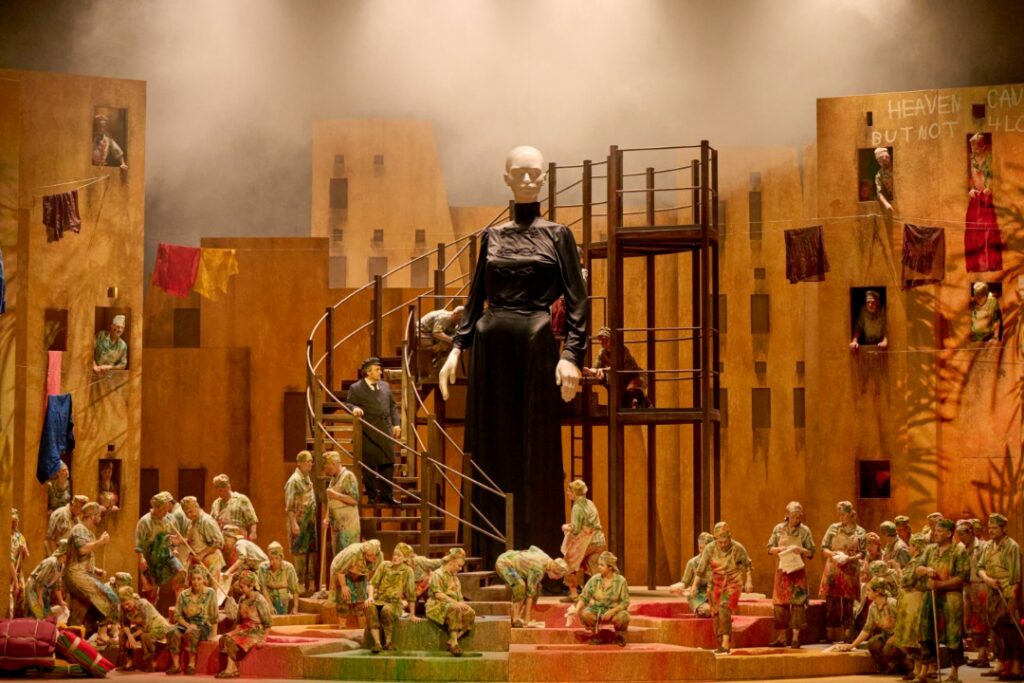
Instead of a fishing village, we see a textile factory, presumably still in Sri Lanka, where workers weave and dye cloth under Zurga’s supervision. The laborers wear nondescript outfits, while Zurga and Nadir (now a buyer for luxury brands) sport Western-style suits. An enormous mannequin towers over the stage like a religious idol and is progressively dressed during the first act. Leïla’s role remains unclear—she appears to be a supermodel or perhaps a fashion influencer. The notion that fashion has become the religion of our times, with luxury brands as the gods we worship, is not without merit. Yet the exploitation of poor workers in the Global South by Western capitalism, however real and serious, simply does not fit the opera’s themes. The concept ends up resembling an inability to imagine a world governed by values different from our own rather than meaningful commentary on post-colonial capitalism.
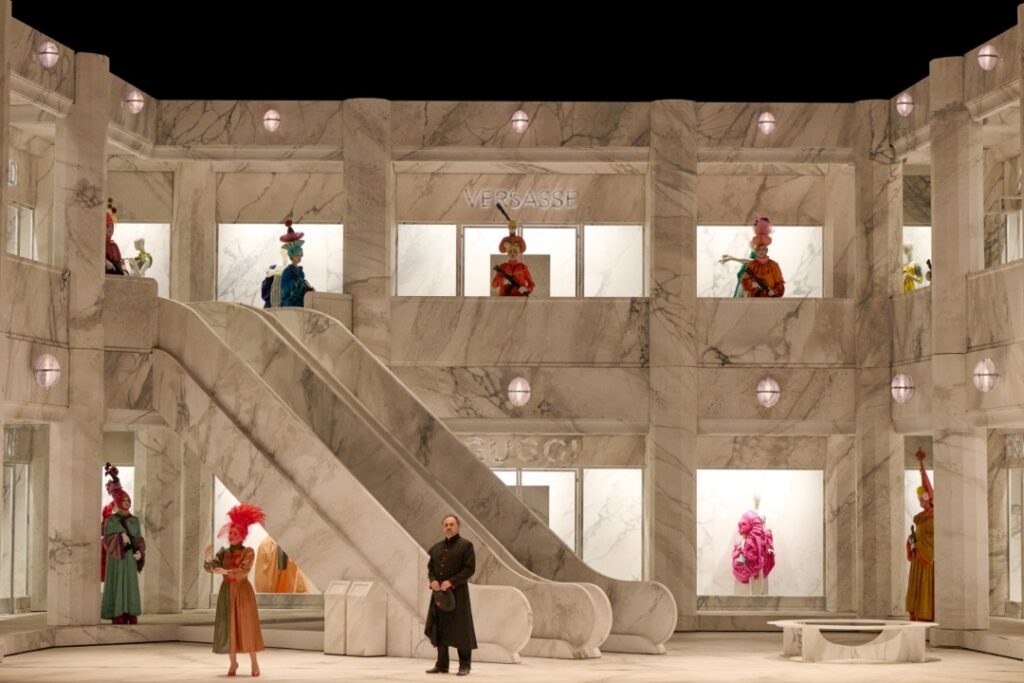
In the second half, the set (designed by Lorenz Stöger) shifts to a modern shopping mall called “Carmen,” complete with luxury boutiques. Here, the plot was entirely lost. Music from Bizet’s “Carmen” blared from loudspeakers before the orchestra began playing. Night security guards in eccentric outfits wielding automatic weapons arrested Nadir and Leïla for no comprehensible reason. The “villagers” had been transformed into security personnel—never have I seen a mall with so many guards. Nothing made sense.
Bizet’s Score Rises Above the Concept
Daniele Rustioni led the Orchestra of the Wiener Staatsoper in a thoughtful, detailed reading of the score. He highlighted the music’s sensuality with a transparent, mellow sound that acknowledged its Orientalist coloring without overindulging in it. In the final act, when Zurga discovers the love affair between Nadir and Leïla, a terrible storm rages over the ocean—and in Zurga’s heart. The tempest conjured by Rustioni and the orchestra was marvelous: waves crashing, wind howling, a true tour de force. (All this while we watched a marble escalator in a shopping mall, alas.)
Since this is the opera’s first appearance in Vienna, the orchestra cannot be overly familiar with the music, yet their approach was at once intense, passionate, and ethereal. The chorus plays a considerable role in this work, and the Chorus of the Wiener Staatsoper delivered a committed performance. With only a couple of exceptions—an offstage passage that briefly lost synchronization with the pit—their interventions were precise, their dynamics careful and tasteful.
(Photo: Wiener Staatsoper Michael Poehn)
Vocal Excellence at the Forefront
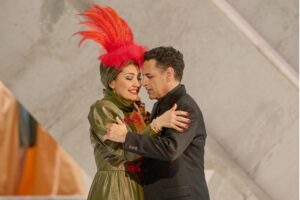
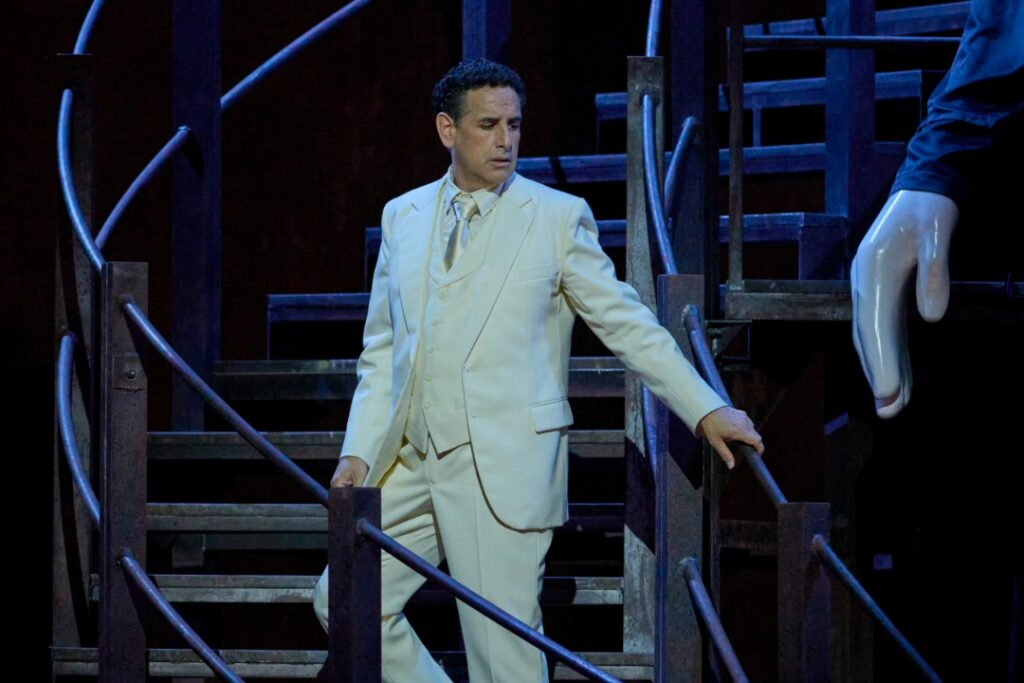
Juan Diego Flórez approached the part of Nadir with his customary elegance and musicality, qualities that seem only to deepen with time. His high notes were brilliant and secure, his phrasing excellent. His celebrated aria “Je crois entendre encore” in the first act was taken by Rustioni at an excessively slow tempo, which even Flórez’s superb breath control could not entirely master. Nevertheless, he conveyed longing, desire for Leïla, and a subdued melancholy that was genuinely moving.
Ludovic Tézier gave a splendid performance as Zurga, the opera’s most complex character. His deep, beautiful baritone possesses an innate nobility that lent Zurga authority and made even his cruelest choices somewhat comprehensible. His dramatic scene in Act III, “L’orage s’est calmé,” followed by the duet with Leïla, was passionate and intense—jealous rage alternating with compassion and sorrow in his voice. The opera’s most famous number, the duet “Au fond du temple saint,” was a true gem, with Tézier and Flórez offering a beautiful, emotional rendition, the two singers vying to see who could produce the smoother legato.
(Photo: Wiener Staatsoper Michael Poehn)
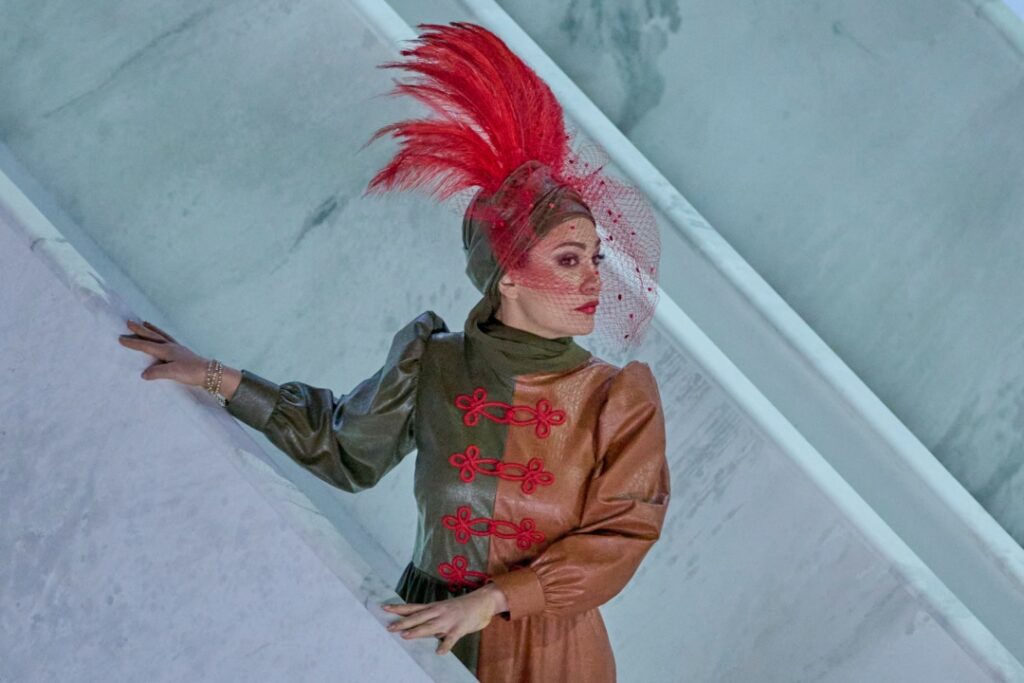
Kristina Mkhitaryan sang Leïla with a powerful, full soprano somewhat heavier than the role typically demands: it is usually entrusted to a lighter, more ethereal voice. Nevertheless, her youthful, fresh instrument, despite its weight, remained stylish and pleasing, with a remarkable account of the coloratura passages in the first act. Her real challenge lay in the pianissimos, which did not seem fully resolved technically: the voice was at times slightly squeezed or broke into a peculiar, metallic vibrato. Occasionally it seemed she was simply trying to “do” too much rather than letting the voice flow naturally. But these are minor details in an otherwise successful performance.
Ivo Stanchev completed the cast as Nourabad, the high priest of Brahma. His bass was strong and well supported, his performance contributing to the success of the musical side of the evening.