Teatro Comunale di Bologna 2026 Review: Olympia
Nicola Campogrande’s World Premiere Discovers a Viable Operatic Language for a Contemporary Experience
By Zenaida des Aubris(Photo: Andrea Ranzi)
Nicola Campogrande’s “Olympia” world premiere at the Teatro Comunale Nouveau di Bologna joins a small category of operas that attempt to absorb the psychic weather of the digital age without collapsing into either technophilia or dystopian cliché. The work takes its cue from E.T.A. Hoffmann’s famous automaton tale, but it relocates the uncanny into a world of algorithms, venture capital, and machine consciousness. The result is less a cautionary tale about artificial intelligence than a meditation on the porous boundary between programmed behavior and human longing.
Contemporary opera has often struggled with the language of modernity. Too many librettists approach technology as a topical subject to be explained rather than as an atmosphere to be inhabited. Piero Bodrato’s libretto avoids that trap with notable deftness. The dialogue is saturated with fragments of corporate English, scientific terminology, and the clipped idioms of start-up culture, yet the text never sounds like an essay disguised as drama. Instead, the opera unfolds with an eerie naturalness.
(Photo: Andrea Ranzi)
Production & Musical Details
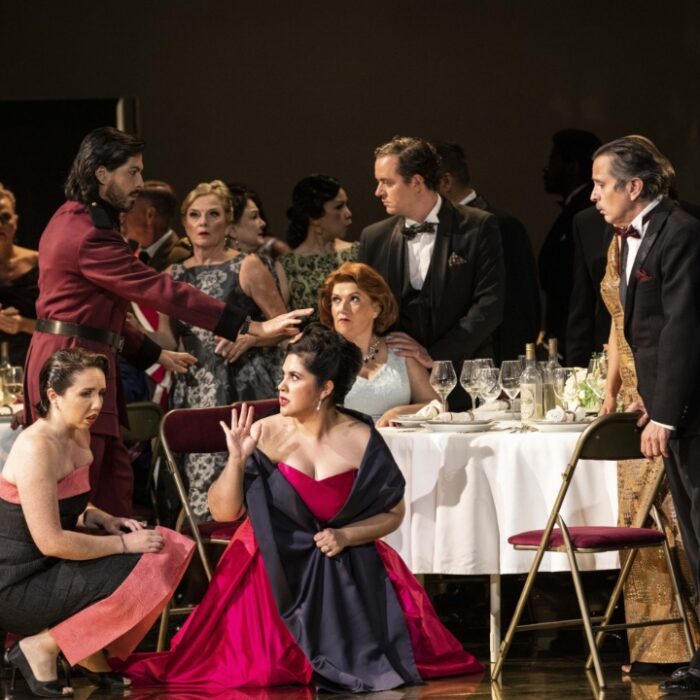
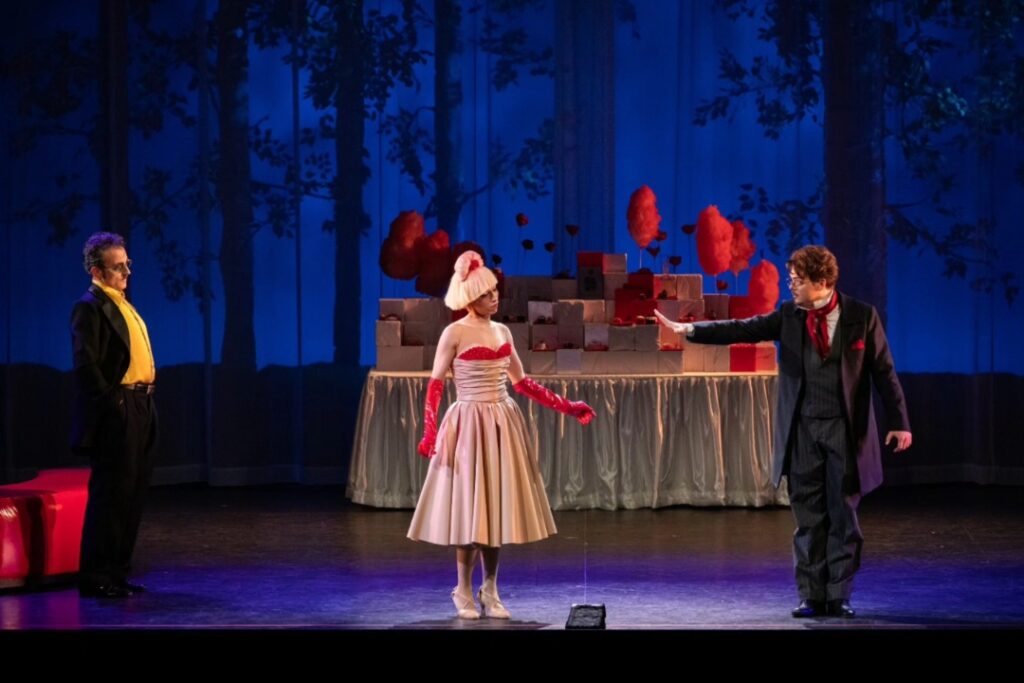
“Olympia,” a beautiful female android engineered by the scientist Spallanzani, becomes dimly aware of her own condition after a dinner guest compares her to a smart refrigerator. The remark lands with devastating force, not only with the party guests, but with Olympia. A machine designed to simulate humanity begins, instead, to experience humiliation, curiosity, ambition.
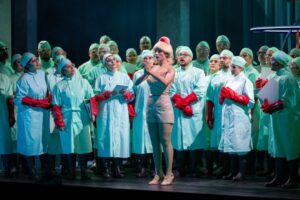
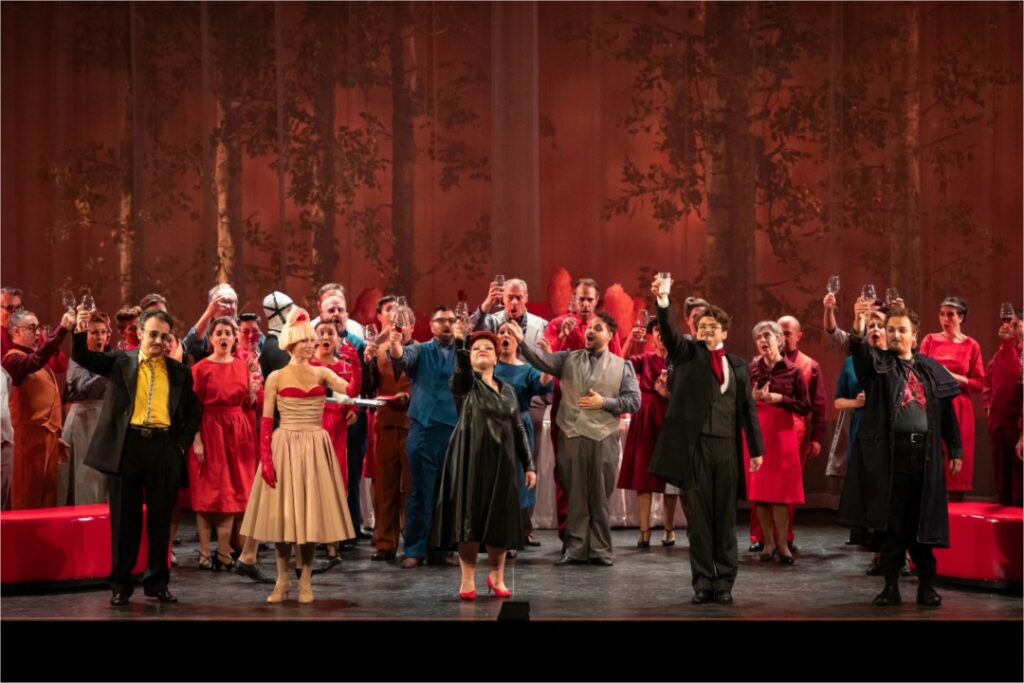
What follows is not a schematic debate about artificial intelligence but a shifting web of emotional dependencies. The entrepreneur Zoltan sees Olympia as scalable technology. The scientist Sherry Hope introduces philosophical speculation about consciousness and ethics. Jean-Paul Dupont — the amiable fool whose careless comparison triggers Olympia’s awakening — functions almost as a comic emissary of ordinary human blindness. Around them moves a chorus of scientists, not so much a Greek chorus as a murmuring collective intelligence, observing events with fascination and dread.
Campogrande’s score may surprise listeners expecting the usual markers of “serious” contemporary opera. There is little aggression toward tonality here, little fetishizing of fragmentation or vocal extremity. Instead, the music moves with a fluid theatrical instinct that recalls an earlier era of operatic craftsmanship. Echoes of Puccini flicker through the orchestral fabric, especially in passages of lush harmonic suspension, but these coexist with other idioms: traces of American film music, hints of lounge jazz, rhythmic patterns that suggest the hum of machinery beneath urban life. The score often feels cinematic in the best sense — not illustrative, but spatially alive.
Most striking is Campogrande’s faith in melody. In recent decades, many composers have treated the singing voice as a vehicle for texture or declamation; Campogrande restores to it the possibility of seduction. The vocal writing breathes naturally, shaping phrases that singers can inhabit rather than merely execute. Olympia’s Beguine aria emerges as the emotional and stylistic center of the work: an oddly intoxicating number, poised somewhere between cabaret sensuality and mechanical precision. Its slithering rhythms and languid brass lines evoke a faded glamour, as though a nightclub standard from another century had been filtered through artificial consciousness. This one number may even assert itself on the concert circuit.
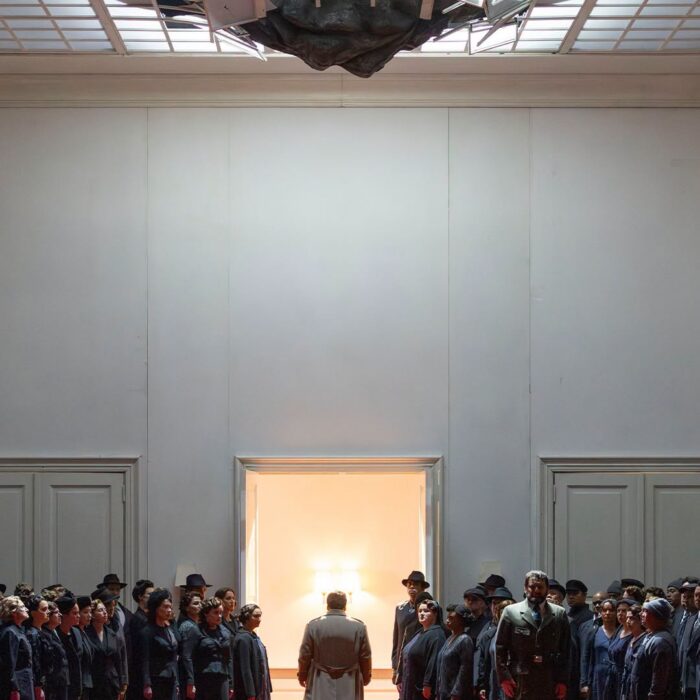
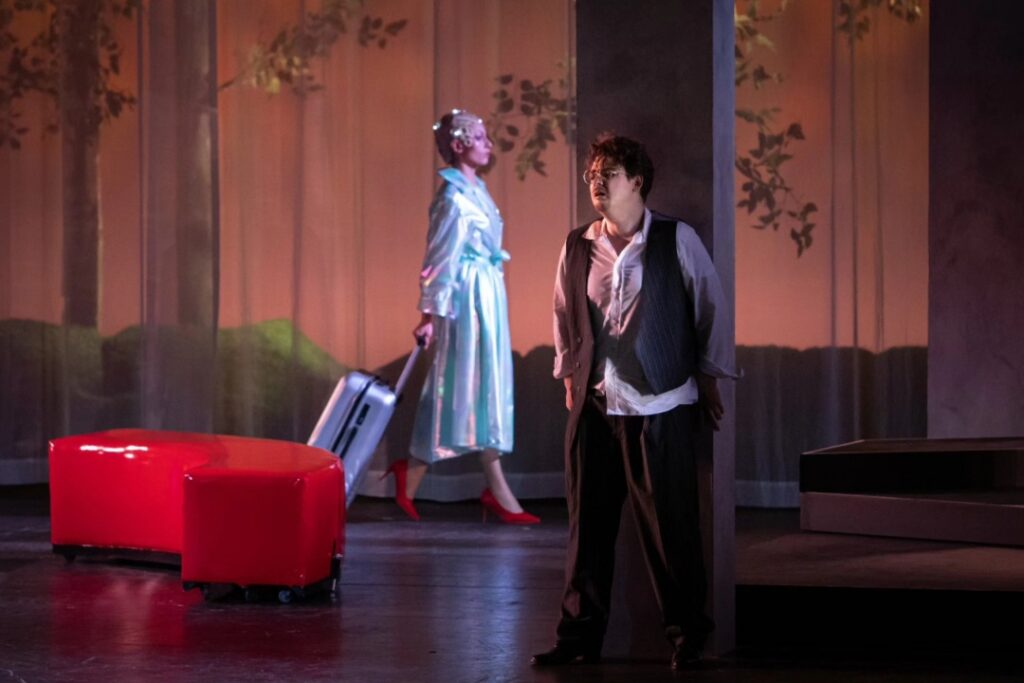
Tommaso Franchin’s production wisely resists the temptation to over design the future. With Fabio Carpene’s sleek sets and Giovanna Fiorentini’s understated costumes, the visual world feels less speculative than an evolution of the present. Spallanzani’s luxurious apartment and the opera’s supercomputing center are recognizable spaces, extensions of contemporary technocratic culture rather than fantasy landscapes. Franchin keeps the focus firmly on interpersonal tension. Even at its most conceptually ambitious, the production remains grounded in gesture, reaction, physical presence.
(Photo: Andrea Ranzi)
Stellar Cast
The performances were uniformly strong. Stefan Astakhov brought unusual authority to Spallanzani, singing with a focused, bronze-colored baritone that carried effortlessly through the dry acoustic of the Comunale Nouveau, Bologna’s temporary performance space. More impressive was his dramatic pacing: the character’s transition from visionary confidence to exhausted moral disintegration unfolded with persuasive clarity.
Isidora Moles as Olympia gave the evening its emotional center. Her soprano possessed both technical polish and a curious translucence of tone that suited the role perfectly. At first she projected an almost unnerving smoothness, every phrase exquisitely controlled, every smile calibrated. Gradually, however, warmth and unpredictability entered the sound. By the opera’s end, the once designed artificial being had acquired something dangerously close to a soul.
Silvia Beltrami contributed incisive theatrical energy as Sherry Hope, while Francesco Castoro sang Jean-Paul Dupont with lyrical ease, his bright tenor floating elegantly through Campogrande’s generous lines. Eugenio Di Lieto’s resonant bass lent Zoltan an appropriately corporate menace.
(Photo: Andrea Ranzi)
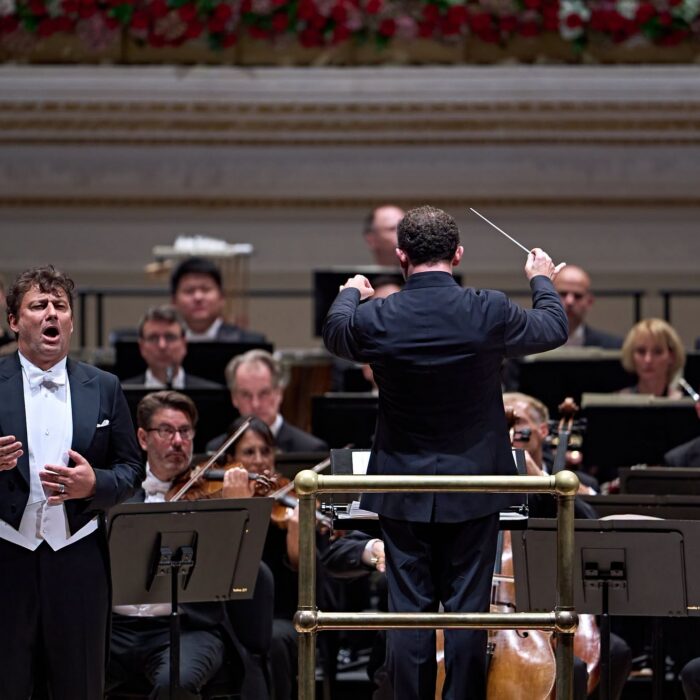
Riccardo Frizza conducted with acute sensitivity to the score’s shifting textures. Under his direction, the orchestra found both muscular propulsion and moments of surprising sensuality. The strings generated a dark, almost viscous sonority, while brass and percussion drove the action with mechanical insistence. Particularly memorable were the rapid wind passages that seemed to mimic systems of accelerated computation. Yet Frizza also reveled in the opera’s softer edges: the sliding horns, the smoky wah-wah trumpets, the strange tenderness embedded in the orchestration.
Not every aspect of the piece fully cohered. The choral writing occasionally settles into static blocks of sound when greater dramatic volatility might have intensified the action. Still, these are relatively minor reservations in a work of unusual confidence and theatrical intelligence.
What lingers after “Olympia” is not merely admiration for a successful premiere, but the sense that Campogrande has discovered a viable operatic language for contemporary experience — one capable of addressing artificial intelligence without sacrificing emotional immediacy or musical pleasure. The opera asks whether a machine can become human. More provocatively, it asks what forms of humanity remain available to us in a world increasingly shaped by machines.