Canadian Opera Company 2025-26 Review: Werther
By Ossama el Naggar(Photo: Michael Cooper)
French operas of the nineteenth century were once among the most popular works in the repertoire, but in the last half century, they’ve fallen out of fashion. One reason is the loss of national singing schools, especially the French, in a now globalized opera world. Without an understanding of the French style, and without the required elegance and clear diction, for the audience these operas are a painful exercise in dated mannerisms or more commonly, sadly generic pieces utterly lacking in style. Though the opera’s two protagonists, Russell Thomas as Werther and Victoria Karkacheva as Charlotte, sang and acted well, the overall singing style in this production was quite remote from the French school of singing.
Cast Highlights
Russell Thomas, who debuts the role here, was a surprising choice as Werther. His voice would have been appropriate for the role a few years earlier, when he sang lyric tenor roles, but he’s now known for heavier roles such as Tannhäuser and Parsifal. Nonetheless, Thomas was a passionate and moving Werther. What he lacked in style, he compensated for with passion and effective acting. His Act one aria, “O Nature, pleine de grâce,” while affecting, disappointed for his diction. Words such as “éblouis” and “inonder” were mispronounced. His Act two aria, the more dramatic “Un autre est son époux!” was more suited to Thomas’s temperament. Again, there was a problem with such phrasing of words as “ardente” which sounded like “ardonte,” a common problem that should have been corrected by COC’s usually excellent language coach. Finally, his Act three “Pourquoi me réveiller ?,” was elegantly and passionately interpreted. As the opera’s most familiar aria and one that is often performed in recitals, the popular aria brought the house down, and deservedly so.
Heard last season as Olga in Christof Loy’s staging of “Eugene Onegin” for Madrid’s Teatro Real, Russian mezzo Victoria Karkacheva is a rising star of the opera world. She managed to make the secondary character of Olga into a major one in Tchaikovsky’s opera, which is no minor feat. The stage presence of this stunningly attractive 30-year-old is truly overwhelming. Add to that her appealing, velvety mezzo, and one can only be mesmerized by her. Of the principal characters, she also had the best diction. Her bright timbre made Charlotte younger than usual, which is a blessing, as she is meant to be quite young according to the libretto. She winningly conveyed the character’s jovial spirit and kind nature as the “mother” of her young siblings in Act one. In Act three, her bright timbre made for a fragile and vulnerable Charlotte who manages to be deeply affecting in her two scenes “Werther! Qui m’aurait dit! Ces lettres!” and “Va! Laisse couler mes larmes.” Restrained in the former and finally surrendering to her fate in the latter, Karkacheva eschewed the histrionics many fall prey to, making this Charlotte truly poised and aristocratic.
Canadian lyric soprano Simone Osborne, who often sings the soubrette roles in Toronto, made an ideal ingénue, outgoing and spirited. For many, Sophie’s function is to contrast with Charlotte, both vocally and temperament‑wise. Indeed, Osborne’s coloratura contrasted beautifully with Karkacheva’s warm mezzo. As far as temperament goes, Osborne portrayed a sweet but not necessary jovial Sophie. This interpretation, which emphasized Sophie’s intelligence and empathy, made the character more interesting than is usually the case.
Canadian baritone Gordon Bintner portrayed an appropriately austere Albert, though not necessarily cruel or devious, as some directors make him. Robert Pomakov was a jovial bailiff. The other smaller roles were competently sung.
Production Details
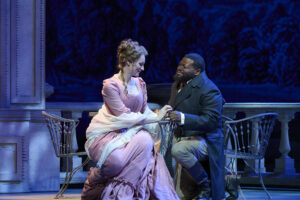
The biggest disappointment was Alain Gauthier‘s tepid staging. Though it was true to the opera’s libretto, it offered little insight. It felt like the typical opera of a half century ago, which, truth be told, appeals to a great many. Indeed, judging from the public’s reaction, most were thrilled with Gauthier’s conventional staging. However, given how dated the story is, it’s necessary to infuse it with some magic to make it palatable for modern audiences. When Goethe published his epistolary novel, it was all the rage and led to a wave of copycat suicides. To a modern audience, a straight telling of the overly romantic story can be sentimental sensationalism at best. At worst, it’s a boring, slow-moving story. Indeed, I have rarely felt time pass so slowly in any other production of this opera. This was especially true of the first two acts.
Olivier Landreville’s sets and Lëilah Dufour Forget’s costumes were appealing. Though transforming Albert’s home into Werther’s dwelling by moving the walls felt rather odd, especially that the furniture remained the same. The turbulent music connecting the third and fourth act is when Werther commits suicide. Usually, the intense orchestral music is played with the curtains down. Gauthier chose to have us witness the reenacted suicide instead, which was ineffective as well as poorly choreographed. When will stage directors learn that the unseen is more effective than the seen?
Other recent productions offered a critique of the conformism of the epoch, a caustic look at class structure, or tension due to Sophie’s secret passion for Werther. Here, it was a literal presentation of the eighteenth century tragic romance. The celebration of the pastor’s fiftieth wedding anniversary in the second act is often used to draw attention to undercurrent societal tensions. Here, Gauthier opted not to show the celebration altogether. The levity offered by this scene is necessary to contrast with the overly sentimental romance. This ill-advised choice added to the dullness of the production.
Other than the stunning Karkacheva, the most appealing aspect here was the orchestral accompaniment, important in Massenet, a major orchestrator maliciously dubbed “Mademoiselle Wagner.” Johannes Debus conducted the score with panache. Occasionally, the orchestra played too loudly. This was especially the case in the opera’s most dramatic moments.
Despite an ideal Charlotte and a great orchestra, this was a forgettable production of a great opera – and one that deserves better.