Washington Performing Arts 2025-26 Review: Danish String Quartet & Danish National Girls’ Choir
Premiere of David Lang’s ‘inn wildness’ (2026)
By Arnold Saltzman
Different music languages, 50 young voices and a string quartet merged into one for their final concert in the United States this season.
Two outstanding music ensembles, the Danish String Quartet & Danish National Girls’ Choir, presented an unusual staged performance, sponsored by Washington Performing Arts, in downtown Washington D.C. at Church of the Epiphany for a capacity audience. On the previous evening, they presented their program at Carnegie Hall.
The performance was presented as a connected program with entrance music and interludes between songs and compositions. In one case, Schubert’s “Death and the Maiden” (“Der Tod” and “Das Mädchen”) from string quartet No. 14 in D minor, based on Schubert’s song about a young woman seized by a personification of Death based on a poem by Matthias Claudius. This early Romantic Period music for a string quartet was a wonderful contrast in a program which featured contemporary music at its best.
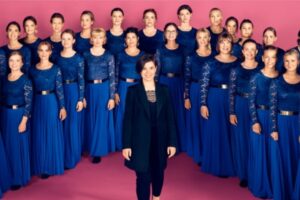
The choir made its impressive entrance down the center aisle of the Church of the Epiphany, on their way to the stage with a lead chorister carrying a deep blue train of cloth about 50 feet in length and looking very regal. This served sometimes as a frame around the Danish Quartet and sometimes as a stage prop, but also set off the lovely deep two-toned blue dresses worn by the girls’ choir.
The choirs’ sound was remarkable based on its pitch, vocal matching, clear vowels, and tone as well as unison within parts which was admirable and unforgettable. The choir’s conductor Charlotte Rowan gave clear direction, with perfect entrances and cut-offs, for lyrical singing, complex harmonies and rhythms. The chorus also exhibited great sensitivity to dynamics, and at times was very powerful, surprisingly. They were remarkable.
As part of the staging, the long blue cloth was rearranged and the chorus had directions to change position when varying their singing parts. This idea of movement and rearranging the chorus for “part singing” worked very well, creating visual interest which can sometimes be static in a choral concert. The girls are young women between the ages of 16 and 22. Noted in the program, conductor Rowan said “DR Pigekoret is both an invaluable communicator of Danish song tradition and one of the world’s leading girls’ choirs.” I’ll second that!
The opening work, Caroline Shaw’s “Partita for 6 Voices,” was performed by the entire 50 voice choir, using speech, and speech effects such as whispers and melodies without words. The effects were otherworldly. The music would work well with ghost stories or cinema. Its title indicates dance movements: Allemande, Sarabande, Courante and Passacaglia, yet one never sensed the dance itself. However, one may have been amazed by the clarity, coordination, direction, and complexity of the Pulitzer Prize award winning work. A challenge for any group, it was performed with great precision and effect in such a way as to win over those who yearn for the folk melodies which traditionally are also performed in concert by this choir.
The bookend to the concert and second half of the program was the premiere of David Lang’s “in wildness,” commissioned for this wonderful ensemble. Using texts from Henry David Thoreau and Hans Christian Anderson on the theme of walking in nature, the work had two distinct musical sections. The first with short, percussive like phrases to the poetic words of Thoreau, the last section using an ostinato played by the string quartet, over which the variations and harmonic changes are constant.
This was a challenging work performed well by these magnificent young singers, perfectly balanced by the Danish String Quartet, a tribute to their Royal sponsor, and to the value Denmark places on excellence in music. David Lang was in the audience and took several well-deserved bows
Of note, many of the arrangements were by second violinist Rune Tonsgaard Sørensen who made use of a slightly more traditional musical arrangement of Danish song, “Dronning Dagmar ligger udi Ribe syg,” and the Swedish traditional dance melody “Kisti du kom.” Other works included Icelandic and Finnish composers. Violinist Frederick Øland also played piano and a hand held drum. Violinist Rune Tonsgaard Sørensen, violist Asbjørn Nørgaard, and cellist Fredrik Schøyen Sjolin all deserve praise for their wonderful ensemble as string quartet, never overshadowing the choir, yet adding to the great energy, beauty, and musicality this program projected to its listeners.