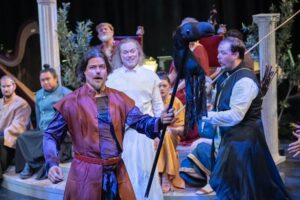
Shakespeare would be proud. Benjamin Britten would cheer. Pocket Opera must celebrate, for its production of Britten’s Opera “A Midsummer Night’s Dream” was a true success. Pocket Opera’s Chamber Opera Company, founded by Donald Pippin and now led by Nicolas A. Garcia, gave us all that delights and stirs in Britten’s musical version of Shakespeare’s famous comedy. At the Thomas Gunn Theater at San Francisco’s Legion of Honor, we had a splendid afternoon.
Britten’s opera is Shakespeare shortened with none of the essentials left out. Britten and Peter Pears reduced it from five acts to three and brought to it, in less than a year of creation, the light touch and magic that such a midsummer miracle required.
The musicians in this world-premier chamber orchestration by Liam Daly were set in the back of the stage, excepting the Act Two offstage brass. Diaphanous and transformative sound came from the violas, violins, cellos, harps, bass, percussion, oboes, English horns and flutes, piccolos, and keyboard. Conductor David Drummond kept it seamless and stunning. Britten’s highly textured score remained ravishing, giving us a sense of dreaming that never faded. The music ranged from a sort of silky magic with ascending and descending slides to mysterious tones coming from somewhere’s nowhere, which launched us into the fairy realm.
The production made use of modern technical knowhow without calling attention to itself. Trees were moved smoothly in and out of position, as was the bathtub. Tasteful and easy, amply defining and supportive, without being dominating or deterring, were the effective and attractive set designs by Daniel Yelen and the original and beautifully created costumes by Nicolas A. Garcia. The Thomas Gunn Theater at the Legion of Honor provided the perfect backdrop for the story at hand. It added to the immediacy of the production and harkened back to theaters of long-ago, its intimacy bringing the story more to life than the large halls of today. An audience of nearly 300 were comfortably seated on red plush seats, enclosing the jewel of a production.
Royals, rustics, and fairies were all there and in fine form. Directed by Nicolas A. Garcia, the entire 20-person cast slid through the extraordinary plot with care and understanding. Everyone was in their place at the right time. There was never any doubt about what was happening, although it was more than eventful. The lovers, lost from their rightful loves, kept the action going; the fairies made themselves quite at home with their mischievous pranks and activities; the rustics asserted their doltish charms with ease and impish skills. But it was not just a romp. The eye remained on the story: the havoc of mistaken identity, the societal mismatches, all with their concomitant laughter and compassion. “Fools we mortals be” was kindly said and lovingly received.
Oberon, sung by countertenor Kyle Tingzon, carried the plot from the top. His graceful presence, his warm and glowing tones, especially in the exquisite aria “I Know a Bank Where the Wild Thyme Blows,” set the tone of magic and mystery with luxuriance. His facial expression added a fine dimension to his vocal tone. So too did that of his Puck, Robin Goodfellow, spoken and performed by actor Atlantis Clay. He wonderfully animated his tone and action with deft movements and lively facial and body expressions. His character succeeded at drawing pure pleasure from his errant mistakes, as he doused the wrong eyes with Oberon’s potion. Tytania, played by soprano Chelsea Hollow, was a fairy queen with élan: imperious, provocative, and amiable. She brought to book her fairy attendants: Peaseblossom (soprano Kochavia Glaubach), Cobweb (mezzo-soprano Nina Jones), Moth (James Coniglio), and Mustardseed (soprano Ash Hurtado). Hollow’s coloratura contrasted wonderfully with Tingzon’s countertenor and Kirk Eichelberger’s bass, the latter in the role of Bottom. The encounter between Tytania and Bottom in the bathtub was musically and dramatically engaging, witty, and sensuous. The small ensemble, performed by soprano Daphne Touchais, mezzo-soprano Stephanie Feigenbaum, and Victoria Coniglio kept things running smoothly throughout.
Hermia (mezzo-soprano Leah Finn), Helena (soprano Ellen Leslie), Lysander (tenor Kevin Gino), and Demetrius (baritone Spencer Dodd) were the Athenian lovelorns. They were a quartet with quicksilver charm and conviction. Their voices remained clear and well-articulated, providing contrast and warmth. Each commanded their quadrant of forest territory with piquancy and conviction, whether it was for or against their lover. Their two musical quartets in each of the acts were well-executed, tucking into the whole spectacle with harmony and ease. Britten’s mastery of plot and music fit better than a glove here; they served as his expression of how love’s inevitable foolishness drives humans towards the extraordinary and transforms who we are and what we do into something “rich and strange.”
Of the Rustics, what can be said? From Bottom (bass Kirk Eichelberger) to Snug (baritone Josh Black); from Starveling (baritone Tony Delousia) to Snout (contralto Deborah Rosengaus); from Flute (tenor Erich Buchholz) to Peter Quince (bass Glenn Healy), all sang, pranced, and mugged until even Pyramus and Thisbe themselves must have been well and truly confounded. Bottom’s “when my cue comes call me” accented the genius of a writer who could capture sheer ridiculousness with such affection. As Queen Hippolyta (mezzo-soprano Buffy Baggott) remarked to Theseus (bass Bill Pickersgill) at the opera’s end, “I have never seen anything quite like it.” To be sure! Irresistible as Shakespeare himself must have thought the play within a play when he penned it, and as Britten and Pears themselves adapted it, good theater remains good throughout the centuries. Pocket Opera pulled it off with ease, exceptional skill, and delectable charm. Gratitude and high praise must go to the Pocket Opera company, whatever stage they grace, for the work of Director Nicolas A. Garcia.