CD Review: Mascagni’s ‘Zanetto’
By Bob DieschburgMascagni’s “Zanetto” does not fit squarely into any one category. Premiered in 1896, it is a one-act miniature with a late scapigliato sensibility—not unlike Alfredo Catalani’s “La Falce” (1875), or, for that matter, any of the soft-aesthetic, off-the-beaten-path operas of fin-de-siècle Italy. Significantly, Mascagni himself originally dubbed “Zanetto” a scena lirica—an anti-”Cavalleria,” one might say.
By all evidence, its storyline has nothing in common with Sicilian blood and thunder. Instead, it presents an episode of pseudo-Platonic, renunciatory love (not exactly the hallmark of Turiddu), involving the courtesan Sylvia and Zanetto, a poet—and Mascagni’s first travesti role.
Set just outside Renaissance Florence, the plot unfolds as follows: Sylvia, in her nocturnal garden, is struck by an existential sense of ennui; she has lost her ability to feel love… until Zanetto appears. Youthful, innocent, and naïve, he is in search of a notorious courtesan—yet Sylvia, so as not to corrupt him, conceals her identity. Zanetto moves on (towards dawn; note the moral tinge), and Sylvia, cured of her melancholy, exclaims: “Blessed be love, I can cry again!”
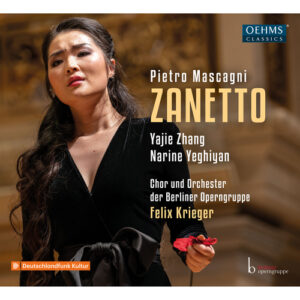
The impact, even after multiple listens, remains appreciable, though it is not nearly as cathartic as Sylvia’s outcry might suggest. “Zanetto”—on Oehms Classics—is a pleaser first and foremost. Its chamber scale makes it suitable for smaller spaces, rather than large stages, whose crowds it is unlikely to draw.
The reasons are manifold. For one, “Zanetto” is not built around arias or set pieces (save for the delicate “Cuore, come un fiore”); it is melodious, yet distinctive in its eclecticism and stylistic erudition, which notably includes a clin d’œil to Renaissance lute music.
Secondly, the comparison to “a miniature [exhibited] from a fourth-floor window”—voiced by Edoardo Pompei—still holds true. “Zanetto” feels like a lyrical vignette, and its emphasis on turn-of-the-century aestheticism represents both a strength and a limitation.
The opera opens with an a cappella chorus—an antecedent, perhaps, to the majestic “Inno del Sole” (from Mascagni’s “Iris”). It is rendered suavely by the chorus of the Berliner Operngruppe. Recorded at the Konzerthaus Berlin in 2022, the release exudes the latent thrill of a live performance—though the sound remains slightly subpar.
Enter Narine Yeghiyan as Sylvia: her timbre is silvery, and her phrases seem woven into the melodic fabric. Sensitive to every motion, she imbues her portrayal with emotional restraint, as if suspended within the orchestration’s inherent lightness or even transparency.
Yajie Zhang offers an equally delicate Zanetto, whose “Cuore, come un fiore” brims with Baroque echoes—harmonic restraint, continuo-like textures—supported by a highly disciplined legato. Her mezzo has admirable depth, though the middle and upper registers bear a striking resemblance to Yeghiyan’s Sylvia. This is not a drawback per se, yet it renders the performance somewhat harder to digest.
Readers will have noticed that my belief in “Zanetto” is far from unconditional. Still, Oehms Classics has produced an utterly commendable release that fills a gap in an otherwise sparse discography.