Washington National Opera 2025-26 Review: West Side Story
By Arnold SaltzmanThe fully staged production of “West Side Story” by the Washington National Opera (WNO) at Lyric Baltimore is an example of turning a disaster into a great success. Making a calculated and difficult decision, WNO decided to take the company out of the former Kennedy Center. Unlike City Opera in New York, WNO’s decision was a moral choice, not a fiscal one, as it would have been financially more practical to remain at the ‘Trump-Kennedy’ Center. Instead it has designed a season in the community that has lived up to its name as Washington’s National Opera.
Francesca Zambello, WNO artistic director, and Timothy O’Leary, general director and CEO, have been greeted with cheers and standing ovations at Lisner Auditorium, and now Lyric Baltimore, for their fully staged opera productions. WNO will also be adding the elegant Music Center at Strathmore, in Bethesda, Maryland, May 14-15, 2026 for a semi-staged production of “West Side Story.” The audiences have been so supportive, and they applaud everything the management has to say, even when they walk onto the stage. The result has been an enthusiastic response and support from donors, including Jacqueline Mars and David Rubenstein. The WNO is leading the world of opera in finding a future path to new audiences and successful productions.
“West Side Story” is a touchstone in American musical theater and modern opera. The music of Leonard Bernstein is secure in its beauty and avoidance of common musical cliché. Baltimore Symphony Orchestra’s music director laureate, Marin Alsop, conducted the 50-member WNO Orchestra. Maestra Alsop demonstrated in this performance why she is considered among the most gifted conductors, looking directly at the singers and giving strong cues to all in a complex work. She gave a strong and sensitive reading of the orchestral writing, which was at times chamber music and at times with the full orchestra, reflecting the gang war occurring onstage.
Bernstein’s orchestration in the first act is exuberant in youthful energy and crosses jazz with the orchestral violence of Stravinsky’s “Le Sacre du printemps.” The second half of the opera’s music has a lighter touch, reminding one of the ballets of Aaron Copland and Bernstein’s ballet “Fancy Free” (1944). It was thrilling to have Alsop leading this performance, especially since she is a protégé of Bernstein and like him, a veteran conductor of a great orchestra.
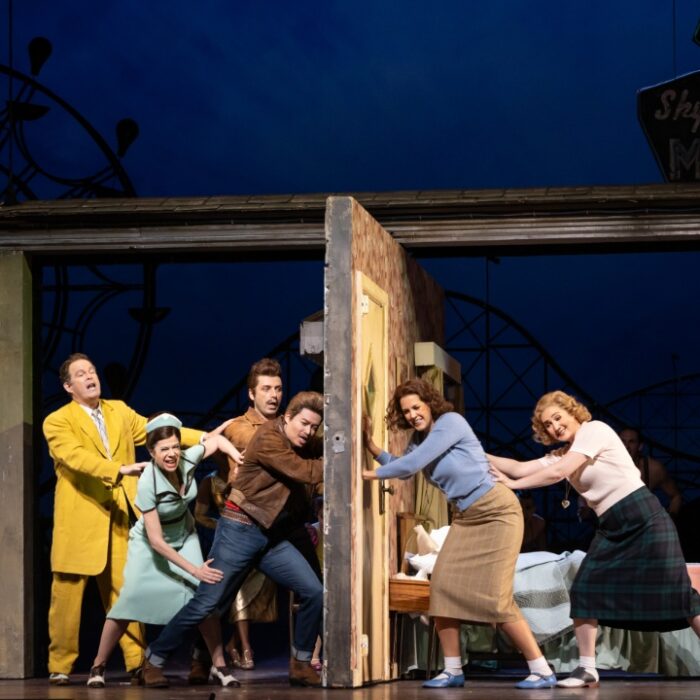
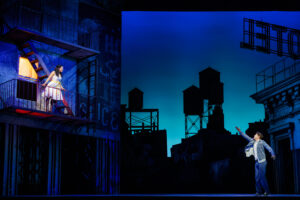
What happened onstage was nothing short of magic! The genius of WNO is they gave full support to this production. The sets included a Harlem skyline with water towers, a tenement with fire-escape and chain link fences – all with rich deep blue lighting or fiery red during the sunrise dance scenes – the dress shop interior, and a set that could swing open to reveal Anita and Maria’s bedroom. All contributed to making this an outstanding production. It was great set design, never stagnant, and at some points even eliciting a quiet gasp from the audience or applause as they appreciated this stagecraft.
The language coaching for the New York accents was authentic. The lines are so well known – “I know Tony, like I know me…” – that there might be groans upon hearing them again. Yet the language was done so well as to sound fresh and new. It did not draw attention to itself and kept us moving with lines we have known for decades. Part of the magic of this work are Stephen Sondheim’s lyrics. He was a person who could capture natural articulation, sentence structure, and nuance, and turn it into poetry in song. The story follows the general concept of Shakespeare’s “Romeo and Juliet.” Two families are at war, the Jets and the Sharks, as represented by these lines: “When you’re a Jet, you stay a Jet…” and “When the spit hits the fan, you got brothers around, you’re a family man. You’re never alone, you’re never disconnected, you’re well protected.” The rhythm of Latin American dance crossed with jazz runs throughout the work, such as in the high school dance scene with the shout “Mambo!” Mambo, with its origins in Cuba, was a genre of music that became popular in the United States in the 1940s. The orchestra was outstanding when playing the dance and ballet sections. This opera/musical is also a very strong work of ballet that was creatively secure with some new work by choreographer Joshua Bergasse as well as the classic work of Jerome Robbins – if there is a Hall of Fame for choreographers, he would take pride of place.
I love the Alto Sax in Eb solo at the beginning with alternating dissonant chords, mimicking the battle we are witnessing onstage between families, gangs, and cultures. There is a subtle (and perhaps not so subtle) mirror image of our current world, with its rejection and demeaning of ‘others’ while unjustly comforting ourselves with the mistaken belief that not all are created equal. Personally, I take issue with the stereotypical portrayal of the police as corrupt and stupid, although I accept that here that representation is done for humor. The reality is that there are many police officers who have also been racially or culturally profiled.
Vocal technique is very different for singers in a Broadway musical and for singers of opera. This cast of opera singers included many who have also sung in Broadway productions. The great vocal talent of Ryan McCartan was immediately recognized by the audience in his thrilling delivery of “Something’s Coming.” His vocal quality has both a fullness of tone and is easy and secure when going to the lighter, higher tessitura, without any breaks in the vocal line. One feels he is a star of this genre. Shereen Pimentel was a youthful Maria, singing and acting strongly, and occasionally revealing her fine operatic voice – which may be heading for the full operatic soprano repertoire. Her singing communicated the lightness and hope of a young Maria, and she was convincing in her acting. Outstanding performances were given by Amanda Castro as Anita; Taylor Harley as Riff; and Yurel Echezarreta as Bernardo. Zambello’s direction was spot on and a remarkable achievement.
Among the most powerfully emotional moments was the scene with Anita and Maria following the stabbing of her brother by Tony. The climax, following the revenge killing of Tony, was also moving, with the entire ensemble as witnesses to the murder. The youthful exuberance of young love and all its obstacles was so convincing that, like “Romeo and Juliet” or “La Bohème,” “West Side Story” remains as relevant and breathtaking today as it was on opening night at the National Theater in Washington, DC, in 1957.