Deutsche Oper Berlin 2025-26 Review: Das Rheingold
By Ossama el Naggar(Photo Credit: Bernd Uhlig)
Stefan Herheim’s take on “The Ring” promises to be an interesting one: original, irreverential and, most of all, not trying to shock for the sake of it. This is my impression based on “The Ring’s” first installment. The imagery and the cultural references are approachable and familiar to the average German operagoer: Loge, who dominates this performance, is portrayed as Mephisto, Alberich as Batman’s Joker, Froh as Liberace, and Mime is dressed as Richard Wagner himself. As shocking as this may sound, it felt natural and uncontrived.
Production Details
Without music, the opera opens to a group of downtrodden people with suitcases walking through a train station. A rundown concert grand piano is center stage. It will play an essential part in the staging. After a few minutes of silence, the public can decide who these people might represent: refugees, asylum seekers or perhaps a metaphor for humanity. One character – later revealed to be Wotan – sits at the piano to play the opera’s opening note. The introductory music of the Rhinemaidens induces the crowd to dance, perfectly choreographed to the music; they gyrate and twist quasi-erotically, and eventually disrobe to their undergarments. From the crowd emerges three women, The Rhinemaidens, and a shabbily-attired man dressed as The Joker. The latter turns out to be Alberich. The Rhinemaidens taunt Alberich more aggressively than in most productions by performing a striptease. Once each is done teasing him, they perform sexual acts with various men in the crowd. This shocked some but mere teasing is too mild for most modern sensibilities, especially in the context of what appears as a violent setting (the crowd resembles refugees, indicating an ongoing war or dramatic event).
When Alberich seizes the ring from the Rhinemaidens he takes to the concert grand piano. In the present staging, being seated at the piano is an act repeated by various characters when they are the focus or when narrating. Also, the piano’s belly is regularly used as the vessel through which characters make their appearance or exit. Another of Herheim’s prominent leitmotifs is the piano score of “Das Rheingold.” It’s used to support the narration or to instill an air of spontaneity, as if the protagonists were sight reading. The idea of the piano and the score are possibly a reference to the act of creating. Also, it may refer to Wagner’s first public performance of parts of the Ring Cycle on piano. Herheim had previously used a bed as the central focus of a 2008 staging of “Parsifal” for Bayreuth. The piano seems to parallel the bed in “Parsifal.”
The descent to Nibelheim is achieved through the piano. As suitcases are the building blocks of this production, there was little contrast in the scenes except that Nibelheim was dimly lit. Unfortunately, there were no original devices for the transformations of Alberich. However, the amusing touch was to have Mime dressed as Wagner. The dwarf was also empowered for he jumps out of the piano and hits Alberich on the head with a hammer just in time, before his nasty brother could free himself of Wotan and Loge.
The giants dressed as hillbillies were quite effective. They too appeared with Freia through the piano. The fair maiden was laid in the piano’s belly, but the measurement using Nibelheim’s was not exactly clear or understandable.
Once Freia is liberated, there is no Walhalla seen in the horizon, though earlier the giants seemed to have built it using the suitcases of the downtrodden seen carrying them at the start. This bothered those wishing for a visually literal or understandable depiction of Walhalla. The passage to Walhalla was also a virtual one, which diminished the solemnity of the opera’s glorious finale. Alarmingly, Herheim seemed to run out of ideas (or gimmicks) toward the end of the opera.
In addition to several stimulating staging ideas, the cast members were overall excellent and well-suited to their roles. Unlike most post-Mozartian operas, “Das Rheingold” is an ensemble piece rather than one centered around a loving pair or a love triangle. All the roles are significant, which makes “Das Rheingold” unique, especially in Wagner’s oeuvre.
Like other directors before him, Herheim emphasized the preeminence of Loge in the opera. After all, he is the instigator of much of the plot (he devises how to steal the gold from Alberich). Instead of making him effeminate as some directors have, he is in the image of Gustaf Gründgens’ Mephistopheles. Gründgens (1899-1963) was a prominent German stage actor, celebrated for his portrayal of Mephistopheles in Goethe’s “Faust,” who continued to enjoy a brilliant career during the Nazi regime. Hungarian filmmaker István Szabó made his 1981 film “Mephisto” about this controversial actor’s Faustian bargain with the Nazi regime.
Stellar Cast
Belgian tenor Thomas Blondelle gave one of the most electrifying portrayals of Loge, emphasizing the demigod’s craftiness and untrustworthiness. Until recently, Blondelle has specialized in character roles, such as Valzacchi in Christoph Waltz’s “Der Rosenkavalier” in Geneva in 2023 and Baron Lummer in Tobias Kratzer’s production of “Intermezzo” in Berlin last season. He has started taking on bigger roles as of last season. Indeed, Blondelle channeled Gründgens’ Mephistopheles so remarkably that the cynical character haunted one’s imagination that night and the following day (so far). He also managed to imbue an aspect into his usually pleasant voice that made him sound appropriately annoying.
Scottish bass-baritone Iain Paterson is one of today’s leading Wotans. Admired two seasons ago as Kurwenal in “Tristan und Isolde” in Vienna, Paterson’s voice is diminished compared to earlier days. Last year, he was a pale Wotan in Vienna’s Ring Cycle. What little is lost vocally is more than compensated for dramatically. As Herheim’s staging is more derisive of Wotan than most, Paterson‘s weakened vocal prowess was appropriate. This may work in “Das Rheingold,” but one wonders how Paterson will fare in the much more vocally demanding “Die Walküre.”
German Mezzo Annika Schlicht was a superb Fricka, both dramatically and vocally. Given the matronly character of Wotan’s wife, the role is often given to mezzos past their prime who overplay Fricka’s domineering nature. Schlicht has an admirable instrument and needs no histrionics to cover any vocal shortcomings. Endowed with considerable charisma, Schlicht played Fricka as an entitled self-centered wife of the villinaous leader of a clan. Indeed, the rest of the family members were played as equally rotten characters. More than Froh and Donner, her attachment to Freia was more due to needing rather than loving her.
More Cast Highlights
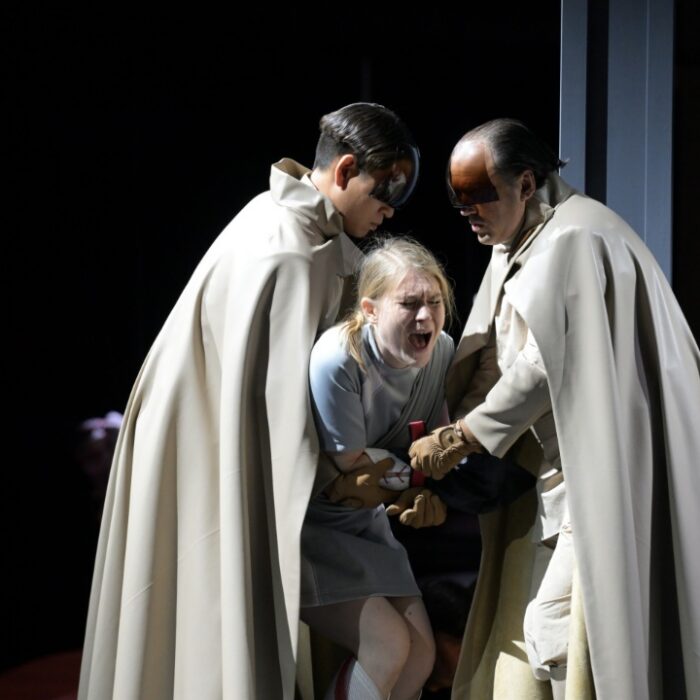
All the secondary characters acted and sang well. German lyric soprano Martina Welschenbach was a luminous Freia. Her beautiful, youthful voice was a perfect fit. Her bright soprano contrasted pleasantly with Schlicht’s powerful mezzo. However, Herheim, keen on humour, made her look and act like the politically incorrect “dumb blonde,” which was gratuitous.
Heard a decade ago as one the Valkyries (Schwerleite) in the Chicago production of “Die Walküre,” Lauren Decker impressed with her warm contralto as Erda, despite the brevity of the role.
Albert Pesendorfer as Fasolt and Tobias Kehrer as Fafner were portrayed as American rednecks straight out of the film “Deliverance” (1972). Kehrer was an impressive Orest in “Elektra” last season in Berlin, and Fafner at last summer’s Bayreuth Festival. Both basses possess beautiful warm voices, yet they are able to sound quite different with Pesendorfer sounding kind in contrast to Kehrer’s gruff Fafner.
A brilliant interpreter of Leporello in “Don Giovanni” in Munich last season, bass-baritone Michael Sumuel is a versatile singing actor who perfectly portrayed the evil Alberich. He seemed to revel in the character’s cruelty, whether harassing the Rhinemaidens or surveilling the Nibelungen. Though he did not overdo the “cruel” dwarf bit, he managed to be quite detestable and did not elicit much pity.
Taiwanese tenor Ya‑Chung Huang brilliantly conveyed Mime’s terror of his bullying brother, Alberich. Herheim chose to introduce some levity by dressing him as Wagner, an ironic touch as Mime has often been thought of as Wagner’s stereotype of “The Jew.” British-German tenor Kieran Carrel’s portrayal of Froh was more entertaining than most as he was dressed as Liberace and acted accordingly, bringing another touch of (politically incorrect) humour to the opera. Of Wotan’s clan, he seemed the most attached to Freia. American baritone Thomas Lehman was a comparatively tame Donner, dressed as a lacklustre Elvis impersonator. His attempts at ostentatious virility fell flat, another touch of humour by Herheim.
As for the Rhinemaidens, they were the most spirited I have ever seen, in part due to the burlesque act. They were also among the strongest vocally, especially Lea-ann Dunbar, a bright and powerful soprano, as Woglinde.
Further Thoughts
Donald Runnicles’ masterful conducting was most impressive. The British conductor never indulged himself into producing a huge “Wagnerian” sound, of which his orchestra is more than capable. Throughout, Runnicles made sure they didn’t obscure the singers, but he gave them free reign in the orchestral passages. Like the singers’ portrayal of their characters, the musical direction felt organic, yet afforded a magical dynamic range to Wagner’s masterful orchestration.
As enticing as this “Das Rheingold” is, one is still lost for answers to Herheim’s symbols and devices: the “refugees,” the suitcases, the concert piano and the score. Hopefully, these questions will be answered satisfactorily in the upcoming three installments of the cycle.