Cathedral Choral Society 2026 Review: Of Love & Spirit
American Choral Composers & Johannes Brahms’ ‘Liebeslieder Waltzes, Op. 52,’ led by Steven Fox, Music Director & Conductor
By Arnold Saltzman(Photo: Cathedral Choral Society)
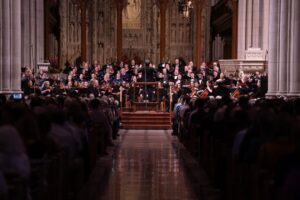
For their final concert of the season, Cathedral Choral Society of Washington and their music director, Steven Fox, offered two concerts within a concert: “Of Love.” This refers to Johannes Brahms’ “Leibeslieder Waltzes,” and “Of Spirit,” including works of the spiritual tradition, belief, and promise of America, along with just fun in singing and in music.
A highlight of any concert at the Washington National Cathedral in May during the evening is the opportunity to appreciate the stained glass windows at the best time of day in order to enjoy the artistry, filled with color in dozens of these windows, including the Rose Window at the entrance to the Cathedral.
Near the entrance is a life size sculpture of President Lincoln by Walker Hancock, next to Lincoln’s farewell address to the city of Springfield, and this work is part the mood of this great Cathedral, one of reverence and appreciation.
In that regard the music selections by the Cathedral Choral Society were an affirmation of American beliefs fulfilled and unfulfilled in honor of the upcoming 250th Anniversary of the Declaration of Independence. This first half of the program was dedicated to American composers of Spirituals – Larry L. Fleming (1936-2003), “The Promise of Living” by Aaron Copland (1900-1990) among the most influential composers of the 20th century, with libretto by Erik Johns (1927-2001). Selections from “Credo” by Margaret Bonds (1913-1972), and contemporary composer Michael Abels (b. 1962) “Anthem” and “Ode To Harmony” rounded out the program.
The opening “Three Songs About Jesus,” arrangements of Spirituals, set a prayerful tone, with lovely singing by silvery voice soprano soloist Chelsea Helm. The choral arrangements were effective and while subdued, yet they delivered the prayerful emotional message and interpretation by this fine chorus.
Copland’s opera “The Tender Land” connected well with the chorus in both its original musical voice, and has the benefit of a meaningful libretto by Erik Johns. Beautifully sung – the words are universal:
…Let’s sing our song with our hearts
and find a promise in that song:
The promise of living,
The promise of growing,
The promise of ending is labor
And sharing our loving.
Margaret Bond’s music is appearing on many programs these days. The two movements of “Credo” set to the words of W.E.B. Dubois “became a touchstone of Black intellectual and spiritual life in America.” The musical setting matches the power of the text, and the chorus delivered this amazing work with full throated passion. Baritone Jason Widney demonstrated a smooth vocal line, with sensitive delivery and vocal power when it was needed. The text: “I Believe in Liberty…the right to breath and the right to vote…for all men.” And “I Believe in Patience…patience with God.”
A real surprise for the program were two selections by Michael Abels (b. 1962: “Anthem” (From Us) and “Ode to Harmony.” These compositions were well written and performed with great enthusiasm and humor. “Anthem” is dedicated to choral warm ups as its text is exactly that “Do mi na vi ri fo sa ci…” Ever wonder how a chorus improves their sound, consonants and vowels? This type of selection is meant to parody how it is accomplished. With a great sense of humor that the Choral Society clearly loved, “Ode to Harmony” had the humorous interplay of sections asserting their superiority and then for the sake of harmony “we’ll preserve the harmony.” Every emotion and dissing of the other voices were included and enjoyed, while ending on the words “Finally, no more compromise!”
This was a joyful and welcomed ending to the first half of the program “Of Spirit” with the featured work, the Brahms’ “Liebeslieder Waltzes,” next in the program.
The poems of Georg Friedrich Daumer (1800-1875), and in the program notes, English translations by Richard Stokes, are the inspiration for Brahms beloved “Liebeslieder Waltzes.”
Here we have a collection of Lieder, arranged for chorus, contrasted with soloists in groups or as soloist, singing settings of short poems set to waltzes. In some ways these resemble the form of a Bach cantata, nevertheless the music is purely Brahms’ setting of love poems.
Brahms is among the great lieder composers, and here we have the interesting idea of a song cycle of solo voices alternating with choral settings of love poems.
Prior to composing the “Liebeslieder,” Brahms had worked on creating a new edition of Schubert’s “Landler” dances. The program notes by Steven Fox indicate “one hears the intimacy, charm, and immediacy of word painting in the Brahms songs, just as we do in Schubert’s lieder.” Like Schubert’s song cycles, this work expands that concept with contrasting chorus, smaller ensembles, and soloists.
Even with the difficult acoustics of the National Cathedral, the singing set the mood which was consistent and reflected well on the meaning of the text. During the second section “The wildly lashed waves” the tenor section had a particularly good blend. This was followed by soloists singing “O women, how they delight the heart! I should have long since turned a monk if not for women!” Tenor Matt Hill and bass Gilbert Spencer demonstrated fine, rich voices which carried well in the Cathedral.
This was followed by “Like a Lovely Rose” sung by soprano and silvery voiced Chelsea Helm and Rachel Hahn, whose voice radiated warmth and firmness. There were moments when the choral singing reminded one of the great Brahms’ Requiem.
In No. 5 “Die grüne Hopfenranke” (The green tendrils of the vine) there is a sense of blossoming in the music. Throughout the performance collaborative pianist Joy Schreiber was especially supportive, never overwhelming the singers, while being dynamically astute in her interpretations.
No. 8 “Wenn so lind dein Auge mir” (When you gaze at me so tenderly) is a tender waltz, my favorite among the settings, while contrasted with the full chorus response following the trio section, with fine blend of voices between the tenors and basses.
No. 11 “Nein, es ist nicht, auszukommen” (No. It is not possible ‘to put up with these people’) demonstrated the passion and power of the chorus in its rhythmic drive and pianissimo contrasted with double forte. Some of the best solo singing of the evening came from Matt Hill, tenor, who has a fine voice for lieder and is a real find vocally.
Throughout the program, Maestro Steven Fox’s, conducting elicited fine singing performances from one of the best choruses in the United States.