La Monnaie 2025-26 Review: Medusa
Claudia Boyle’s Compelling Portrait Turns The Gorgon Into A Victim
By Alan Neilson(Photo: Simon von Rompay)
Anyone fortunate enough to have been present at La Monnaie for the world premiere of Iain Bell and Lydia Steier’s “Medusa” would have left the theater with little doubt that communing with the gods of Ancient Greece is something that should be avoided at all costs. To say that they are an egotistical, self-serving bunch of hedonists that views anyone or anything else as a mere plaything is an understatement. In this telling of the Medusa myth, the gods’ utter contempt and wanton cruelty are played out in the most bold and brutal terms, in which they are exposed for the psychopaths they are.
A Strong Presentation of the Medusa Myth
That Medusa was a hideous monster with snakes sprouting from her head is well-known, as is the fact that one glance of her face was enough to turn a man to stone. Many men came to slay her, only to find themselves turned into grotesque statues, until the hero Perseus, supported by the gods’ favor, arrived on her island. Using his shield to capture her reflection, he was able to locate and decapitate her without having to look directly at her. There is, however, far more to her story. According to Ovid’s telling of the tale in his book “Metamorphoses,” Medusa was originally a beautiful young woman who had the misfortune to attract the unwanted amorous attentions of the sea god Poseidon, who pursues and rapes her in a temple dedicated to the goddess Athena. Outraged by the incident, the goddess responds by condemning Medusa to a life of eternal torment by transforming her into a monster with snakes sprouting from her head that no man will ever be able to look upon again without suffering death. Significantly, she attaches no blame to Poseidon.
Thus, by including her backstory, Steier transformed Medusa from a hideous, evil creature into a sympathetic, even tragic, figure, which she reinforced by adding her own twist to the tale in Medusa’s final confrontation with Perseus. And to hammer home the full horror of the events, Steier ensures that the rape is portrayed in the most graphic terms possible. There was no attempt to put a gloss on Poseidon’s actions; he is in full control of his behavior, and although his actions are unambiguously violent, he shows no emotional excess. For him, this is just normal behavior. The language he directs towards Medusa is equally violent; it is vulgar and coarse. When he has finished, he walks casually away, unmoved by his what he has done and that he has left Medusa abused, terrified and humiliated.
The rape followed by Athena’s retribution brings the first act to a climactic ending, leaving the audience to digest its full horror during the interval.
Act two begins with the transformed version of Medusa walking among the petrified remains of the assasins that had come to her island to kill her. Accompanied only by her two sisters, she spends her time watching the seas for the arrival of new victims. It is at this point that Perseus, the man destined to kill her, enters the scene, which Steier uses to drive the narrative in a different direrction. Rather than simply decapitating Medusa, Perseus is moved to feel sympathy for her isolation and the fact that she will never bear another child or feel the touch of another man, while Medusa responds by encouraging him to kill her and free her from the torment she is destined to suffer for eternity.
The myth was thus transformed; the monster that is Medusa becomes a victim of the gods, a tragic figure whose only sin was to have crossed paths with a powerful individual who refuses to restrain his desires, and for which she is subsequently punished ands with her taking her own life. It is a fate that will be played out many times over the centuries by women who have been similarly violated and then blamed and punished. Thus the myth becomes reality.
Steier’s Staging Combines Seemlessly with Delanghe’s Musical Direction
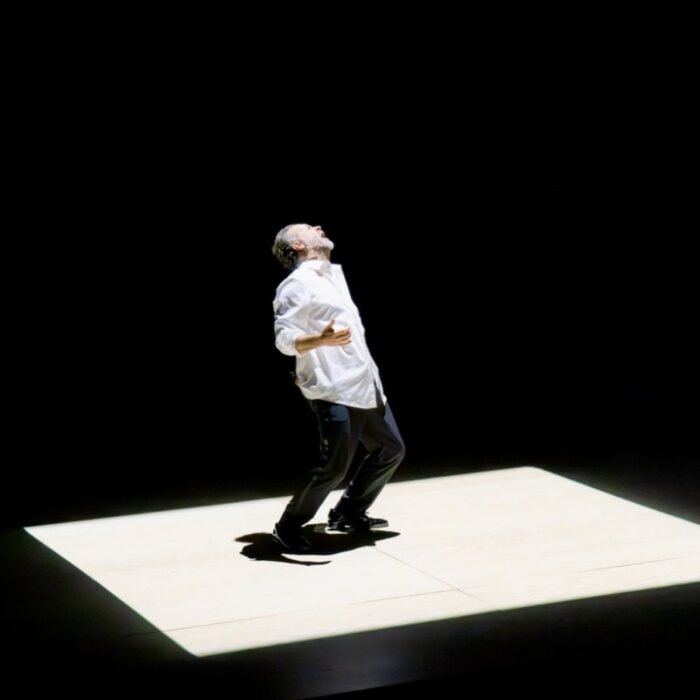
Having written the libretto, Steier was perfectly placed to undertake the stage direction and, with scenographer Flurin Borg Madsen, costume designer Katharina Schlipf, and lighting designer Elana Siberski, she created a reading that brought out the menace, anxiety and sense of dread under which Medusa lived out her life. There was nothing airy or light, just a heavy darkness. Only Poseidon, who went about his business confidently and nonchantly, seemed immune from such concerns.
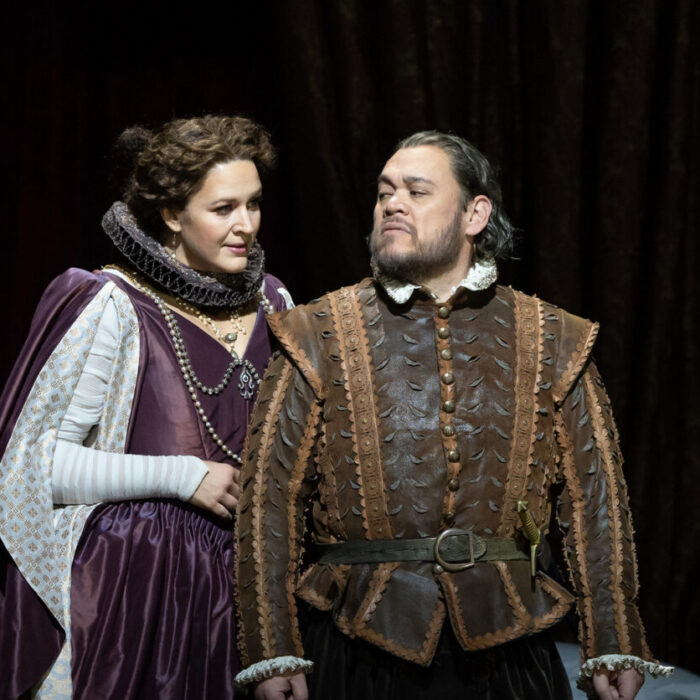
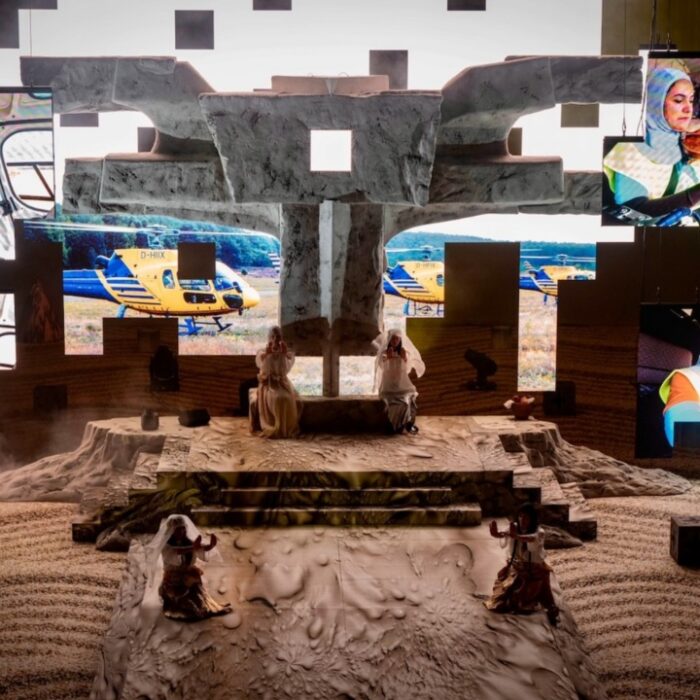
The stage for the most part consisted of two large blocks that moved to close or open up the space to create varying degrees of oppression and confinement. A metal scaffold was used by ghoulish creatures, who moved around its frame at various points, which successfully added to the unearthly atmosphere and sense of horror. Schlipf’s costumes were expertly created to magnify the effects. Medusa’s sisters, Euryale and Stheno, wore black, 17th-century dresses that provided them with a gothic appearance that contrasted meaningfully with Medusa’s initial simple white dress. Medusa’s transformation found her attired in an ugly-looking, body-hugging costume, deliberately designed to degrade Medusa’s humanity with snakes caked into her hair. The atmosphere of each scene was sensitively molded to enhance Medusa’s fears and trauma. The temple scene, for example, had the chorus of priestesses carrying gorgoneia masks, which they sometimes raised to cover their faces, while Athena strode onto the stage dressed in a dominating costume that had her standing at least three meters tall, allowing her to look down on the cowering Medusa, as she harangued and abused her for her disgusting behavior. There was nothing at all to relax or to comfort the audience. It was a hard-hitting, emotional, gut-wrenching drama in which the pain inflicted by the guilty went unpunished and innocence suffered in extremis. Only Medusa’s death, which was in effect a suicide, brought a degree of relief.
Iain Bell finely tuned his score to reflect every twist and turn of the drama, brilliantly conjuring up the heavy atmosphere, fear and horror while supporting each character’s inner struggles or, in the case of the gods, their unfiltered emotional reactions; his use of a wide orchestral palette was expertly employed to create layers of heavy dark colors. There was an ever-present fear of violence and sense of foreboding baked into the fabric of the music, in which his imaginative use of percussion was notably prominent, as was his writing for the chorus with its background murmuring that suggested evil was at hand. Yet, there was also beauty; some of Medusa’s melodies, in particular, had an attractive sheen despite their subject matter, perfectly illustrating how beauty can be found even in the darkest tragedy.
The conductor, Michiel Delanghe, elicited an emotionally exhausting and detailed reading from the Orchestre Symphonique de la Monnaie, in which his management of the rhythmic urgency, pace and tempi were expertly and sensitively molded to meet the demands of the staging. His ability to build and relax the tensions, to intensify and diminish the manacing atmosphere, and to drive the drama forward was instrumental to the performance’s success, and the detail and clarity that he was able to bring to his interpretation allowed the textural quality of the score to be fully revealed.
Boyle Leads A Excellent Cast with an Outstanding Performance as Medusa
It was a stellar cast that took to the stage, all of whom put in compelling performances, not least soprano Claudia Boyle, who, cast in the title role, was outstanding. Her identification with Medusa was total; every utterance was heartfelt; you could feel the full depth of her pain and suffering to the point that her need to die seemed natural. Medusa is a very demanding role, emotionally, physically and vocally, requiring a high degree of expressivity, leaps and endurance, and by the end of the evening she appeared exhausted. Her characterization was convincing, layered and detailed, and her interaction with Poseidon during the rape scene was horrifying and painful to watch. One could only feel an intense sympathy for her character.
As for Poseidon, bass Konstantin Gorny could not have created a more dislikable figure. The fact that he was brutal, yet largely emotionally detached, made him psychopathic. His deep, authoritative voice added to his powerful demeanor and sense of control, which he deliberately used to terrorize Medusa during the rape.
Medusa’s two sisters, Euryale and Stheno, both provide a supportive role and attempt to protect her from Poseidon and the men who come to the island to kill her. Although both suffer severe anxiety, tormented by the threat that hangs over their sister, they have developed very different relationships with her.
Mezzosoprano Paula Murrihy, playing the role of Euryale, was the more attentive. Using the warm colors of her vocal palette, she offered her comforting support where possible but was so overcome with anxiety and fear that she inevitably suffered extreme emotional outbursts, for which she displayed considerable vocal versatility and expressive force as she pushed her voice towards its upper limits and engaged in audacious leaps and wide dynamic contrasts.
Stheno, played by soprano Angela Denoke, by contrast, was a very anxious woman, tormented by her own fears, and who found it difficult to express her love and compassion for Medusa. She was more demanding and insistent on how Medusa should be protected, which made her appear somewhat uncaring and less accommodating to Medusa’s own desires. She was often carried away by her own anxieties, in which she would would push her voice towards its limit in brilliantly crafted passages riven with stress, insecurity and even aggression. Yet such was the sensitivity of her expression, the underlying feelings of sympathy she felt for Medusa were never far from the surface.
Tenor Josh Lovell, cast in the role of Perseus, emerged from the mist that covered the stage, searching for the monster Medusa, in true heroic sytle, and like any hero worth his salt, his singing was assertive, secure and confident, successfully capturing his character’s fearless determination. His change of heart on meeting Medusa was sensitively portrayed so that his forced killing of Medusa becomes an unwelcome task, one that requires Medusa’s active collaboration in an act that undedrlined the tragedy of Medusa’s life.
Soprano Anu Komsi produced a strongly defined, energetic portrait of the High Priestess of Athena’s temple, whose commitment to the goddess was total. When it became clear that she had failed in her duty to protect the temple and its flame and must thus be punished, she quickly descended into a state of hysteria. And it was quite a show! Employing her vocal skills to the full, she served up a terrifying display of madness, in which her senses appeared to have completely deserted her.
The most impressive visual statement was made by soprano Mary Elizabeth Williams, essaying the role of Athena; she moved smoothly and slowly onto the stage, dwarfing all around her, including the female chorus, who recoiled in front of her intimidating, imperious presence. Everyone was propelled into a state of terror. Williams slipped into the role perfectly, her voice cutting through the orchestra with ease and dominated all around her. For sure, she was no benign goddess; she dispensed her cruel justice without mercy or care and displayed no sympathy for Medusa’s plight.
Mezzosoprano Marie-Juliette Ghazarin, cast in the small role of Danaë, mother of Perseus, made a very strong impression with the irresistible beauty of her singing.
The female chorus, as priestesses of the temple, sang with vigor and feeling. Visually, they made an excellent impression with their long golden robes and gorgoneia masks. The male chorus was less involved, restricted to a few murmurs, but was still able to impose their presence on the performance.
“Medusa” appeared to split the opinion of the audience. However, for those with a strong enough constitution to sit through the horrific rape scene and engage with the length of certain scenes that some felt were too long, this was a powerful opera. It was a dark, menacing drama with a strong atmospheric score that explored very powerful emotions. It also dealt with an issue that is as pertinent today as it was in Ancient Greece: throughout the centuries women have had to suffer being accused of being partially or fully responsible for their own rape, while the male perpetrator walks away free and without guilt, with the women left to suffer the devastation of a trauma that can lead to some taking their own lives.
It is to be hoped that revivals and new productions are already in the pipeline; it is a work that deserves to be seen again.