The Atlanta Opera 2025 Review: Semele
Dionysiac Sex and Death, Bathed in Apollonian Light
By Benjamin Torbert(Photo credit Raftermen Photography)
The Atlanta Opera (TAO) closed their 2024-25 mainstage season with Georg Frideric Handel’s 1744 semi-oratorio, or quasi-opera, “Semele.” General Director Tomer Zvulun structured the season around art’s transnational commonplace, the Hero’s Journey. But interestingly, all four works selected also play with genre and they address the nearly unanswerable question, ‘what is opera, anyway?’ They began with Mozart’s “Die Zauberflöte,” a singspiel. Second came Verdi’s screwiest opera, “Macbeth” — an opera, certainly, but one which seems to gaze in three or four directions down different paths of opera’s subgenres. The third installment of TAO’s 2023-26 staging of “Der Ring des Nibelungen” arrived with “Siegfried,” composed at a time when Wagner had taken to calling his operas by the label ‘musikdrama.’ And finally, “Semele,” which Handel specified to ‘be perform’d after the Manner of an Oratorio.’
Polyphonic choruses aside, Zvulun’s production makes a theatrical case for “Semele” as opera. Zvulun’s production notes that, while almost all operas engage with the art form’s ‘two most persistent concerns, sex and death,’ rarely is that presented quite as elementally as in “Semele.” This is an operatic modus operandi as well. This staging premiered a decade before at Seattle Opera, and its airy projections, elegant lines, and vibrant colors give the viewer so much operatic eye candy that the “Messiah” and “Judas Maccabeus” depart the mind entirely.
But hark, the heav’nly sphere turns round
This production might be considered a sort of counterpoint to the style of David McVicar. That esteemed director has placed about 13 stagings in the loose collection that might be considered the ‘longitudinal repertory’ of New York’s Metropolitan Opera: those productions that may or may not appear in a given season but have not been replaced by a different staging of the same work. Most of them look similar, and if you have seen several, you may call to mind several visual signatures. Firstly, McVicar champions astonishing physical verticality. His sets, whether his own or in collaboration, are tall. He employs space above the stage for architectural detail and other eye-grabbers, often stretching all the way up from the floor. His “Médée” comes to mind, especially during the hypertheatrical death of Glauce in Act Three: in 2022, Janai Brugger expired on an absurdly long blood-soaked bed beneath an equally stretched vertical reflection, surrounded by skyscraping square columns. At the finale, Sondra Radvanovsky’s Medea threw herself upon her dead children’s funeral pyre, the scene projected above her by a huge mirror. You can experience that production at Lyric Opera of Chicago this October. Act Two of his “Tosca” also reaches the Met’s fourth or fifth or storey despite the paradoxical claustrophobia of Baron Scarpia’s office. Secondly, McVicar’s lighting designers, such as Paule Constable and David Finn, leave the stage mostly in near darkness yet afford the singers rich light. Colors tend towards the darker ends of their own spectrums, especially the reds. McVicar’s productions are tall, dark, and handsome.
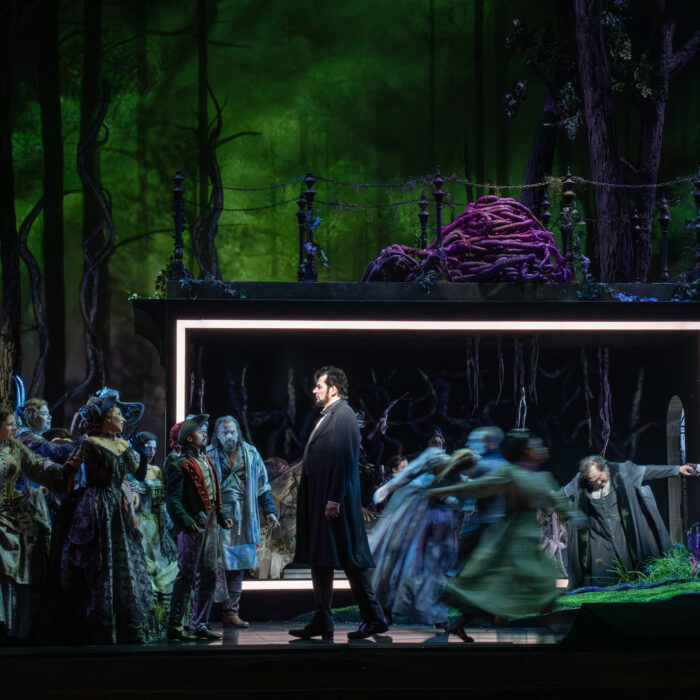
Zvulun’s “Semele” is tall, too, stretching far above the surface of the stage, but where McVicar encloses and entraps lanky spaces with darkness, Zvulun aerates them. Light floods the stage, even in Somnus’ ‘nightclub’ in Act Three, which is suffused with dark blues. This production seems almost as though it would levitate. All three acts dazzled the eye, often reflecting the music. As directed by conductor Christine Brandes, the overture sounded like that of “Messiah” for a few bars, before Vivaldian ‘columns’ of sound rose from the pit as mists ascended on the fore-scrim. Lauren Snouffer’s stationary Semele received a spotlight behind, looking less like a marble statue and more like a porcelain figurine. Zvulun and his lighting and projection designers — Robert Wierzel and Erhard Rom in this production — kept it constantly moving. As the scrim departed, replacing relative darkness with light, cumulus clouds populated an arctic blue sky behind two modernist architectural diagonals: the initial reveal lasted less than a minute. Then sky and stage darkened as the chorus swarmed and encouraged Semele, spotlit and now downstage left, to participate against her will in a wedding to Athamas (‘Lucky omens bless our rites’). We lack space to recount each of these transitions spanning a two-and-a-half hour show, but as in TAO’s recent “Siegfried,” each change in lighting or new projection proceeds fluidly from its antecedent. By the end of the act, when Snouffer was reinstalled on a ledge behind the scrim for her aria anticipating her date with the sky god (‘Endless pleasure’), she was encircled by a massive pink rose.
Where’er you walk cool gales shall fan the glade
Act Two Scene One opened with a stage-filling Mount Olympus on the scrim fronted by a transparent close-up of Snouffer’s face, especially her eyes. But that image zigged while the audience headed down a contrasting zag with the curtain rising: a spare throne room for Catherine Martin’s Juno backed by screens with art-deco-esque lines and bathed in heirloom tomato-orange light. Gigantic projections of Jupiter and Semele in bed reinforced her rage at Iris’
report of their assignation. Scene Two returned to the first act’s set, now with Semele’s’ ledge removed and the nuptial firepit downstage right replaced by a concubinal bed, a sweeping white curtain revealing Olympus’ snowy heights. The mega-rose returned for Semele and Jupiter’s time in bed. At the act’s close, Semele and Ino’s duet unfolded as they regarded a supersized full moon and starry sky in place of the mountain. An even larger planet earth, rotating and consisting mostly of oceans then replaced the moon. Act Three began with Somnus, sacked out on his patent leather sofa in his ‘nightclub and lounge’ in front of the curtain. The main set returned for Semele’s death and apotheosis, but with a 15-foot flat screen bearing a projection of the smaller mirror Ino gave her to admire herself. Another image of her face in orgasmic delight landed on the swoopy curtain stage right.
All the sets, in each variation of them, contributed to an understanding of why Semele would run off with the sky god — a desire for the beauty of the heavens, yearning for the infinite. Though Apollo’s short tenor role is cut in this version, and though Semele gives birth to his antithesis Dionysius, this Semele appeared sexually attracted to Apollonian light.
Myself I shall adore if I persist in gazing
Not a single visual element missed the mark. That extended to Vita Tzykun’s costumes and Joyce Degenfelder’s makeup and wigs. Snouffer’s titular character got the most varied kit. Her first costume telegraphed that happily-ever-after with Athamas was not in the cards, a white veil and a wedding gown with a white skirt… beneath a black bodice. For the ‘Endless pleasure’ sequence, as her voice bloomed, she complemented the pink mega-rose with an armless garnet gown, frills fluffy, the top framing her décolletage and face like flower petals. In Act Two, mattress time with Jupiter brought a champagne negligee and black choker in the form of a butterfly. And finally, in Act Three, Semele met her reward in a peach halter dress with cinched waist. Strawberry blonde ringlets cascaded about her back.
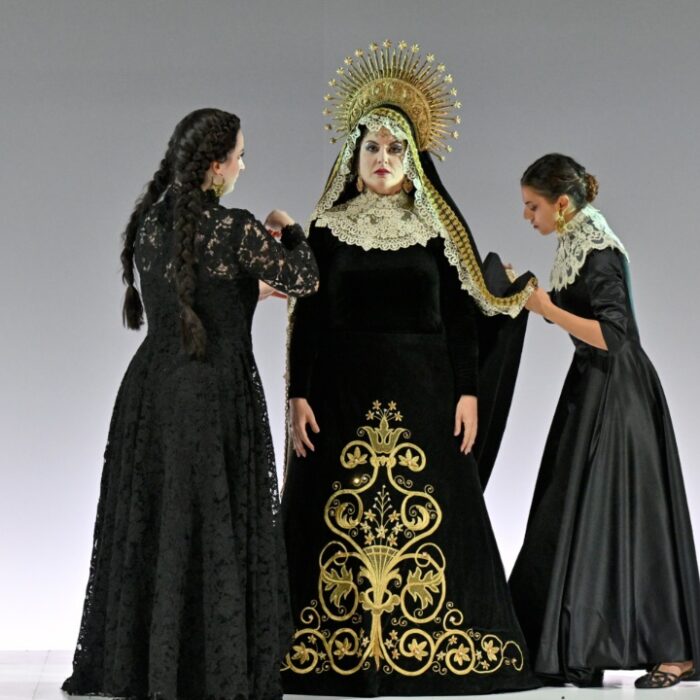
Your reviewer’s gaze stayed mostly with the soprano, but everyone else wore smart threads as well. If you have seen HBO’s “The Wire,” you will recall a tan yet somehow garish, $2000 leather coat hanging from Ziggy Sobotka’s frame, eventually evaluated as collateral and rejected by Method Man’s character Cheese, who opines, ‘Not even a Black man could style that shit.’ Tenor Josh Lovell is white but far more handsome than James Ransone’s Ziggy, and as Jupiter he sported a large leather coat of similar hue and length: but this time it was carried well, especially when paired with a wig that made him look like Gerard Depardieu’s heart-throbby son, Guillaume. Jupiter’s wife, Catherine Martin’s Juno, got a great costume for Act Two Scene One: a regal gold and midnight blue number with trumpet sleeves, topped by an ostentatious spiky crown. Even better was her dress for her mortal guise as Ino, which looked like a shipwrecked Mondrian painting, framed by a black cape below a black Louise Brooks wig. The choristers wore the same wig, but with peroxided sides. Her sidekick, Elisa Sunshine’s Iris, wore a gold helmet and a uniform, one part Roman sentry and one part Marvin the Martian. William Guanbo Su, one of the tallest men in opera, was afforded sweeping, swooshing royal robes and a “Game of Thrones”-style curly grey hairdo in Act One as Cadmus, and in Act Three, as Somnus, a cobalt, crushed velvet Hugh Hefner robe — with a train no less. Amidst all this couture craziness, Nils Wanderer’s Athamas looked like a regular dude in a three-piece consisting of a gray vest and a black and silver dinner jacket.
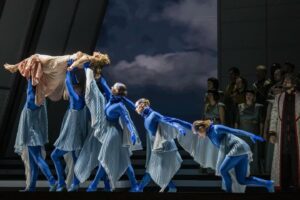
Best of all — both for wardrobe and stage action — a sextet of balletic dancers appeared in blue bodysuits: a co-ed Blue Man Group, the women with silvery corrugated skirts and avian sleeves for accent. These were Bailey Jo Harbaugh, who amounts to a prima ballerina for TAO, joined by Jacob Attaway, Heather Jolley, Brandon Nguyen-Hilton, AC Wilson, and Gwynn Wolford. They danced in all three acts, at the wedding gathering, and as adjuncts to Semele and Jupiter’s sexy time. But in the most striking image in the entire production, which will remain with me every time I think of this opera henceforth, in the final act they acted as pallbearers for the deceased Semele, holding her body aloft while forming human stairs, slowly carrying her off stage right. This might have been the most beautiful image I saw in all the operas I attended this season.
Happily, producers of opera are getting it into their heads: just because we are not mounting productions of Meyerbeer featuring 20 minutes of classical ballet in Act Three anymore does not mean opera does not need dance. It does, desperately, and Amir Levy’s lovely choreography fit the bill.
Songs of mirth and triumph sing
As is often the case, TAO compiled a roster of principal vocalists without a single weak link. Whether Baroque fans would ratify most of them for Baroque opera we will leave to another writer. Your reviewer takes a deeply skeptical stance towards Baroque performance practice fundamentalists, saying as much in this admiring review of Daniela Candillari’s conducting in OTSL’s 2024 “Julius Caesar.” In “Semele” all six principals pleased me by making abundantly beautiful sound.
Texan soprano Lauren Snouffer’s vita ranges from Monteverdi to Mazzoli. She will make her Met debut next month, on opening night no less, in Mason Bates’ “The Amazing Adventures of Kavalier and Clay.” She has performed quite a bit of Handel. Snouffer was perfectly cast for making this oratorio-esque opera operatic. The physical height of Catherine Martin and the men made Snouffer seem extra-petite, which worked well when she is mortal and the other characters gods. Abundant stage presence radiated from her big, beautiful eyes, easily visible even from the twentieth row.
Her credits are mostly of lyric fach, including a Mélisande your reviewer wishes he had heard in Dallas last year. She negotiated ‘Endless pleasure’ with resplendent spin and a tight vibrato. Her sweet timbre befitted the character’s earnestness, and all those florid runs sounded pleasurable to produce. In Act Two Scene Two, she seemed a little bored with her new life on Mount Olympus, awaking in Jupiter’s bed, until she began ‘O Sleep why dost thou leave me,’ during which she seemed enamored of her own desire for sleep. Abundant limpid tone emerged after pitch-dominant onsets. Alas, she sang only one verse before Jupiter entered to canoodle with her and give her that butterfly for her neck. Josh Lovell explained his human form to her as Harbaugh and the dance squad appeared with champagne and fruit. She negotiated well her vocal acrobatics in ‘With fond desiring’ while peppering Lovell with grapes.
Semele gets a lot of great music but her best show piece is probably ‘Myself I shall adore.’ Snouffer delivered weightless runs while Martin’s Ino (Juno disguised) read a fashion magazine in bed. This aria features some dialogic interplay between the soprano and the orchestra that prefigures later developments in opera, such as Donizetti’s mad scene for “Lucia di Lammermoor.” Snouffer tossed the whole thing off playfully and the audience stopped the show with applause. You have to bring a vivacity to the role or the whole affair can become a bit static. Snouffer thoroughly won the evening.
As her boyfriend the sky god, Josh Lovell brought a lot of malgré lui energy. We tend to think of our godly top dogs in opera bullying giants and dwarves, or otherwise pushing their subordinates around. But this Jupiter is thoroughly whipped by a mortal woman. Snouffer comprehensively dressed him down in ‘No, I’ll take no less,’ as he meekly agreed to her demand to appear to her in his immortal form, an entrapped chess king. Lovell’s Jupiter drew parallels to Verdi’s “Aida,” in which the hero Radamès usually comes off less as an independent man than a territory contested by the feminine pro- and antagonists, Aida and Amneris. Lovell sang well, stronger in low and middle voice than at the top, communicating genuine affection for his side-boo Semele in ‘Where’er you walk,’ and deep sorrow mourning Semele’s decision in ”Tis past recall.’ If a mortal woman could so easily walk all over this Jupiter unto her own death, one wonders how the marriage with Juno was going in the first place.
Mezzo-soprano Catherine Martin gave a saucy Ino, and a Juno often less raging than insouciantly manipulative. Iris plied her with martinis that she chain-drank while dispensing bon mots a la Megan Mullally’s Karen in “Will and Grace.” Even her gown in Act Two Scene Two resembled a more elegant bottle of Crown Royal. She did not think much of her husband, drawing cartoon devil horns on a portrait of him dutifully held aloft by Iris. A versatile singer, Martin sang Waltraute in TAO’s “Die Walküre” last year. She projected queenly force as Juno with a robust, crimson-colored sound that filled the house. Convincing people to do things is far easier when they feel like these things are their own idea: in Act Three as Juno disguised as Ino, she playfully egged on Semele to her doom.
The most delightful singer of the evening was TAO debutante, soprano Elisa Sunshine as Juno’s assistant, Iris, who provided the aural rays promised by her surname. Iris gets a lovely aria in Act Two Scene One, ‘There from mortal cares retiring’ as she explains to Juno that Semele cavorts about with Jupiter in a protected location. Sunshine, though deferent to Juno, could not resist revelling in her own description of all the fun Semele was having with Jupiter, unzipping her vest and fanning herself with a manila envelope marked ‘confidential.’ Sunshine’s modestly-sized instrument carried very well with superb technique and a Mozartean timbre. She will excel in leading roles.
The remaining two main cast members also do not receive a lot of music but carried themselves very well. Bass William Guanbo Su is everywhere these days, including the Met, and has become a repertory generalist. Your reviewer first heard him at OTSL in a powerful performance of Olin Blitch in Floyd’s “Susannah.” Like much of the cast, Su does not necessarily sound idiomatically Baroque, but his sound is more beautiful than most basses and his acting and stature fill the operatic role of king/father with distinction. Cadmus does not have a lot to do besides urge his daughter to marry the countertenor, but as Somnus, Su was hilarious in the duet with Martin at the beginning of Act Three (‘Obey my will, thy rod resign’) when Juno promises Pasithea to him for his complicity in her disguise plot. Su possesses enough basso cantante agility to handle the preceding aria, ‘More sweet is that name.’ The opera is full of subservient men, and it did not take much wiggling from Harbaugh’s Pasithea to wreck him. Also debuting at TAO, countertenor Nils Wanderer portrayed a morose Athamas, a character that seems a plot device from which Seleme moves on. But Wanderer sang well Athamas’ aria ‘Your voice my tale would tell,’ with an English churchy sound on top and a reasonably robust middle. The cuts excised the tenor role of Apollo — whom Wierzel’s lighting design managed to replace.
Each sacred minstrel tune his lyre and all in chorus join
Conductor Christine Brandes directed all this traffic skillfully with a well-textured, robust orchestra that did not sound pared down into period practice austerity. She integrated well chorusmaster Rolando Salazar’s medium-sized ensemble, well-coordinated in all their numbers, and who acted as audience for Semele in ‘Endless pleasure’ as the Blue Man dancers air-caressed her. My favorite player in the orchestra at TAO is fast becoming Charae Krueger, who is blessed with the unfair advantage of possessing a violoncello. The principal cellist enjoyed a winning turn as the third participant in Athamas’ and Ino’s Act One duet. If there is a major problem with “Semele,” it is that, after a very brief prayer, the chorus toggles from sorrow at Semele’s death to rejoicing in the space of a couple minutes, made all-the-more jarring by a small cut TAO executed (‘Guiltless pleasure we’ll enjoy,’ a very Messiah-like closing number). Yes, Bacchus will inebriate them all, but it is a whiplash ending. Too happy, too soon, more aligned with the work’s leanings toward oratorio, which tends to be choppier than opera: #77-79, the heroine dies; #80-85, all is well. Nonetheless, TAO made the best case possible for “Semele” as a bona fide opera.
Going back to Ovid and the Greeks before him, “Semele” transmits an ur-myth: the relationship between mortals and the divine. That encounter always results in transformation, and it is always lethal to humans. Later, Christians of a neo-platonic bent would squeeze such myths into an allegorical template explaining God’s workings on the human soul. Zvulun’s production captures why a mortal woman would insist on such risky behavior as insisting her immortal lover appear to her in his divine form. Finite humans have always longed for infinity. Semele’s sexualized fervor for Jupiter kills her. And whether you’re a Parisian courtesan contracting tuberculosis from your johns (“La Traviata”), or a Norse warrior stumbling into exactly the right wrong house (“Die Walküre”), or the hottest cigarette girl in Seville (“Carmen”) or simply a tenor in proximity to a meaner baritone who likes the same soprano, in opera, nothing kills you deader than having sex. TAO ended their Hero’s Journey season with a heroine who wanted it all and got more than any mortal could handle.