Theater Koblenz 2025-26 Review: Antony and Cleopatra
Danielle Rohr’s Compelling Adolescent Portrayal of the Egyptian Queen Dominates the Stage
By Alan Neilson(Photo: Matthias Baus)
“Antony and Cleopatra” is not a subject matter one might readily expect for an opera by John Adams. Primarily a love story, it does not fit easily alongside the other operas in his catalogue, which focus on religio-philosophical issues or significant, recent events impacting the USA. By comparison, Antony and Cleopatra’s intense, turbulant, ultimately doomed relationship appears somewhat distant and even flippant, notwithstanding its cultural importance to Western consciousness. Yet, Theater Koblenz’s recent production – its German premiere – dispelled such notions. Not only does Adams’ narrative successfully highlight the complex relationship between lovers, but he also explores the power dynamics that exist between Antony and Cleopatra and Caesar, which the director, Markus Dietze, cleverly exploited by shifting the action closer to an undefined present. The context of their love affair is thus switched from the ancient world to a modern society, in which Egypt is portrayed as a decadent Eastern society, very similar to the Egypt of the Pharaohs while Rome takes on a militarized, quasi-American society, primed for Caesar’s dictatorship and imperial conquest, hinting at the USA’s wars in the Middle East during the 20th and 21st centuries, and by association, the current conflict in Iran.
The libretto, compiled by Adams, follows the basic structure of Shakespeare’s play, but in a reduced form. Rather than the bard’s five acts and 40 named characters, Adams reduced it to two acts and 12 characters, in which Antony, Cleopatra and Ceasar dominate. The first act defines the relationships between the three central protagonists: Cleopatra’s jealousy is established by Antony’s decision to return to Rome, where he subsequently marries Caesar’s sister, Octavia, and sends the Egyptian queen into a rage; the volatile and deteriorating relationship between Antony and Ceasar is built carefully over the act, culminating in the spectacular sea battle of Actium, from which Antony, defeated, is forced to flee. Act two plays out the consequences of his defeat with Ceasar arriving in Egypt to hunt down Antony. However, he is forestalled by Cleopatra’s childish machinations; she sends a messenger to Antony to inform him that she has died, which precipitates Antony’s suicide, to which Cleopatra, overcome with grief, then takes her own life, leaving Caesar triumphant.
Dietze Delivers a Powerful, Clearly Focused Interpretation
Dietze’s handling of the fundamental aspects of the staging was expertly managed: the dramatic tensions, its cohesion, pace, focus and the characterization of the protagonists were sensitively developed, keeping the audience thoroughly engaged throughout the performance. However, it was his ability to add depth and intellectual interest through his imaginative development of the work’s underlying themes that really impressed.
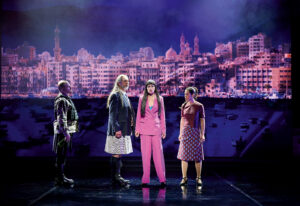
The contrast between the two societies was subtlely developed by tapping into our readily accepted stereotypes of the West and the East. The decadence, the sensuous luxury, and the colors of the East were captured in the opening scene in the party in which Cleopatra and Antony hosted celebrities that included the likes of Elvis, the Muppets, the Pope and Hollywood stars such as Charlie Chaplin – then again, it may have been a fancy dress party, not that it is significant. Some were dressed as expected; others were dressed in togas. It was all very indulgent and a long way from the portrayal of the Imperial court of Rome, which was focused on efficiency, uniforms, technological superiority and a strict hierarchy dedicated to enforcing imperial power. Ocassionally, they were maintained and reinforced by the use of projected videos designed by Georg Lendorff; terrifying images of the military might of the West were captured at the Battle of Actium by waves of missiles, launched from warships, and overseen and applauded by the military elite, which he combined with images of Ancient Rome and other societies so as to extend the message to cover the nature of totalitarian regimes in general while successfully ramping up the tensions in perfect harmony with Adams’ musical interlude.
It was a theme that was reinforced through Dietze’s highlighting of another theme: the private versus the public arena, which he captured most clearly in his treatment and depiction of the main characters. Whereas Antony and Cleopatra, notwithstanding the queen’s abilities in manipulation and self-preservation and Antony’s military prowess, were constantly distracted from their duties as they indulged themselves in their private love games, Caesar was focused on extending and imposing his power. His private actions were also aimed at securing his political ambitions, notably through his promotion of the marriage of Antony to his sister, Octavia.
One of the most enduring images we have of Cleopatra is as the archetypical femme-fatale, and this was something that Dietze played with throughout the performance, playing up her sexual and dangerous, almost infantile nature and adorning her with an array of eye-catching costumes designed by Bernhard Hülfenhaus.
The simple staging, designed by Bodo Demelius, made sparse use of props or elaborate scenery, relying instead on the roles provided by the costumes, lighting and videos to create atmosphere and context, and it proved to be a good decision as it opened up the space allowing the focus to fall directly upon the performers, who used the opportunity to develop strong characterisations. One aspect, however, of the staging that was totally superfluous to the presentation was the use of two dancers. Whislt their skills were admirable, their dramatic purpose was, at best, pleasant but irrelevant and, at worst, distracting.
Overall, it was an excellent staging, in which Dietze’s clear presentation established a clear link between the underlying themes that drive the behaviour of the main protagonists and the tragic ending that befalls the lovers.
Musical Excellence Undermined by the Decision to Mic the Singers and Hide the Orchestra
Why does Adams so often insist on his operas being miked? The argument that it creates a more balanced sound, revealing its finer details and textural qualities, may well be true, but it is actually anti-theatrical. It destroys the illusion that one is encouraged to accept if the drama is to be enjoyed.
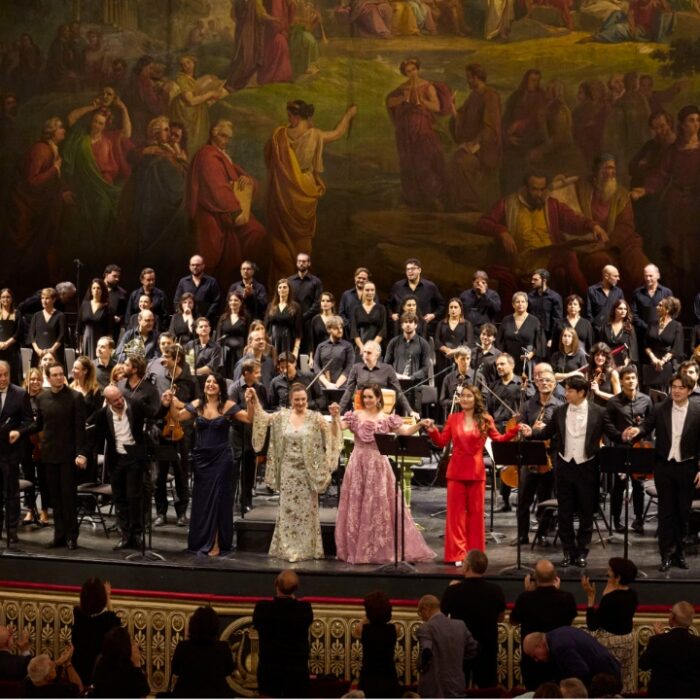
The Staatsorchester Rheinische Philharmonie, under the direction of conductor Enrico Delamboye, was positioned on one side of the theater behind a black screen and thus out of sight of the audience and the stage so that the singers had to engage with the conductor solely via monitors. Why, apart from the traditional curtain call, did they even have to be in the same building? Certainly, the quality of the sound was excellent, but it was a homogeneous sound emitted through speakers that removed any variations that the members of the audience may experience, depending upon their seating position. Many may, indeed, prefer this state of affairs. However, the singers were also miked, which created numerous problems, not least the lack of a spatial dimension: whether the singer was standing at the back, front, or either side of the stage, the position of the voices did not alter; even if they faced the back of the stage, the sound remained the same. One may have well been listening to a recording. An important aspect of live theater was thus completely lost! Added to this was the decision to use live, close-up videos of the singers’ faces relayed onto a large screen to highlight their facial expressions, which, owing to a slight time lapse, meant that their voices were not synchronized with the images. It was all very disconcerting and further destroyed the illusion one necessarily has to buy into when attending a theatrical event.
While one may feel sympathy for concerns about the balance, musical detail and the textural qualities that Adams is so keen to create, the problem can actually be laid to one side. The existence of recordings and, maybe to a lesser extent, concert performances, provides a perfect solution without the need to compromise the theatrical event.
Despite these reservations, Delamboye, nevertheless, successfully delivered a dramatically intense and musically fascinating interpretation. His molding of the musical arc was expertly rendered to bring out the work’s dramatic pace and tensions for each act, in which the details, colors and textures were beautifully revealed. The musical interludes, particularly the sense of violence and anxiety that was created during the battle scene at the end of Act one, were particularly impressive.
Danielle Rohr’s Excellent Portrayal as the Adolescent Queen
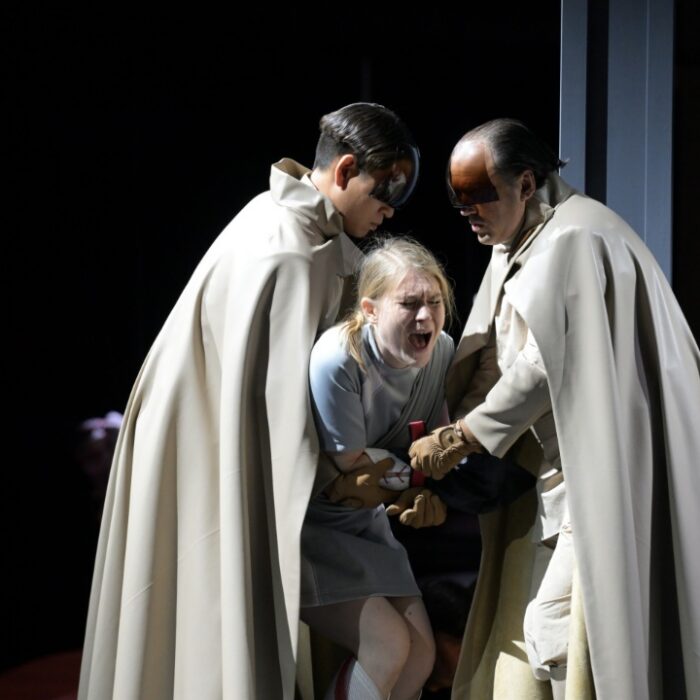
The star of the show was undoubtedly soprano Danielle Rohr, who gave a wonderfully layered presentation as Cleopatra, characterizing her as a woman stuck in her adolescence; she was demanding, egocentric, self-indulgent and entitled, and prone to aggressive outbursts when frustrated, such as her ferocious attack on the messenger who brings her news of Antony’s marriage to Octavia. Everything she did was boiled down to a power game, even her love for Antony; she gave the impression that she had no idea of what love entailed other than a relationship determined through a power struggle. Only when faced with the loss of Antony and the destruction of her world does she display a more mature sense of realization, which ironically leads to her final narcissistic act in taking her own life, which she acted out superbly to maximize its effect; even in death, her presence still dominated the stage.
Vocally, Rohr produced a versatile, expressive presentation in which she coated the voice with an array of emotions as she moved easily across the range, sensitively adorning the line with inflected emphases and meaningful dynamic contrasts and with varying degrees of intensity to develop and support her excellent charcterization.
By contrast, baritone Andrew Finden characterized Antony as an easily manipulated man in thrall to Cleopatra’s beauty. He was passionate and jealous, yet emotionally weak and easily provoked, which played into Cleopatra’s childish hands and which she used to emotionally abuse him. Finden depicted Antony’s volatility in a well-sung, expressively captivating portrayal.
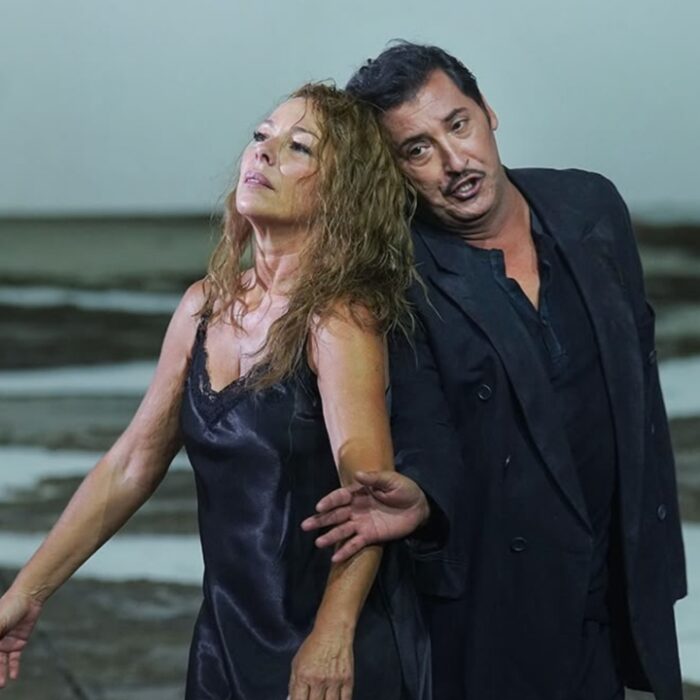
Together Finden and Rohr developed a strong partnership that brought the fiery nature of Antony and Cleopatra’s relationship to the fore, in which they successfully presented the shifting dynamics of their emotions, which were rarely constant for very long.
While the two lovers played out their love affair and dominated the stage, Caesar’s presence was rarely absent. Even when not on stage, his power and influence loomed menacingly in the background. The tenor Tobias Haaks did a wonderful job in bringing this power-hungry dictator to the stage. He was viciously aggressive, violent to the point of attacking his own servants and advisors, uncompromising and demanding. He strutted the stage with a confident, imperious disposition and at times even appeared unhinged; the deaths of Antony and Cleopatra made little impression on him. His singing was resonant, authoritative and forceful, which he used expressively to deliver his lines. In one of the most dramatic scenes in the opera, he presents a monologue in which he manipuates the populace, urging them on to fight for the glory of Rome. The genuine sense of power and confidence with which he was able to infuse the voice was impressive, as was his innate lyricism.
Nico Wouterse used his excellent acting skills to produce a strongly defined portrait of Caesar’s trusted advisor and general, Agrippa. Although he aggressively and determinedly followed Caesar’s commands to the letter, and was certainly not averse to using threatening behavior in the process, he was quick to bend the knee to Caesar, even to the point of suffering humiliation. Woterese sang with purpose, displaying a secure, well-grounded, expressive voice with a commanding tone that he used to project his forceful nature.
Mezzooprano Tábita Iwamotom showed off the beautiful tonal quality and attractive phrasing with an emotionally balanced interpretation of Charmian, Cleopatra’s lady-in-waiting, in which her loyalty to the queen was the defining characteristic.
Tenor Nando Zickgraf, playing the relatively minor role of Eros, nevertheless did enough to display his fine acting and singing qualities, in which his vocal flexibility was particularly notable.
Bass Marco Kilian produced a vigorous portrayal of Antony’s loyal general Scarus.
Baritone Christoph Plessers, playing the role of Antony’s loyal lieutenant, Enobarbus, added a calm, reflective aspect to the drama with his observations about the self-destructive nature of the lovers’ relationship. He is given a couple of substantial monologues to sing, which he delivered in an articulate, clear and expressively thoughtful manner.
Lepidus, the third member of the triumvirate that ruled Rome, was portrayed as a passive figure that had minimal impact on events. He was given a solid interpretation by bass, Jongmin Lim, who was also cast in the role of Caesar’s trusted messenger and officer, Maecenas, which gave him plenty of opportunities to show off the beauty of his darkly colored palette along with his attractive phrasing.
Mezzosoprano Haruna Yamazaki was double-parted as Caesar’s sister Octavia, whom she characterized as fairly cold, indifferent and manipulative, as well as Iras, Cleopatra’s loyal servant, for which she produced a suitably loyal and servile portrayal.DanielleRohe
Overall, Adams’ retelling of Antony and Cleopatra’s tumultuous and ultimately doomed love affair was both musically and dramatically successful, and its focus on the interplay of the personal and political worlds was convincingly relayed. Nevertheless, the work does not possess the intellectual and politico-philosophical dimensions that make Adams’ work so fascinating. However, Dietze’s imaginative staging drew one’s thoughts to the current war involving Iran and the USA, successfully adding an interest and depth that was not immediately evident in the libretto.