CD Review: Vatroslav Lisinski’s ‘Deutsche Lieder’
By Bob Dieschburg
Who was Vatroslav Lisinski (1819–1854)? A composer—and ideologue of Illyrism, the South Slavic campaign against Austrian hegemony; a Croatian nationalist, and—like his Italian counterparts of the Risorgimento—very much a child of his time.
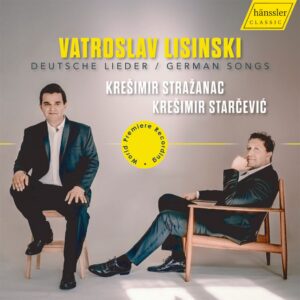
He is credited with the first Croatian national opera, “Ljubav i zloba” (“Love and Malice”), and is the namesake of the Zagreb Concert Hall—as was pointed out to me by Krešimir Stražanac, the protagonist of a new, Lisinski-only recital of German songs, recorded here for the first time.
Its program is composed of eighteen Lieder, written—by all evidence—between 1846 and 1851. In spirit, they are kindred to the works of other mid-century melancholics; Romanticism, after all, was a pan-European cultural phenomenon—arguably the last one.
Lisinski therefore is not an outlier. His songs tread a beaten path, aligned with the Shelleyan concept of beauty through transience. The titles speak for themselves: “Liebe und Ferne” (“Love and Distance”); “Lebewohl” (“Farewell”); “Abreise” (“Departure”); “Einsame Träne” (“Lonely Tear”); and “Ins wärmere Land” (“To Warmer Lands”). Musically, they present as small vignettes, plugged into the German-Austrian idiom. Schubert, for instance, lurks at the back of Lisinski’s mind—even if not explicitly.
Just listen to “Der blinde Fischer,” in which the rolling figures emulate the sound of waves. All of a sudden, Lisinski introduces a piano ostinato; the mode then shifts—albeit briefly—before the water metaphors resume. (The ostinato occurs in other pieces, too; it appears to have been a staple in Lisinski’s repertoire.)
As in their previous recitals—“Blagoje Bersa: Lieder” and “Schwanengesang”—Krešimir Stražanac and his accompanist, Krešimir Starčevič, are superb. It is a flawless collaboration, in which the esprit of post-Schubert salon music is embraced to the fullest.
Starčevič gives definition to the arpeggiated melodic contour, while Stražanac lends his warm, yet nimble, timbre to a wide palette of expression. In “Der Zufluchtsort,” the contrast between tension and repose translates into beautiful diminuendi and the use of a voix mixte. The accompaniment is congenial, since Lisinski conceived the piano as a narrator—albeit less revolutionarily than Schubert or even Loewe.
Stražanac phrases effortlessly, and his renditions are far from doctrinaire. In “An ein Mädchen,” the rhythmic variations bear an air of nonchalance—in the very best sense—while “Das Paradies” commands a more elegiac tone. The repetition of “Wo ist Eden?” (“Where is Eden?”) reveals the modes of Stražanac’s inwardness: reflective, nostalgic, yet not desperate. There is a radiant lightness in his voice, akin perhaps to Lisinski’s overall preference for major keys.
For this Romantic is not a full-fledged artiste maudit. He does not embrace his obsession, and his melancholy does not shatter like Schumann’s–or reach, for that matter, as deeply as Schubert’s. Lisinski’s plight remains communicable, and it comes with a sliver of hope.
This is, perhaps, a limitation though one sublimated nonetheless in this delightful homage–memorial, almost–on Hänssler Classic.