Royal Ballet & Opera 2025-26 Review: Siegfried
Barrie Kosky’s Production Strays Away From Wagner’s Musical Genius
By Esme Skevington(Credit: ©2026 Monika Rittershaus)
Despite the numerous positive accounts of Barrie Kosky’s “Siegfried” that gave me hope for a rich and nuanced performance, I found the singing, acting and stage design to be flat, unconvincing and shallow.
As a devoted Wagnerite, I do not feel that most of the performers truly understood the vast musical work that they were performing.
The quality of the cast’s performances did not feel worthy of being called world-class, and this severely inhibited the performance from doing justice to Wagner’s music.
Production Details
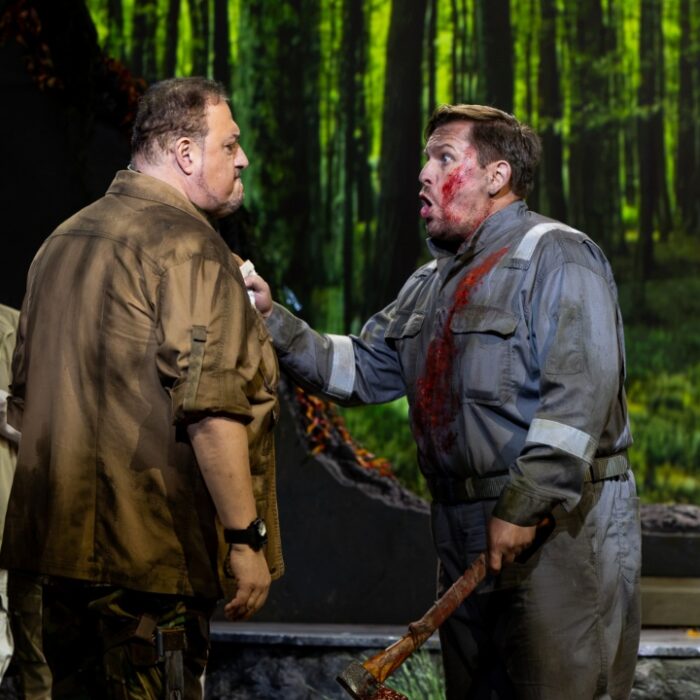
An interview with Barrie Kosky in the accompanying program reads: “There is a lot of text that is sung very loudly.” In this production, I would argue, it is not only loud, but forced, strained and painful on the ear. The first act scenes between Siegfried and Mime exemplified this, as the hostility between them manifested itself, not as powerful or rich voices or acting performances, but in sheer brute-force volume of voice. In some moments, this scene is also accompanied by loud clatters as the frustrated Mime throws shattered pieces of metal from the window of his treehouse, resulting in a wince-making barrage of metal hitting the stage which momentarily blotted out the sound of the orchestra. In what should be harmonious, passionate outbursts of orchestra and singers, the tone of the voices and instruments became a soup of sound, with the voices drowned out by the orchestra, while failing to match its tone and speed, producing a confusing sound where singers and orchestra battled for dominance of tone, volume and tempo. Although all productions of this opera are bound to convey some level of male aggression and rivalry, I felt that it was overpowering in this production. I was not let into the true nature of any, particularly any of the male, characters. I could not see past the aggressive, arrogant front of Siegfried or the scheming bitterness of Mime into the deeper nuances of their personalities and motivations.
Musical & Set Design Differences
The forging of Notung, typically cascading emotion in the scales and effortless softness and strength in the top notes, was instead delivered stiffly and with brute force by Andreas Schager, who was, again, in conflict with the orchestra’s tempo. The sword, when forged, looked strangely oversized, resulting in Seigfried sometimes holding it by his side by the blade near the hilt, which should of resulted in severed fingers.
The second act opens on a scene snowing heavily in the dead of night, which makes Seigfried’s line “high stands the sun in heaven, from brightest blue the sun shineth down on my head this glorious light” somewhat confusing! The character of Alberich, sung by Christopher Purves, is presented similarly to Seigfried and Mime in his two-dimensionality, this character maintaining a front of rage and selfishness and missing all the complex nuances such as desperation, addiction and pathos that should be manifest in this role. This production boasts one of the least threatening Fafners of any I have seen portrayed as a slow-moving man with two walking sticks. It was a disappointingly easy fight for Seigfried to win, hence an extremely unconvincing fight scene and death of Fafner (Soloman Howard seemed to lower himself comfortably to his frozen deathbed, not flinching in the slightest at the cold snow beneath him). Sarah Dufresne’s voice as the Woodbird sounded enchanting. However, due to the rapid orchestral tempo of this section, she sounded shrill, too fast, and lacking some of the “liquid gold” quality that was desired.
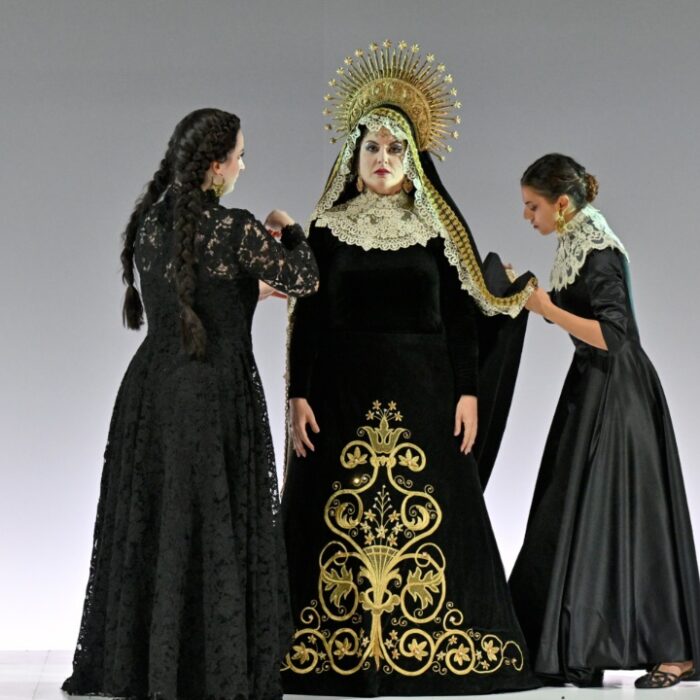
Erda, although ever-present throughout the opera, was not the powerful character that Wagner had, perhaps, envisioned. Older Erda was played by actor Illona Linthwaite, and I could not tell what the choreographed choice of having her movements so oddly slow was trying to express about her role, other than that she was weak and powerless in the face of the men fired up with ambition and power. I think it would have been far more powerful to have her as a woman with natural, recognizable mannerisms, rather than a character completely abstract from any readable personality or humanism. Even then, the decision to have her on stage at all outside of her scene with The Wanderer decreases the impact of her flood of emotion when Wotan wakes her from her “sleep of wisdom.” The choice to have her as the feathered but otherwise naked on-stage representation of the bird was a bizarre one. Was she a woman or a bird? If she was a woman, Seigfried was oddly comfortable and loving in the presence of the first woman he had ever seen, which was mismatched with his well-portrayed awkwardness around Brünnhilde in the last act.
It was announced at the beginning of Act two that Christopher Maltman as Wotan was suffering from a chest infection a few days prior, therefore I cannot pass judgement on the quality of his singing (though I wonder why they did not employ the understudy?). In the scene opening Act three when The Wanderer awakens Erda, I could not feel the urgency or passion of the fate of the world hung in balance, or of the Earth Mother’s despair when she confronts the chaos and pain taking place in the world that is slipping from her control. This performance as a whole felt lacking in the passion and spontaneity that is desired in any live performance of any kind. It felt predetermined in every way, not as if all the events and emotions between the characters were developing right before the viewers eyes, which is what I was hoping for in such an emotionally profound opera full of tumult and euphoria. Young Erda (Wiebke Lehmkuhl) and The Wanderer did not have much chemistry or connection with each other during this scene. Instead, the intensity of their interaction was diluted with their preoccupation with making eye contact with the audience and over-the-top physical movement.
In the last scene of the opera, Elisabet Strid‘s voice as Brünnhilde was undoubtedly my favorite in the opera, although I felt she lacked some of the emotional complexity of her uncertainty as she wakes into her new state of consciousness. I wanted to hear a softer tone to her voice in some moments, which I think she would have handled perfectly if she had chosen to add them. Again, her performance on the side of her acting felt predetermined and so lacked the complete dramatic tension of Brünnhilde’s transition from uncertainty to the tormented plight of her decision whether to follow love or keep her divinity, to complete release and surrender to love. Nevertheless, I found her performance passionate at the right moments and engrossing.
Although this performance was extremely disappointing, I enjoyed reflecting on what it takes from performers to truly live up to what the music expects of them. I also met a few other devoted Wagnerites and enjoyed some animated conversations with them during the intervals! And all in the gorgeous setting of the Royal Opera House.