Poznán Opera House 2026 Review: King Roger
By Marta Janiak(Photo source: Official website)
Szymanowski’s “King Roger” unfolds as a hypnotic meditation on desire, power, and spiritual awakening. Set in a world suspended between Byzantine splendour and Mediterranean sensuality, the opera follows a Christian ruler, King Roger, whose carefully ordered reality is disrupted by the arrival of a mysterious Shepherd. Radiating an almost dangerous charisma, the stranger awakens in Roger a longing he cannot fully name — one that challenges the rigid structures of faith, reason, and kingship upon which his identity rests. As the court resists and condemns the intruder, Roger is drawn ever deeper into a realm of ecstasy and ambiguity, ultimately embarking on a solitary journey toward self-knowledge — a journey that, in the recent Poznań staging, finds a strikingly tangible and thought-provoking expression.
The Poznań Opera House, as one of the leading theaters in Poland, has established itself as a true temple of the arts, with a strong dedication to Polish operatic tradition. This is far from accidental: the institution bears the name of the father of Polish national opera, Stanisław Moniuszko, while the building itself is located on a street named after the distinguished playwright Aleksander Fredro — together forming a symbolic framework ideally suited to the cultivation of the arts.
This time, however, the focus was on a work by Karol Szymanowski, one of the most important Polish composers of the 20th century, whose music combines late Romantic sensuality with modernist language and a distinctive, often mystical, harmonic palette. Deeply influenced by mythology, ancient cultures, and Mediterranean aesthetics, his work is marked by emotional intensity and richly colored orchestration. Szymanowski remains a central figure in Polish musical identity, with “King Roger” widely regarded as his most visionary stage work.
The opera premiered on 24 April in a fully staged production (following a concert version presented in 2025), and did so with what can, without exaggeration, be described as considerable success. “King Roger” is, in many ways, closer to an oratorio than a traditional opera. It is a search for God, a journey into the inner self, and a painful questioning of whether our existence is reality or merely a dream — a question embodied in the character of Edrisi, here reimagined as a psychoanalyst delving into the depths of Roger’s psyche.
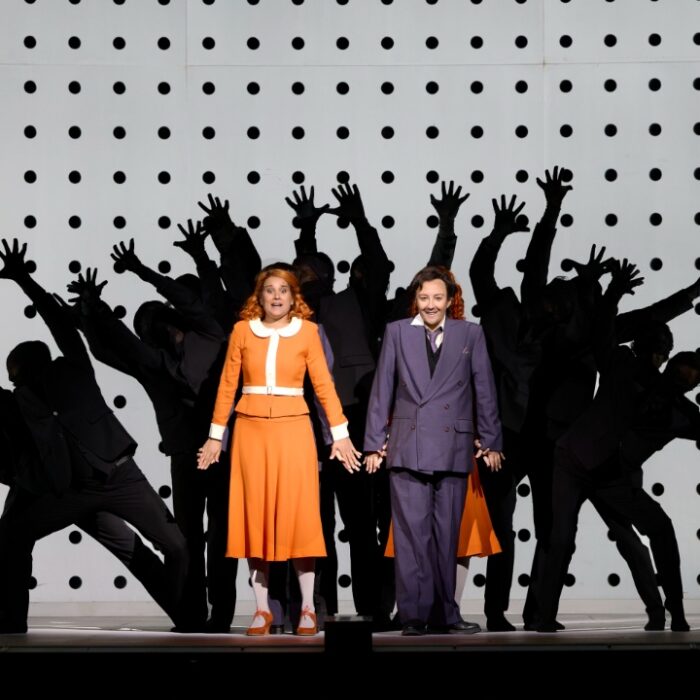
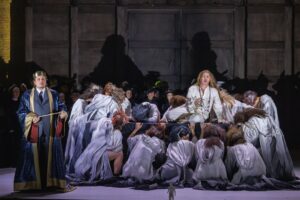
Krzysztof Cicheński’s directorial vision blends the oriental world of the Alhambra with a striking fascination for Freudian psychoanalysis. Lighting by Giuseppe Di Iorio plays a crucial role in the production, building tension and continuously shaping a sense of doubt. However, while visually impressive, it can at times feel overly sharp — almost excessive — dazzling the audience and occasionally prompting more sensitive viewers to avert their gaze. As much as this visual intensity demands attention, the choreography by Krystyna Łama-Szydłowska proves a true feast for the eyes. Intense and at times unsettling, it seems to emerge from another reality — a kind of requiem for a dream, in which the dancers’ bodies engage in a silent struggle between desire and pain. The costumes by Julia Kosek offer a striking interpretation of classical Byzantine style, enriched with a modern twist: the king wears a contemporary suit beneath his regal garments. His gradual shedding of the royal cape becomes a symbolic passage between the Christian sacrum and the profanum of the modern, secular world. Roxana’s red dress carries an almost fairytale-like quality, while the most visually arresting costume is undoubtedly that of the Archbishop, performed by Rafał Korpik, who carries himself with near-papal dignity. Kosek, also responsible for the stage design, creates a cohesive and immersive world in which every element feels precisely aligned, prompting the audience to question whether the events unfolding before them are real or merely projections of Roger’s troubled mind. Perhaps he himself is part of the dream — unaware of his own unreality.
The orchestra, conducted by Jacek Kaspszyk, artistic director of the Poznań Opera House, demonstrates an exceptional understanding of the score, unfolding its full complexity and expressive depth. Rather than serving as accompaniment, the music becomes one of the true protagonists of the drama. As noted earlier, “King Roger” poses considerable challenges, particularly when performed without an intermission, as was the case here — making the orchestra’s achievement all the more worthy of recognition.
The cast chosen for the premiere night proved more than successful. The focal point of the performance was, beyond any doubt, Szymon Mechliński — a wildly promising baritone who is rapidly making a name for himself internationally, having already appeared in cities such as Palermo, Toronto, and Madrid. In the title role of King Roger, Mechliński proved more than capable of balancing the immense interpretative demands of the part with its vocally unconventional writing. King Roger does not offer a traditionally lyrical melodic line; instead, it unfolds as a continuous current of questioning, propelling the drama forwards. This is an element as essential as the role of the Shepherd, with which it exists in perfect equilibrium. Mechliński commands the stage with undeniable presence and natural charisma. As the king, he is authoritative and powerful, yet beneath this exterior lies a man fraught with doubt — brought to the surface by the arrival of the mysterious Shepherd. The role demands a strong, resonant baritone, which the artist, despite his young age, undoubtedly possesses. Even when required to sing standing, moving, sitting, or lying down, Mechliński never loses vocal control, delivering a performance that is both dramatically convincing and visually compelling. His onstage chemistry with Ruslana Koval (Roxana) and Andrzej Lampert (the Shepherd) is equally noteworthy — an intoxicating performance, one to remember.
Ruslana Koval is a dutiful, graceful queen whose devotion to her husband is unmistakable and — according to the onstage narrative — eternal, binding her to his side until the very end. Her subtle lyric voice is delicate when required, yet capable of strength when revealing the resilience hidden beneath her feminine demeanour. Her elegant phrasing and impeccable diction lend the performance a sense of lightness, making Szymanowski’s masterpiece — though undeniably complex — more immediately accessible to the audience. Roxana’s infatuation with the Shepherd might border on obsession, had it not been for Koval’s nuanced interpretation. Here, the queen appears less consumed by desire than fascinated by the magnetic force embodied by the stranger.
Andrzej Lampert, one of the most intriguing tenors of the Polish operatic stage, delivers a performance that hovers on the edge of reality, as though the Shepherd himself were a figment of collective dream. His background in lighter, pop-oriented repertoire lends the portrayal a striking multidimensionality and inner depth. Rafał Korpik, principal bass of the Poznań Opera, offers a credible portrayal of the Archbishop. The Freud-like Edrisi, played by Karol Kozłowski, occasionally feels somewhat one-dimensional, though he remains pleasing to the ear throughout. It is an interesting directorial choice to present, in effect, three incarnations of Roger — as a child, an adult king, and finally an old man. Each stage of life is portrayed by a different artist, though with notable consistency across the conception.
This is a demanding yet profoundly absorbing journey — one that leads us, alongside Roger, into the most unsettling corners of the human psyche. And perhaps the most disturbing question it leaves us with is precisely this: if everything we perceive is shaped by desire, doubt, and projection, can we still call it reality at all? One thing seemed beyond doubt as the audience left the auditorium that night: they did not leave the same as they had entered.
Categories
Reviews