Q & A: Sebastiano Rolli on ‘Nabucco,’ the Arena di Verona & the Italian Repertoire
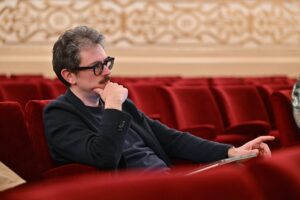
By Francisco SalazarItalian conductor Sebastiano Rolli is known for his Italian and bel canto repertoire, having conducted all over the world at such theaters as Teatro Regio di Parma, Teatro Filarmonico in Verona, Maggio Musicale Fiorentino, and Teatro La Fenice, among others.
Over the years he has conducted such operas as “L’elisir d’amore,” “Giovanna d’Arco,” “La Cenerentola,” “Torquato Tasso,” “Maria de Rudenz,” and “Rosmonda d’Inghilterra.” This week, he make his debut at the Arena di Verona conducting “Nabucco,” a work he has conducted for years.
Ahead of his debut, Rolli spoke to OperaWire about Nabucco, Verdi and the Arena di Verona.
OperaWire: What does it mean to make your debut at the Arena di Verona?
Sebastiano Rolli: Making my debut at the Arena di Verona means becoming part of one of the most visible and widely celebrated musical events on the international opera scene, while serving the most popular dimension of opera. Opera was not originally conceived as a form of mass entertainment, but rather as a courtly art reserved for a privileged social class. However, with the opening of the Teatro San Cassiano in Venice in 1637, it quickly evolved into an art form capable of bringing together people from every social background, fostering an extraordinary sense of shared cultural identity. Making my debut at the Arena di Verona means becoming part of this remarkable legacy of cultural civilization, one that played a fundamental role in shaping Italian society and, to a great extent, European society as well.
OW: What does it mean to make your debut at the Arena di Verona?
SR: I have been to the Arena only twice in my life. I cannot remember exactly how old I was, but it was certainly more than thirty-five years ago. I saw “Rigoletto” and “Turandot.” I have very fond memories of those experiences because my grandfather, a great opera lover, used to tell me how, before the war, he would cycle all the way from Colorno to the Arena—a journey of about 120 kilometres—making a couple of stops along the way. As for me, despite not having a driving license, I managed to get there by car.
OW: Why is “Nabucco” the perfect opera for this debut?
SR: “Nabucco” is the opera that Verdi himself regarded as the true beginning of his artistic career. It is the opera of beginnings: with “Nabucco,” Italian opera discovered a new voice. Its expressive spontaneity—already fully mature in the clarity with which the composer sought to resolve the drama in purely musical terms—marked a point of no return in the evolution of operatic language, establishing an artistic supremacy that would endure for more than 50 years.
To borrow a thought from T. S. Eliot, a classic is an artist who brings a language to its full maturity by placing upon it the stamp of his own genius, becoming the benchmark against which future creative work must be measured. By that definition, Verdi is unquestionably a classic. His third opera is the cornerstone of an architectural edifice whose final stone would be “Falstaff”—a work that remains unsurpassed within the boundaries of the tonal tradition.
OW: Tell me a little about your history with “Nabucco” and when is the first time you conducted this opera?
SR: I have been studying “Nabucco” for 35 years, and I first conducted it about 20 years ago in Piazza Duomo in Parma. That production also marked Michele Pertusi’s debut as Zaccaria—he will also sing the final performance on September 9. I returned to the opera ten years ago at the Israeli Opera (it seems I conduct “Nabucco” every ten years…). My engagement with “Nabucco” has been a constant throughout my career. I vividly remember the conversations I had with my teacher, Marcello Conati, as well as with Pierluigi Petrobelli, and today with Francesco Izzo, about the critical approach that should be taken toward a work so often—and, in my view, mistakenly—interpreted as the manifesto of the Italian Risorgimento. In reality, “Nabucco” is a biblical opera, following in the tradition of Rossini’s “Mosè” and Donizetti’s “Il diluvio universale.” It was Verdi himself, later in life, who helped foster Nabucco’s posthumous reputation as a patriotic opera. Yet the Milanese audience of 1842 enthusiastically acclaimed passages that had nothing to do with political insurrection. It was “Immenso Jehova,” not “Va, pensiero,” that was encored by popular demand. Evidently, the ideals of Italian unification still belonged to a relatively small intellectual elite, while the broader public lived quite comfortably under the efficient Habsburg administration. It is no coincidence that this same administration’s censorship never raised any objections to “Nabucco,” unlike what would happen with many of Verdi’s later operas. The voices of Silvio Pellico, Giuseppe Giusti, and Ugo Foscolo had not yet come to define the cultural and political consciousness of the age.
OW: How long did they have to rehearse and how long did you work with the cast? You will have many different casts for this production. How do you adapt to these changes?
SR: I am joining a production that is already well underway, so my rehearsal time is extremely limited. In fact, I will meet the cast for the first time on the evening of the performance, shortly before the curtain goes up. In the European repertory system, stepping into an ongoing production is perfectly normal and is, in many ways, a mark of professional maturity.
The theatre fulfills a fundamental social role, and the Arena di Verona serves as a cultural landmark throughout its two-month summer season. Over such an extended period, it is only natural for different casts and conductors to alternate. Since “Nabucco” is a repertory work and we can rely on the outstanding quality of the permanent orchestra, chorus, and technical staff of the Arena di Verona, I am confident that we will be able to deliver a fine performance.
OW: You are known for the Italian repertoire. Where does “Nabucco” belong in your repertoire?
SR: “Nabucco” has always occupied a central place in both the Italian Romantic repertoire and in the repertoire of any conductor who has devoted his life to exploring the musical languages of the bel canto tradition. It is a work that is born out of bel canto, yet at the same time challenges its very aesthetic. Its musical writing remains rooted in traditional forms, but the meaning Verdi assigns to those forms marks a decisive turning point. It is no coincidence that, only a few years later, critics—particularly in France—began calling for a new generation of performers capable of meeting the demands of Verdi’s music. What is essential to understand, however, is that the writing itself still looks to the past—Verdi is, after all, Donizetti’s heir. What makes it revolutionary is the expressive weight and dramatic significance that the interpreter must bring to that writing, transforming it into an entirely new musical voice. With Verdi, variation ceases to be mere ornamentation. Instead, it becomes a means of psychological exploration, achieved not so much through altered notes as through changes in dynamics and tempo, through a sophisticated command of musical and verbal accents. Virtuosic display is no longer the ultimate goal. Opera evolves from a form of entertainment into a social art—one of civic and political engagement—where audiences can recognize themselves and reflect upon the world around them.
In this sense, Verdi helped educate an entire generation of spectators, giving cultural form to that common Italian identity so fervently envisioned by Massimo d’Azeglio, long before it was consolidated through diplomacy or politics. “Nabucco” also answers the question posed by Giuseppe Mazzini in his 1835 Filosofia della musica: when would there emerge a composer capable of transforming the chorus from a mere background element into a powerful metaphor for collective identity and the voice of the people? With “Nabucco,” that moment arrives. The chorus becomes the true protagonist of the drama, a character every bit as significant as Abigaille or Zaccaria. The people—the embodiment of the collective—step onto the stage, inviting the audience to recognize themselves as part of the great historical panorama unfolding before them. It is the same panorama that shapes some of the most magnificent pages of The Betrothed by Alessandro Manzoni, whom Verdi revered almost as a saint. “Nabucco” is all of these things at once. One might even describe it as a secular, profoundly Italian St. Matthew Passion.
OW: What’s next for you after the Arena?
SR: Afterwards—and for a certain period of time simultaneously with my engagement at the Arena—I will conduct Mozart’s “Così fan tutte” in Magdeburg (Mozart is the foundation upon which all of Verdi’s theatre is built), followed by a concert for the Festival Verdi in Parma and “Rigoletto” as part of the opera season of the Teatro Regio di Parma.
OW: What are some operas you have yet to conduct that are on your wishlist?
There are many operas I would like to conduct, but among them I would mention three that I consider, for different reasons, fundamental and unrepeatable milestones in Verdi’s artistic journey: “La forza del destino,” “Simon Boccanegra,” and “Otello.”