Q & A: Maria José Siri on Singing 200 Performances of ‘Aida’

By Francisco Salazar

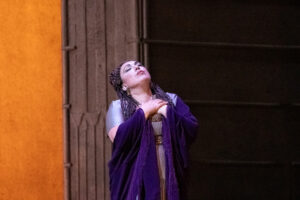
When Maria José Siri sings her performance of “Aida” on Sept. 10, the soprano will have completed 200 performances of the famed Verdi opera.

Since 2003, the role has been in Siri’s repertoire. She first sang it in Argentina and would go on to perform it at such major theaters as the Teatro alla Scala, Teatro Massimo, Arena di Verona, Staatsoper Stuttgart, Israeli Opera, the Palau de Les Arts in Valencia, the Théâtre des Champs-Élysées in Paris, the Semperoper Dresden, the Staatsoper Unter den Linden in Berlin, the Ópera de Las Palmas, and the Teatro Verdi in Salerno, among many others.

She has also worked on the opera with such conductors as Riccardo Muti, Daniel Oren, Zubin Mehta, Marco Armiliato, Daniel Barenboim, Andrea Battistoni, Gustavo Dudamel, Michele Mariotti, Christian Thielemann, and Omer Meir Wellber.

OperaWire had a chance to speak with Siri in anticipation of this milestone and experiences singing “Aida.”

OperaWire: What does Aida mean to you after so many years. How do you feel it has  developed in your voice and how has the character developed for you?

Maria José Siri:  Well, I debuted as Aida far too early. It was my third opera. I prepared it entirely on my own, and we had three performances with one day of rest in between. I even did the high E-flats because I thought they sounded good, without even knowing that Maria Callas did it in Mexico. I mean, it was really at the very beginning of my career, and it went very well. I have that video, and when I listen to the voice, on the one hand, I hear that the interpretation has evolved a great deal and that it is more refined in terms of the musicality, the colors, the dynamics, and everything that Verdi requires. But the heart of the voice—the pulp of the voice, the flesh of the voice, as we say—is the same. And that makes me very happy, because it means that my voice, after more than 20 years since I first sang it, has evolved but is still my true voice. I never wanted to be someone else. I never wanted to sing Aida as someone else would. Of course, I have my influences—my greatest reference for Aida is María Chiara—but I never wanted to imitate her or anyone else.

So what has happened over these 200 performances is that, by working with the best musical directors in the world, and also with so many stage directors, they have given me tips, ideas, and suggestions about how to interpret her, and that is something that continues to happen to this day.

So I think Aida is a character who could practically be my second surname, or my second name: María José Aida because that’s really how it happened. I started singing her at a very young age, and I decided that for three or four years I wasn’t going to sing her again, because I realized that I was too young to sing Verdi and that I needed to do other things before. I let three or four years pass and when I started singing her again in 2008, I never stopped. It is the opera I have performed the most and I have been in almost 32 productions, so you can imagine.

I have been open to so many ideas. For example, I finished doing my latest Aida at the Arena in Stefano Poda’s production and now, on August 15, I have my first performance in Franco Zeffirelli’s production, which I have already done at the Arena. They are two completely different Aidas, two completely opposite productions, but it is very interesting how, despite that contrast, the character’s development works and feels logical in both.

OW: The role of Aida is a very complex and difficult one that uses all of the soprano’s range and is extremely long and complicated. For you, what is the most challenging aspect of this role, and how have you managed it over the years? What has become easier to sing and what is something that, even now, you still feel you have to plan how you’re going to sing it or how you’re going to prepare for it mentally?

MJS: What I’ve learned over the years is that Aida is a long role. It’s a role that begins with a very aggressive, combative, powerful soprano aria, “Ritorna vincitor,” which people tend to take for granted, as if it were easy to sing.

But it isn’t easy to sing because it has so many dynamics. I mean, anyone can shout loudly—we all know how to do that, right? But to actually do what Verdi wrote, and what he intended, is another matter. That aria ends with pianissimos that have to be heard in a theater like the Arena, for example. You have to sing them in a certain way, with the voice very well projected, because if there is one theater that doesn’t forgive voices that aren’t properly placed, it’s the Arena. So it begins with an aria for almost a dramatic soprano.

Then you have Act two, which is also somewhat overestimated because people say, “Aida doesn’t sing.” But she sings the entire concertato. Some colleagues choose to save their voices in the concertato, but that’s another matter. I sing all of it, and it’s quite demanding. There’s a very long high C at the end of the Triumphal Scene, and Aida really has to be felt there. That C has to soar above the chorus, it has to soar above the orchestra, and that is very tiring.

And then there’s a pause, and you have Act three, which is completely different. I’ve just come from singing that C with all the force it requires—making sure it rises above the orchestra and the chorus—and then I have to switch completely and sing piano, soft, elegant, sweet, and intimate. Because in “O cieli azzurri,” the difficulty is, of course, the high C, especially the way you come out of it. But for me, what is sometimes missing when I listen to certain Aidas is that sweetness, that nostalgia, that melancholy that has to be present in the color of the voice when she is thinking about her homeland.

Because in many of Verdi’s operas, when the soprano is alone, he really brings out the most intimate side of her. It happens with Abigaille, with Odabella, with Amelia, with many of his heroines. He has this way of giving them an aria of great strength and then, at some point, an intimate aria. And vocally, it almost has to sound like another soprano. The vocal quality has to be completely different—a very sweet, soft, warm sound, as if she were returning to her childhood and seeing the blue skies of her homeland.

So what does that mean? You have to have a plan for conserving your energy, because you need to arrive very fresh at Act three. That’s where everything happens. It’s not just the aria and its difficulties; afterward she becomes combative again with her father. She has these beautiful but very demanding, very low phrases: “Patria, patria, quanto mi costi.”

And then she has another duet, and everything is lyrical, floating, as if everything were among the clouds. The duet with Radamès is really difficult because you have to sing piano. Otherwise, it makes no sense that she is trying to manipulate him into revealing the information. So there is another color there, very different from the aria.

The aria, we could say, is about nostalgia. There’s a beautiful word in Portuguese that doesn’t really exist in any other language—I think you know it—it’s called saudade. Yes, well, it’s that color. But then the color in the duet is different, because she feels the duty to help her homeland, her people, and she uses seduction. And when you seduce someone, you don’t shout. When you seduce someone, you whisper. And you have to sing exactly as Verdi wrote it, in that passage with E, F, G, A, and several B-flats that he deliberately wrote that way. The soprano finishes the duet the tenor sing, “Aida, tu non m’ami,” and she ends with “Fuggi! Fuggi!” on a B-flat that should feel eternal. It’s beautiful to sing it piano.

So what happens? For example, when I go in to warm up my voice, I think, “Okay, I don’t need to vocalize all the way up to E-flat, because I don’t have that many high notes in Act one. I’ll vocalize up to C.” I don’t change anything, because if you warm the voice up too much for the very high register, you can shift the placement of the voice, and I need my lower register. So that’s what I’ve learned: economy within the opera, both vocally and, obviously, interpretively.

OW: The duet with Amneris is also quite thrilling and incredibly intense.

MJS: The confrontation with Amneris is wonderful. There really has to be that contrast. Even though Aida is a princess, she is also a slave. And in my interpretation, I see them as friends. That’s why it hurts Aida so much when she discovers the truth.

And there, too, the strength and aggression have to come from Amneris. Even when she says to Aida, “Anch’io,” and then regrets it, Aida has to immediately change into a submissive vocal quality, singing piano. The way it is written gives you the sensation that you are bowing, that you are obeying. It’s beautifully written.

And, of course, we mustn’t forget the tomb duet either, which is the most lyrical of all. Perhaps it requires an even lighter soprano, because she has to extremely soft pianissimos that Verdi specifically asks for  after having sung such a full, demanding Act three. Fortunately you have Amneris’ aria as a kind of rest, a moment when you can let the voice settle. But honestly, I love this role so much that it just flies by for me. I know it’s long, but it goes by quickly.

OW: What does it feel like to celebrate the 200th performance of “Aida” in the town where you live and in Franco Zeffirelli’s legendary production?

MJS: Well, for me, Zeffirelli was, at a certain point, when I met him, a very important moment in my career. Because I actually met him through “Aida.” My first “Aida” in Italy was at La Scala with Zeffirelli and Lila De Nobili. It was a production from 1964 that they wanted to stage one last time at La Scala. It was also Daniel Barenboim’s debut; he had just taken over as musical director.

So, in that production, I didn’t actually see Zeffirelli because he was feuding with Barenboim. In an interview with the newspaper La Stampa, Barenboim said, “I’m going to debut at La Scala with old furniture.” Of course, Barenboim had wanted a new production.

So Zeffirelli didn’t show up. Later, I did work with him in Palermo, where I performed that same “Aida” production. And from there, a collaboration with him began on many operas.

He always had words of wisdom for me and gave me advice that I will carry with me for the rest of my life—from a visionary, from someone who made his mark in both film and opera. And with his beauty, his style—whether you like it or not, because we can all criticize and we can all have our opinions—I feel particularly fortunate that this happened to fall into place this way.

I had been doing the calculations for years, and this year it finally happened, in September. And I thought, “It’s happening with Zeffirelli.” Because it could have happened with Poda; I could have ended up doing it with Poda. And I thought, “This is like a gift.”

And to do it at the Arena, which is my favorite theater. I say that without hesitation. It’s where I love singing the most, even with all the difficulties, especially when the temperatures are high. Right now we’re dealing with 38–39 degrees Celsius, and tomorrow I have to sing “Nabucco,” wearing a coat that weighs 30 kilos. It’s not easy. But I love singing at the Arena, and for it to coincide with this was just incredible.

I kept thinking, “Let’s see when it falls,” because I was looking at my calendar, you know? And I thought, “It can’t be that it’s going to happen with Zeffirelli at the Arena.”

So, it’s a huge emotion, a major milestone. I’m still learning things, and I know I’ll continue learning things about the role, but by now, that role has a little bit of my own stamp on it.

It’s a role that is very much associated with me. Obviously, “Tosca” comes next, but it’s quite a long way behind in terms of the number of performances. Floria is coming along behind Aida—but Aida is running much faster.

OW: You are doing two different productions of “Aida” at the Arena di Verona, Zeffirelli’s and Poda’s. When you’re performing in two productions that are so extremely different, how do you adapt your interpretation of Aida? What do you change within yourself? How do you approach the role differently?

MJS: So, “Aida” in the Poda production is almost magical, more surreal, more lunar, and much more intimate. And the character of Aida in the Poda production is much more contained and restrained. The emotions are obviously expressed through the voice, but not through the body language. The emotions are conveyed by a group of young people who are always next to the soloists. They’re the ones who make the gestures and everything and we don’t move our arms or raise our hands to the sky. We’re almost like hybrids as characters. And it’s what happens around us that tells the story of the character, rather than the character itself. Vocally, nothing really changes and it doesn’t either in the orchestra. But obviously, when you change the body language, something changes in the voice too—the energy and even the intention. For example, there’s a part of the duet with Amneris where I have to make myself into a cross on the floor, and the stage is slanted, so everything is sliding down onto my neck and I’m thinking, “Oh my God, I have to turn around”  It has its complications, but of course, it’s more peaceful.

Zeffirelli’s “Aida” is more realistic. She’s an Ethiopian woman with royalty and proud of her roots. And when she’s alone singing “Ritorna vincitor,” she’s much more of a woman, a warrior woman who is there, and who has been kidnapped. She can’t even begin to imagine that they have just mentioned Radamès, the head of the army, and that perhaps they might take her father or her brothers hostage or hurt them. This is much more realistic as a character. You see a woman who moves, who gets agitated, who cries, and who physically begs. It’s much more real. Physically speaking, it takes more work. It’s a little more tiring, especially in the arena. We’re talking about sometimes having to walk 50 meters to sing one part and then go somewhere else. So the body language changes too, and the intentions with the other characters change. The duets are much more realistic. They’re pushed much more toward the emotions and toward externalizing those emotions so that they’re very clear and visible. That’s the biggest difference I see between the two productions.

OW: You have worked with so many amazing conductors in this work. Who are some of the memorable ones and what advice did they give you?

MJS: There are four who taught me the most, and I’m going to name them in chronological order, not in order of importance.

The first was Daniel Barenboim, because he has a completely personal vision. It isn’t necessarily what is written in the score, but rather his own interpretation. I remember doing, I think, four, five, or six piano rehearsals with him and with the whole cast. Obviously, everything he told us was so interesting, because he is an extraordinarily intelligent person. What he proposed was so compelling that he convinced us to do things that weren’t actually written by Verdi, in terms of dynamics or intention. For me, that was the first time I sang “Aida” at La Scala, in 2009, and it was with him. Well, with his ideas, he gave me one dimension of Aida. So that production was Zeffirelli and I had a highly innovative musical interpretation together with an extremely traditional production. So I had to make those two things fit together.

Then, chronologically, the next one was Zubin Mehta, when I arrived in Florence and the stage was completely covered in sand. It was as if they had brought in truck after truck of sand. At the first rehearsal, Mehta was sitting there in his little chair and it was very interesting to work with him and with his point of view. It was also very interesting because this was the first opera that the filmmaker Ferzan Özpetek directed. He wanted to pay tribute to his homeland. Instead of creating the pyramids of Egypt, he recreated the desert of Istanbul. There is a desert in Turkey with these particular shapes and formations. So he reproduced that. And well Mehta brought me into his world, which is a completely faithful vision of what Verdi created. And in this case it was the opposite of La Scala: a traditional musical interpretation with a completely new production. It was so much so that Ferzan would tell me,  sing all of “O patria mia”  looking backward, looking toward the monuments. And I would say, “Ferzan, I can’t sing the entire thing facing backward. I have to sing to the audience.” It was his first Aida, and it was very sweet.

Then I had the pleasure of working with Riccardo Muti. And there we went into the strictest possible interpretation of what Verdi actually wrote. It was like doing a backup. It was like when you restart your phone or your computer and it gets rid of what isn’t useful, cleans things up, removes what’s unnecessary, and then you go back and review everything. That’s what happened to me with Muti. I brought it back to the way Verdi wrote it, rigorously, and that also gave me a great musical lesson, because I’m a pianist, I’m a musician, and it was incredibly interesting to work on “Aida” that way.

And finally, I’ve sung most of my “Aidas” at the Arena, because I’ve been singing “Aida” at the Arena since 2013. So most of my Aidas have been with Maestro Daniel Oren, who puts all of his intention into it. His vision is also traditional, respecting what Verdi wrote, but he puts his heart in our hands. It’s truly heartfelt. It’s very passionate and very emotional working with him.

We’ve just finished the Poda performances, which he conducted throughout, and every year it’s as if we add one little thing and one tiny detail. We even have two moments that I do in a certain way simply because I like doing them that way. I sing two piano passages in two phrases that are written forte. So Daniel knows it and he say we’re doing the Siri version.

So Daniel Oren, finally, chronologically, is one of the great conductors who has given me those last little tips and, above all, this emotion—the ability to sing with such emotion, with so much heart, with so much feeling. It’s incredible. And that isn’t the same thing as sentimentality. It’s feeling with incredible intention.

OW: You will sing one of your milestone Aidas with Jonas Kaufmann. What is it like singing with him?

MJS: Its  an absolute pleasure. He’s a great musician and a very collaborative person on stage. It’s really wonderful to sing the duets with him because he truly sings piano, and it’s not easy to find tenors who actually sing piano. The final duet is a real pleasure because he does all the piano dynamics that are written in the score—and so do I. You don’t always have that good fortune, so I’m very happy to be able to sing with him again.

OW: What other role do you feel a strong connection besides Aida?

MJS: Well, I have to tell you that ever since I made my debut as Abigaille, it has been as close with me as Aida. They’re very different.

But it’s a role that is actually very well written, despite what people say. It’s difficult to sing but Aida is also difficult to sing well. Singing well is difficult. And by saying this, I’m not trying to boast about how well I sing.

My goal in life, ever since I started studying, has been to sing better and better. I study so that I can keep improving as a singer—not to be the best. I want to become better and better at being myself. And ever since I debuted the role in 2020, I realized that it was going to give me a tremendous number of tools for other roles. And that’s exactly what has happened, because it really is a role with a huge impact. It’s a villainous role, and I have so much fun being so evil. It requires me to have agility with the high notes and the low notes always fully present.

And then, once again, there’s this recitative, which is fantastic. She sings the high C, then there’s the low C, with the chest voice completely engaged, and then, ten seconds later, she goes on to sing the sweetest aria I could possibly imagine being written. Because “Anch’io dischiuso un giorno” is such a sweet aria—even sweeter than Odabella’s second aria, or the aria from “Ernani.”

It’s incredibly contrasting, and that’s what I do, because you can show another color, completely change your sound, and of course, it’s almost as if she’s crazy. She finishes singing this aria, and then the other character appears to tell her that we’re at war and that she has to take power, and then you get this cabaletta that—my God—is absolutely crazy.

So, when it came to singing Abigaille, I said no for many, many years. I didn’t accept the role. I waited until I had first sung Odabella and Norma before singing Abigaille. And I think I did it at exactly the right moment. Since then, I’ve been singing it quite a lot, and it’s a role that is truly giving me an enormous amount of satisfaction.

OW: The roles of Abigaille and Odabella are quite lyric in many places.

MJS: Of course, it’s just that things in opera are changing very quickly. I sing bel canto. The way I sing and the way I approach the music, and especially Verdi is bel canto. For me, Abigaille is pure bel canto. It’s written that way. So, the fact that in the tradition there have been sopranos who used to scream the role doesn’t help.

But what does help is that, back in the golden age, there were very few singers—not the number of singers we have today. So now there’s this whole range, this wide spectrum of singers, perhaps with voices that are lighter than what one might traditionally expect for roles like Norma, Abigaille, or Aida.

But since everything is evolving and growing, I think it has to be that way. It has to be open. The audience has to get used to experiencing different voices and different interpretations, rather than there being only one type of voice that can sing a particular role, and only in one particular way—whether by shouting or producing that kind of echoing sound.

That’s what I think. As an audience, we have so many more possibilities to hear different performers, and very different interpretations, in the same opera. And that makes opera richer.

Categories

InterviewsStage Spotlight