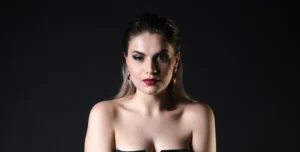
Q & A: Francesca Pia Vitale on ‘The Pearl Fishers,’ U.S. Debut & Dream Roles
By Mike Hardy(Photo: Press Image)
Included in the TOP TEN rising stars of opera by OperaWire in 2022, soprano Francesca Pia Vitale has won numerous international awards after graduating in 2020 from the Accademia Teatro alla Scala in Milan. She is renowned for her eclectic repertoire that in recent months ranges from “Tancredi” to “Rigoletto” and “Orfeo ed Euridice.”
She is currently receiving positive plaudits and reviews for her debut role as the priestess Leïla in Bizet’s “The Pearl Fishers” in Florida’s Palm Beach Opera, alongside tenor Long Long.
She visits more with OperaWire in this exclusive interview.
OperaWire: Congratulations on your US debut, singing at Palm Beach opera. Tell me how you came by the role in “The Pearl Fishers.”
Francesca Pia Vitale: My encounter with Leïla felt completely natural. It’s a role I feel very comfortable with vocally, allowing me to sing with great freedom and to explore new aspects of my voice, as well as colours and nuances that had not yet seen the light of day. Making my debut in the United States with a character with whom I identified from the very first notes is a tremendous gift. I bring a lot of myself to Leïla: her fragility, her gentleness and her simple yet profound desire to love and be loved. She is a priestess, but first and foremost she is a woman, and I believe that her humanity is what really resonates with the audience.
At the same time, I am deeply fascinated by her determination. In the third act, an extraordinary courage emerges, an almost instinctive strength. She is ready to risk everything for love. This determination moves me profoundly and makes me feel even closer to her, because she is not merely an ethereal or contemplative figure, but a vibrant, passionate woman, capable of making choices and fighting for them.
I’m thrilled to be making my debut at Palm Beach Opera, where I have found an incredibly welcoming environment. There is a wonderful cast, a very attentive creative team, and a fantastic conductor. There is a great atmosphere of collaboration and trust. I couldn’t ask for more for such an important debut.
OW: Historically, Bizet’s “Pearl Fishers” has a checkered history, frequently referred to as a ‘flawed work’ and often lamented for its problematic or outdated staging. What can you tell us about this production?
FPV: It’s true that, historically, “Les pêcheurs de perles” has had somewhat of a troubled life and that for many years it was regarded as an “imperfect” opera. Yet I must admit that, as a performer, I struggle to understand why this was, because when you experience it from within you realize just how rich and inspired it truly is. The music of Georges Bizet is extraordinary: the orchestration is full of color, nuance and the most refined detail, and there is something genuinely magical in the way he places and interweaves the voices. There are astonishing musical numbers, moments of pure lyricism and others of great dramatic tension. In my view, it’s an opera that absolutely deserves recognition, above all for the intrinsic richness and variety of styles it contains. And this production enhances it enormously. It was created in 2004 through a collaboration between major companies such as the San Diego Opera and San Francisco Opera and has since toured to several theatres across the United States, including Chicago. You can sense that it is a substantial production, conceived on a grand scale.
Visually, the staging has a striking visual presence and is extremely refined, thanks to the sets and costumes by Zandra Rhodes, which create a world brimming with colour and atmosphere, fully immersing the audience in a realm suspended somewhere between fairy-tale and reality. It’s a production that is not afraid to be beautiful and that restores to the opera its full poetic dimension.
It means a lot to me to be able to experience this double debut with a powerful project. The teamwork that has developed with the cast and with Maestro David Stern – who brings energy, precision and great sensitivity to the score – makes our day-to-day work both stimulating and lively.
There is also a small thread of fate: being reunited with the director Kathleen Smith Belcher, with whom I worked during my time at the Accademia Teatro alla Scala on “Gianni Schicchi” with stage direction by Woody Allen, makes me feel somehow at home even on the other side of the ocean.
The outstanding corps de ballet (with its strong choreography) adds further energy and vitality to the performance, making it theatrically pulsating. To me, this is proof that when a work is approached with love and quality, it ceases to be “problematic” and simply becomes beautiful music theatre.
OW: You have a curious mix in terms of repertoire; baroque, bel canto through to 20th Century fairly modern, with a just smattering of Verdi and Puccini. Did you formulate this path by design, or did things just happen that way?
FPV: The idea of rigidly planning a career is, in a sense, almost surreal. Of course, one can have dreams or a sense of direction, but the reality of our profession is shaped by encounters, opportunities and paths that reveal themselves, often quite unexpectedly.
I thoroughly enjoy challenging myself through this variety of styles. Over the years I have had the opportunity to explore very different repertoires, from Baroque to bel canto and through to twentieth-century music, and I have genuinely loved them all. Each has tested me in a different way. Every style has taught me something: technical control, precision, flexibility, colour and expressiveness. These are not separate worlds. On the contrary, one repertoire does not exclude another; they complement each other. Everything I study and sing contributes to making me more grounded, more vocally aware and more professionally mature.
This variety is essential. It keeps the voice trained, supple and curious. Above all, it continually pushes me to improve, to question myself and to grow. That, ultimately, is what stimulates me most about my work: the feeling of never standing still, of constantly evolving. It’s often by confronting the most demanding challenges that real growth happens. Testing oneself, stepping outside one’s comfort zone and overcoming obstacles are what allow us to develop as artists. But always with deep respect for the voice and for one’s instrument, which remains our home and must be listened to and protected.
OW: You studied and graduated from the Accademia Teatro alla Scala. Tell me about your time there and your favorite memories of such an iconic opera house.
FPV: My time as a student at the Accademia Teatro alla Scala was intense, formative and transformative. It was not merely a period of study, but a true school of life. Each day demanded concentration, discipline and a constant willingness to question oneself. It was a fundamental step in my journey, and I am deeply grateful to everyone who was part of it, because it was there that I built the solid foundations on which my work now rests.
What I carry with me above all from the Accademia is a method: attention to detail, absolute respect for the score and the awareness that talent alone is never enough unless it is supported by rigor and dedication. The guidance of the teachers, as well as the daily exchange with my colleagues, proved invaluable. Even today, when I am preparing a role or stepping into rehearsal, I sometimes catch myself hearing those words within me again, like a quiet inner compass.
One of my most vivid memories is the final stage of the audition. It was the first time I had set foot on a stage as important as La Scala. Until then I had only sung at the conservatoire, in a very different context. I remember perfectly how my legs were trembling with emotion. Yet that feeling did not remain a memory of fear; it became a point of reference. It still reminds me where I began, and how passion and respect for this life can help you overcome any fear.
The Accademia also gave me the opportunity to experience the theatre from the inside: the first stage rehearsals, working with directors and conductors, my debut, the real encounter with the audience. Working side by side with professionals of the highest level are experiences that shape you profoundly, because they teach you to be independent, responsible and ready to adapt to ever-changing circumstances. Today, when I step onto the stage, I feel that discipline and care are part of who I am. I know that the way I approach music, colleagues and the audience was shaped in those years. Being a singer does not simply mean performing; it means safeguarding a tradition, serving the music with humility and working every day to be worthy of the trust that a theatre places in you. And a fundamental part of that awareness was born there.
OW: Of course, like many singers you started from a young age learning piano. Do you think the piano lends itself towards developing the voice, perhaps more so than developing a general development in music or orchestration?
FPV: Well, I wouldn’t say I ever considered myself a true pianist. I had a strong sense of musicality, but rather little patience, especially when it came to the technical study of the instrument. In the early years, however, I worked with a teacher who followed the pianistic school of Vincenzo Vitale, the so-called “old school,” I spent almost a year practicing falls to lighten the wrist, articulation exercises for the fingers, scales and variations, always paying close attention to bodily awareness and muscular relaxation.
Those first years, though demanding, gave me the discipline I later needed to approach vocal study in a structured and methodical way. Singing is different from the piano because the instrument is actually within you. You cannot touch it; you perceive it, you feel it. Yet it requires the same patience and training. Having that technical foundation allowed me to understand how to organize my vocal practice, how to read a score properly and how to give each musical phrase the attention it deserves.
So although I was never a brilliant pianist, the piano provided the foundations I needed to relax and control my own instrument, to grow as an interpreter, to develop musical sensitivity and discipline, and above all to respect every detail of the music I sing.
OW: You were listed as one of OperaWires “Top 10 Rising Stars Of 2022.” With more principal roles planned for this year, do you feel that your star is now on a definite rise?
FPV: Being named one of OperaWire’s “Rising Stars of 2022” was certainly a wonderful recognition, and I received it with immense gratitude. It was an important moment, as it showed me that the work I was doing was being noticed beyond my own perspective. For me, a rising career is not defined by titles or external recognition, but by continual growth, curiosity, the chance to take on new roles, and the constant challenge of pushing oneself further. I like to think of a career not as a sudden explosion, but as a light that gradually grows over time. I prefer to build slowly and steadily, role by role, with care and curiosity. That is what matters most. To continue with the astronomical metaphor, I hope to keep shining as I develop, growing ever brighter, yet with patience and consistency, without burning too quickly. It is far better, I think, to avoid becoming a supernova: making a spectacular display only to fade away too soon.
OW: Where would you like to be in five years? What roles do you aspire to triumph in?
FPV: Five years is a long time, but my main wish is to continue studying and working on as many new roles as possible, to discover new music, explore different vocal worlds, and always strive to improve and refine myself.
Naturally, there are roles I dream of and iconic theatres where I would love to perform, such as the Metropolitan Opera or the Royal Opera House, and roles like Norma, Lucia di Lammermoor or Violetta. These dreams accompany me every day and provide a constant motivation to grow, with patience and dedication. There is also a very special aspiration: to one day sing on 7 December at Teatro alla Scala, on the evening of Sant’Ambrogio. For an Italian artist, this is an incredibly important milestone, representing history, tradition and responsibility.
Beyond these artistic goals, I hope to learn to be a little kinder to myself. I’m someone who rarely feels satisfied: after every performance I always find myself thinking, “I could have done more, I should have done better.” I would like to change this attitude, to live each moment fully, to recognise the progress I’ve made, and to appreciate the journey, without being constantly consumed by the pursuit of perfection.
OW: How do you like to relax away from the stage?
FPV: Free time as a singer is often limited, because between rehearsals and preparing for upcoming productions there isn’t much space to breathe. But I always try to carve out moments to do things I love, things that let me switch off. I enjoy painting, cooking, DIY… you could say I’m a bit of a jack-of-all-trades. I also love going to the theatre, not just for opera, but for symphonic concerts, musicals, plays and even cinema. Anything that is art and storytelling feeds me and inspires me.
Whenever we can, my husband Carlo and I love to travel, even without a fixed plan, a little on the spur of the moment. Discovering new places, seeing a different horizon, getting lost in a city you don’t know – that’s the best way to recharge and return to the stage with a freer, more curious mind. I think it’s so important to nurture passions and relationships outside of work, because they help you breathe, put things into perspective, and, paradoxically, allow you to return to music with greater authenticity.