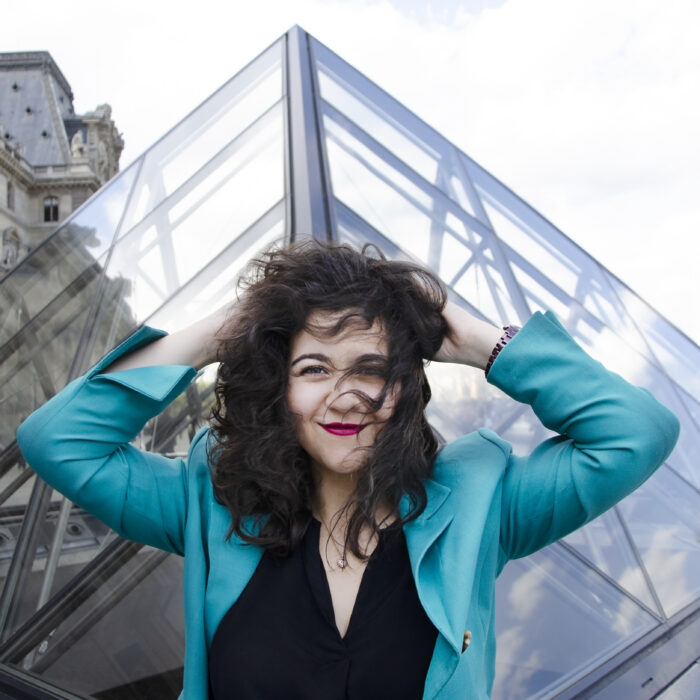
Q &A: Sara Cortolezzis on her Royal Opera House Debut, Verdi & the Challenges of Being a Young Artist
By Francisco SalazarWinner of the first prize “Carlo Bergonzi” and the special prize “Renata Tebaldi” for the best female voice at the 58th Voci Verdiane International Singing Competition in Busseto in 2022, Italian soprano Sara Cortolezzis’ star is on the rise.
Since taking that top prize, her career has expanded rapidly, with high-profile role debuts as Leonora in “Il Trovatore” at the Teatro Coccia in Novara, Elena in “I Vespri Siciliani” at the Teatro Comunale in Bologna, Desdemona in “Otello” at the Teatro Petruzzelli in Bari, Mimì at the Tiroler Festspiele Erl and Amelia in “Simon Boccanegra” during an Opera North tour in the UK. Most recently she made her debut at the Royal Opera House as Hélène in Verdi’s “Les Vêpres Siciliennes.”
OperaWire spoke to Cortolezzis about her recent Royal Opera House debut, the Teatro La Fenice, and her upcoming projects.
OperaWire: What was it like to make your Royal Opera House debut earlier this season?
Sara CortolezzisL: Making my debut at the Royal Opera House was an incredible and unexpected emotion, and perhaps for that very reason even more exciting. It was also a wonderful personal milestone, both for how it unfolded and for the opportunities it generated.
OW: Was that a dream you had?
SC: Of course. Debuting at Covent Garden was one of those artistic milestones I had always hoped to achieve. I’m so grateful that it happened so early in my career and with such an extraordinary cast of artists.
OW: Tell me about jumping into this production and later in Simon Boccanegra. What are the challenges of jumping in and how do you prepare for a swift turnaround like this?
SC: One of the biggest challenges of jumping into this production was going on stage with very little rehearsal time, both scenically and with the orchestra. Luckily, I arrived very well prepared musically, and I had worked on the staging during the first weeks of the production, which helped me feel secure dramatically.
I was also incredibly fortunate to have the support of Maestra Speranza Scappucci. The atmosphere was calm and collaborative, and there was a strong sense of mutual respect and trust among everyone involved. That made a huge difference — it allowed me to feel relaxed on the day of the performance and simply focus on bringing my artistry to the stage, knowing I had everyone on my side.
As for Simon Boccanegra at La Fenice in Venice, everything happened extremely quickly. I received the call at noon to replace an ill colleague, and luckily I was only an hour away by train. The role of Amelia was still fresh, since I had debuted it the previous year in England, which definitely helped. There was almost no time to rehearse, so I went on stage without a very clear idea of the staging, although it turned out to be quite intuitive.
What I’m most proud of in moments like these is my mindset. I don’t even know if it’s really a merit or simply a fortunate part of my personality, but in both of these jump-ins I honestly didn’t have time to get nervous — I was simply too happy and excited to have the opportunity to step onto such important stages. I walk on stage trying to enjoy every second as much as possible, and making my debut in this way at the theatre of my own city made the whole experience even more special and unforgettable.
OW: You sing a lot of Verdi. Do you feel that repertoire is good for your voice?
SC: I love the Verdi repertoire and I have a special relationship with this composer, who has always brought me great fortune, starting with the Concorso Voci Verdiane, which I won in 2022. I work with an excellent coach specialized in Verdi repertoire, with whom I have prepared every single debut. He is teaching me how to interpret this music with the right style, phrasing, and accents. I believe this has truly made the difference, and it is largely thanks to him that I have been able to approach these roles while staying true to my vocal identity, which at the moment is that of a lyric coloratura soprano.
OW: What is your favorite Verdi role?
SC: I love Violetta very much, as well as Amelia in Boccanegra.
OW: You’ve also done Mozart and Puccini. How does this repertoire work for you and how does it differ from Verdi?
SC: Singing Mozart is fundamental for me in order to maintain vocal health and stylistic clarity over time, especially after performing late nineteenth- or twentieth-century repertoire. I feel it is essential to “reset” , most of all after demanding productions, and I hope to continue singing Mozart for a long time.
Puccini, on the other hand, is a composer I hope will accompany me more and more in the coming years. It was through his music that I first fell in love with opera, and I find it very stimulating to interpret his heroines, which are psychologically rich and fully developed. Vocally, his music requires a softness in the line and a roundness of sound that greater vocal maturity can support. So far, I have approached him with Gianni Schicchi and La Bohème, and there are all the conditions for a deeper exploration in the coming years.
OW: What are some of the performances you are looking forward to next?
SC: I am preparing Bernstein’s Kaddish and Ravel’s Shéhérazade, which I will debut under the direction of Maestro Eliahu Inbal, a true legend. After that, I will be preparing a series of role debuts: the Countess in Le Nozze di Figaro, Olga in Fedora, and Donna Anna in Don Giovanni.
OW: What are some of the challenges of being a young artist in today’s opera world?
SC: Entering the market was certainly not easy. You need patience, because healthy professional growth does not necessarily coincide with a large quantity of work. It is important to focus on the quality of your work, your study, and the right repertoire, approached without rushing. This often involves significant costs that you need to be prepared to manage. For me, this has been the most challenging aspect at the very beginning of my career. It is also important to recognize that there are many sopranos today. Competition is strong, and everyone is eager — and needs — to work. It is simply a reality that young artists must learn to navigate. For me, it has therefore been essential, within this competitive environment, to maintain a sense of sportsmanship and respect toward colleagues. In the end, I believe that staying grounded, focused on artistic growth, and supportive of one another is essential for building a meaningful and lasting career in today’s opera world.