Q & A: Anna Skryleva on Making Her Debut at Opera Australia & ‘Eugene Onegin’
By Francisco Salazar(Credit: Katharina Gebauer)
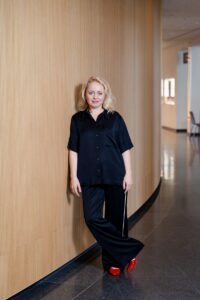
Anna Skryleva is an award winning conductor, composer, pianist, and synesthete.
She regularly appears as a guest conductor at prestigious opera houses including the Hamburg State Opera, the Royal Swedish Opera, the Dallas Opera, the Gewandhausorchester Leipzig, and the Frankfurt Radio Symphony Orchestra and this season she made her Teatro alla Scala debut.
She is also making her debut at Opera Australia where she will conduct Tchaikovsky’s “Eugene Onegin.”
OperaWire spoke with Skryleva about Opera Australia and the famed Tchaikovsky piece.
OperaWire: Tell me about working at Opera Australia.
Anna Skryleva: It has been a wonderful experience to work here in Sydney. What I especially enjoy is the atmosphere in which a theatre hierarchy can function on equal terms and with great mutual respect.
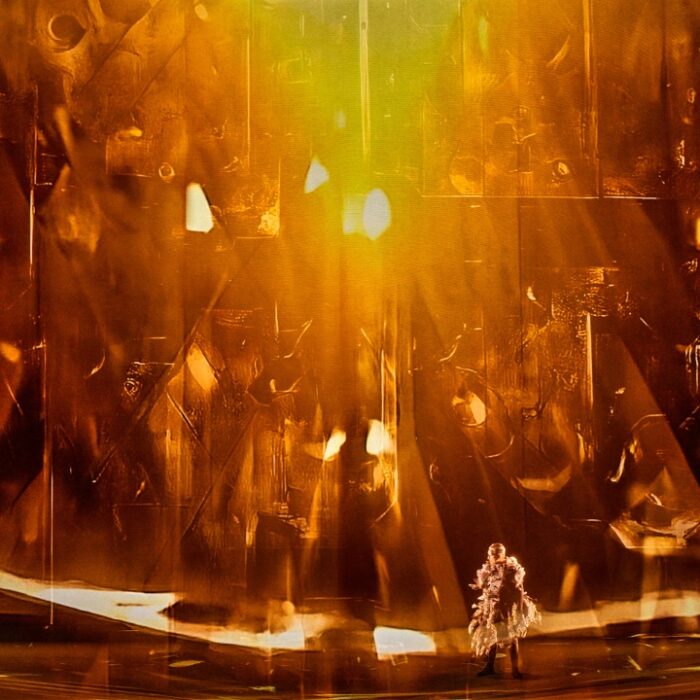
I feel very fortunate to be part of this beautiful production by Kasper Holten. I find the concept of this staging truly compelling, as it allows the characters to unfold in a very natural way while conveying the unique atmosphere and color of the period. And of course, it is incredibly exciting to stand on the podium in this famous house, which has long become one of Australia’s cultural landmarks.
OW: While in Australia, will you be exploring the city and what are you excited to see there?
AS: This is actually the second wonderful reason to be here. Australia is so far away that when one undertakes such a long journey, one naturally hopes to have the time to experience the country and its way of life.
I must say that I am truly enjoying these weeks in Sydney. My husband is here with me, and on our days off we explore this extraordinary city and its beautiful natural surroundings. It is one of the rare moments in my life when I can genuinely speak about something like a “life-work balance.”
We have also met many wonderful colleagues whom we knew from our time in Germany and who are now living and working in Sydney.
OW: Why is this debut so important for you? When did you first hear about this theater?
AS: Between 2007 and 2012 I worked in Hamburg with Simone Young. I assisted her, among other projects, on Wagner’s “Ring,” and she was an enormous supporter of my career.
Of course, like many people, I had known the image of the Sydney Opera House from television and postcards long before. But through my close contact with one of the most prominent conductors from Australia, my awareness of Australia as a cultural landscape became much deeper.
During that time I also met many fantastic Australian musicians and singers, many of whom built remarkable careers in Europe. Most of them eventually returned to Australia because they missed their homeland. Now that I have spent several weeks in Sydney myself, I completely understand them. The balance between life and work here is truly impressive.
For me personally, however, it would be difficult to live permanently so far away from Europe. It is wonderful to spend time in this extraordinary country, but my home remains in Europe.
OW: Tell me about “Eugene Onegin.” When was the first time you heard it?
AS: I cannot answer this question precisely. Having been born and raised in Moscow, I cannot remember the exact moment when I first encountered this music.
However, I became consciously engaged with the opera only later, in Germany. During my time in Russia—quite literally in the previous century—I was focused mainly on other repertoire rather than opera.
While studying as a concert pianist at the Moscow Conservatory, I naturally played other works by Tchaikovsky, such as the First Piano Concerto, the famous Piano Trio, and many of his romances.
Only later, when I began studying conducting in Germany, did I explore the operatic repertoire more deeply—initially more the Italian and German traditions. Interestingly, many presenters now ask me specifically to conduct Russian repertoire. Yet I prefer not to be defined exclusively by it. My artistic identity was not formed only in Russia.
I have lived in Germany for more than twenty-six years. I speak German as fluently as Russian and read German literature in the original—Goethe, Schiller, Thomas Mann, and many others. At the same time, having Russian as my mother language gives me the privilege of understanding works like “Eugene Onegin” on a very intimate level and bringing them closer to audiences.
OW: As a young woman, did you read the Pushkin novel?
AS: Yes, of course I read Pushkin as a young girl. Later I returned to the novel again as an adult. I was also fascinated by the famous commentary on “Eugene Onegin” by one of my favorite authors, Vladimir Nabokov.
OW: What are some of the opera’s challenges?
AS: The challenge in “Eugene Onegin”—and in Tchaikovsky’s music in general—is to find a sound that resembles the natural phrasing of human speech.
There is always a danger with Tchaikovsky of falling into false pathos. At the same time, Tchaikovsky himself described “Eugene Onegin” as “lyrical scenes.” The word “lyrical” must also be treated carefully, otherwise the interpretation can easily become overly sentimental.
For me, Tchaikovsky’s lyricism is above all psychological and inward-looking. It has a certain simplicity and intimacy. The real challenge is to sustain this atmosphere across the entire work while still maintaining dramatic tension.
OW: What is your favorite part of the opera?
AS: It is very difficult for me to single out one moment. Tchaikovsky’s opera is far more emotionally intense than Pushkin’s ironic verse novel.
Through Tchaikovsky’s music, each character undergoes a powerful dramatic transformation. What fascinates me most is the gradual shift from the everyday life of a somewhat bored and idle society into a deeply personal and psychological drama.
OW: Compared to other Tchaikovsky scores, how does this one compare?
AS: As I mentioned earlier, what distinguishes this work from Tchaikovsky’s other operas is its intimate character. The composer focuses primarily on the inner world of his characters.
Musically, the work contains many clearly structured numbers—arias, duets, and ensembles—which has also contributed to its popularity. Many of these arias are frequently performed in concert. I think almost everyone has heard Lensky’s famous aria, “Kuda, kuda?” at least once.
OW: Tell me about the cast and have you worked with any of them?
AS: We have a wonderful cast. One of the finest interpreters of Onegin today, the outstanding baritone Andrei Bondarenko, sings the title role. He has performed this part with great success on many of the world’s major stages.
The other principal roles are sung by excellent Australian artists, many of whom have built successful international careers: Lauren Fagan, Nicholas Jones, Sian Sharp, David Parkin, Helen Sherman, and Angela Hogan.
It is a very cohesive ensemble. Although I am working with all of them for the first time, I am deeply impressed by the sensitivity and artistic depth that each performer brings to their character, both vocally and dramatically.
OW: What other Russian operas would you like to conduct and which would you like to repeat?
AS: To be honest, I would prefer not to limit my repertoire only to Russian opera. I am very eager to continue conducting works by Richard Wagner and Richard Strauss, whose symphonic approach to opera fascinates me deeply.
If we speak about Russian repertoire, however, one work I would particularly love to conduct is Shostakovich’s “Lady Macbeth of Mtsensk.” The immense contrasts in this opera make it both fascinating and incredibly challenging.