Q & A: G. Phillip Shoultz, III Artistic Director, Educator, and Pastoral Musician on ‘Sing Democracy 250’
By Arnold Saltzman
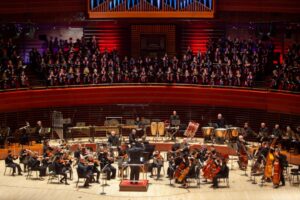
G. Phillip Shoultz, III, Artistic Director of “Sing Democracy 250” reveals what went into the preparation and nature of the upcoming concert in Constitution Hall, a concert to echo the words of the Declaration of Independence 250th anniversary. “Sing Democracy 250” is a multiyear program bringing youth choirs and adult choirs from around the country to seek meaning in the anniversary of American Independence. At a time of division in the United States, this program seeks to bring people together and especially to inspire youth through connecting to the foundation of the country and its promise. Seeking a “more perfect union” through music which can create a sense of community and obligation to work for a better future.
OperaWire: Who initiated the idea for “Sing Democracy 250?”
G. Phillip Shoultz, III: The idea for “Sing Democracy 250” was initiated by the founders of project, Gary Aamodt and Celia Ellingson, who created the “Together In Hope Project” in 2017. The “Together In Hope Project” is a Minneapolis-based nonprofit organization that creates unique, music-anchored projects to address specific needs and to provide opportunities for healing and reconciliation.
OW: What do you hope to achieve with this program?
GPS: “Sing Democracy 250” aims to ignite a nationwide movement. From every state in this nation, the power of song will ring out in 2026, a symphony of unity and hope, echoing the words of the Declaration of Independence.
It is our hope that Sing Democracy 250 will inspire Americans to do their part to strengthen this democracy. Democracy depends on all of us. We, the people, are the key. This is our time to fulfill democracy’s promise.
We want to inspire the future, to cultivate a new generation of citizens who embrace their responsibilities and believe in the transformative potential of democracy.
OW: When did you begin preparing the participants?
GPS: I’ve been involved in the project for two years now. The initial phase was to select the participants of the “Together In Hope Choir,” a collective of Minneapolis based singers who serve as the anchor choir for each of the four signature concert performances (Philadelphia, Minneapolis, New York City, and Washington, DC). That ensemble of fifty singers has been preparing the music for over a year. We held quarterly retreats to rehearse and discuss the topics of relevance captured in the music.
From there, I worked with our team to select the choirs and orchestras that would join us from each city. Those ensembles begin preparation on their own and then I made a trip to visit them before our residency period leading up to the performances began.
OW: How did you decide on the music and pick the composers?
GPS: We knew we wanted to include our nation’s anthems, “Star Spangled Banner” and “Lift Every Voice and Sing,” as the bookends to the program. So, I created an a cappella arrangement of each for us to use.
Our project co-founders, Gary and Celia, curated the texts for the project with one piece, “Redeem the Dream,” composed by University of Missouri professor, Dr. Brandon A. Boyd based on the writings of Langston Hughes. That work sets the context for where we’ve been and how America has not always lived up to the ideals it espouses. The second commissioned work, “US,” was written by Long Island based composer, Michael Bussewitz-Quarm, and is based on a book by Richard Haas called “The Bill of Obligations.” Gary and Celia selected a series of 33 quotes from thinkers all across the ideological spectrum that invite each of us to consider the actions we will take to help fulfill democracy’s promise.
The two commissioned works were written specifically for this project and were designed to be sung together.
OW: How often did the younger singers meet in order to rehearse?
GPS: This is a tricky question to answer. In each location, the amount of rehearsals is different. Some of the young singers are part of a community choir that rehearses once a week. Others are part of a school choir that rehearses daily. Each of the groups began their preparations three to four months ahead of our performance together.
OW: What is your background? Can you give us an idea of your grounding as an artist, educator and Pastoral Musician?
GPS: My grounding began from the age of three at the Fourth Street Baptist Church in Columbus, Georgia where I sang my first solo. From there, I participated in the Columbus Boy Choir and traveled the world as an elementary school aged singer. Music in church and school continued to play an influential role throughout high school and college where I began to play for worship services and lead ensembles. A pivotal moment in my development occurred during my junior year at the University of Georgia, where I was asked to step in and lead my peers in the Men’s Glee Club in performance for the spring semester because our director, Dr. E. Pierce Arant took ill. Dr Arant told me he needed me to do this and that I had the skills. That experience helped me to find my calling as a leader of vocal ensembles. From that time, I honed my craft as an educator and began teaching middle school, director community-based choirs for singers of all ages, and have served churches in the Missionary Baptist, African Methodist Episcopal, Lutheran, United Methodist, and Presbyterian traditions.
OW: Can you tell us why people should support this program?
GPS: I think people should support this program because our mission is simple yet profound. We seek to bring people together across the lines that divide into community to celebrate our shared humanity, and to recommit to the promise of a “more perfect union.”
OW: How do you view your message in these troubled times?
GPS: We are musicians, singers, artists, and advocates, all bound by the belief that music can bridge the gaps and mend the divides.
Music is a language that transcends cultural boundaries and can unite people of different backgrounds. Throughout history, music has played a crucial role in social movements. From protest songs to anthems of solidarity, music has been used to express dissent, promote unity, and inspire change. Music has the power to connect people and create a stronger community.