Q & A: Julia Muzychenko-Greenhalgh on Her Work as Juliette for Teatro Real’s ‘Roméo et Juliette’ & Her Dream Roles
By Galina AltmanToday’s guest is soprano Julia Muzychenko-Greenhalgh, a representative of a new generation of opera artists and the winner of numerous prestigious international competitions, including First Prize and the Audience Award at Ópera de Tenerife in Spain, as well as the Grand Prix at the Jacques Offenbach International Competition and the Verdi Voices Competition.
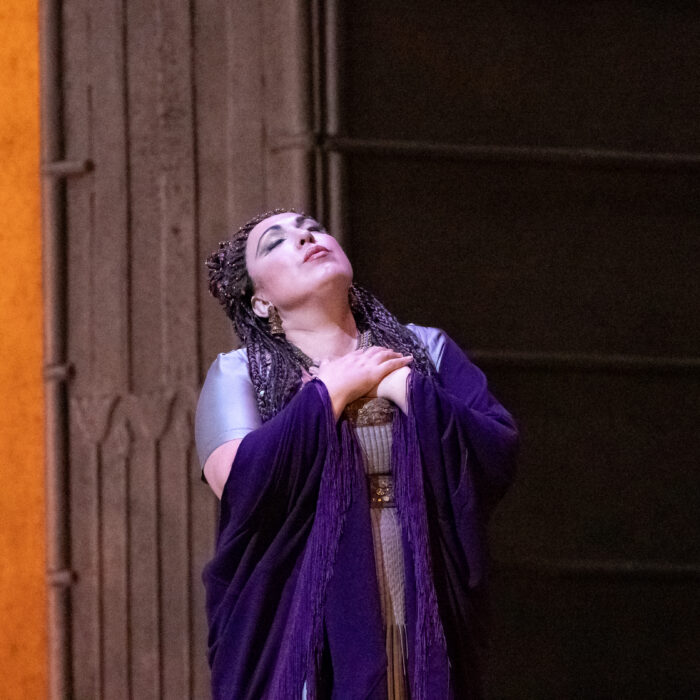
She is currently appearing as Juliette at Madrid’s Teatro Real, performing one of the most coveted and demanding soprano roles in the French lyric repertoire.
OperaWire spoke with Muzychenko-Greenhalgh about her artistic plans, her work on Juliette, her Madrid debut, and how a contemporary operatic heroine is born on the stage of the 21st century.
OperaWire: In this production, Thomas Jolly makes a bold visual gesture–he takes the grand staircase of the Palais Garnier, the ultimate symbol of the elegant and prosperous Belle Époque, and transforms it into a dark Gothic crypt engulfed in shadows. From the auditorium, this aesthetic dissonance feels incredibly powerful. Tell me, what is it like to inhabit this visual horror from within? Does the concept help reveal the Shakespearean tragedy that Gounod, with his refined French lyricism, perhaps tried to soften and polish?
Julia Muzychenko: In my opinion, Thomas stayed remarkably close to Shakespeare. He did not really alter the essential elements. Directors often like to experiment, but he followed the classical story quite faithfully. I was fascinated when he explained that the cave and the boat in which the lovers are married–and later in which Juliette is laid to rest–are actually inspired by the underground lake that really exists beneath the Palais Garnier. It was originally created during construction for structural stability and fire protection.
It immediately reminded me of “The Phantom of the Opera,” where the Phantom sails across the underground lake, and suddenly everything became even more exciting, almost cinematic. People do not necessarily think about why there is a boat on stage–they simply see something beautiful. But behind it lies an entire story, so I am glad to have the opportunity to share it.
OW: I think it is a boat of love.
JM: Exactly. It immediately creates associations. Thomas told me, “One day, when you make your debut at the Opéra Garnier, whisper in someone’s ear and ask them to take you down to see the lake. It is not large, but it is incredibly impressive.”
So this is based on reality–there really is a lake beneath the opera house, which is why we have this vault from which the boat emerges. Above ground there is one world; below, an entirely different life exists.
OW: Do you personally prefer productions that are richly decorated, with lots of detail, choreography, and movement? Or do you prefer minimalism, where you can focus solely on acting?
JM: This production achieved a perfect balance. The first scene is full of dancing, fireworks, costumes–there is an abundance of visual activity. At first, I worried that all of this would distract from the music and draw attention away from it.
But Thomas handled it so skillfully that the balcony scene, where there is almost nothing–just Juliette, the light, and Roméo–feels completely different. Suddenly you focus entirely on the music, the voices, and the line connecting two people.
All the bustle of the first act is exactly what a ball should be. It is Juliette’s first experience of society, of crowds, of the outside world. Everything flashes before her eyes. And in the middle of all that chaos, she meets her first love.
Incidentally, this production marked the first time I drank alcohol on stage. I even wanted to take a drag from a cigarette, but Nurse Gertrude took it away from me. Thomas also described the moment when Juliette looks from one young man to another and said, “It’s like modern Tinder–swipe, swipe, swipe, not him, not him. Then suddenly: Roméo.”
OW: And suddenly there is a match.
JM: Exactly. Suddenly there is a match. And she grabs him. She literally stops him as he walks by. Even with the mask on, she senses his energy. Something about him intrigues her, and she immediately thinks, “Take off the mask. I need to see who you are.”
That is her ball, and that is love at first sight.
OW: Why do you think she falls for him? Because he is different from everyone else, or because she immediately recognizes him as her person?
JM: I think he had not even spoken yet, and she had already felt something. There is a kind of cosmic connection between them from the very beginning. He could have walked right past her, but somehow they connected before a single word was exchanged.
And then they begin speaking while dancing, and that is it–they know they were made for one another. A few minutes are enough for them to fall in love for life. I believe that is a very real truth.
OW: The action unfolds very quickly–only five days. Yet in those five days they live through an entire lifetime, a drama, a tragedy. Beyond your remarkable vocal performance at the premiere, your acting was equally striking. Many of us were genuinely in tears. How did you prepare for the role? What inspired your interpretation?
JM: I can honestly say that Juliette was difficult for me. It is an extremely demanding role. In some ways it reminds me of “La Traviata.” There is a famous observation that one soprano must sing as though she were three different voices and three different characters.
At first she is a high coloratura soprano. Then she becomes more dramatic. Then she transforms again.
The same thing happens in Gounod. Juliette enters on a high note, floats through her famous waltz, and then gradually moves into a more lyrical dimension as genuine suffering begins. She is married, she has experienced her wedding night, and suddenly fate throws everything at her at once.
And this is a girl who is only fourteen, almost fifteen years old. To experience all of this within five or six days–and to portray it on stage over two and a half hours–is incredibly difficult.
The second half of the opera is especially demanding. From the wedding-night scene until the tomb scene, I am on stage almost continuously. It is exhausting physically and emotionally. The morning after the premiere, I felt as though I had been carrying Roméo in my arms all night.
OW: And from an acting perspective–where did you look for inspiration? Were there books, films, performances that influenced you?
JM: I absolutely love Zeffirelli’s film. To me, his Juliette is perfect. She combines innocence and youthful tenderness with great passion and romantic intensity.
That duality is exactly how I see Juliette. Those glances, those shadows, those subtle emotional shades.
OW: How much does such a powerful and even aggressive directorial environment affect your vocal approach? How do you maintain flawless French legato when your body is fully subjected to the demanding laws of contemporary physical theatre?
JM: A dramatic role is always difficult. Although people say comedy is just as hard–making an audience laugh can be as challenging as making them cry.
For me, a successful performance contains three elements: goosebumps, tears–or at least moist eyes at some point–and a smile. If all three are present, then the performers have successfully conveyed the director’s vision.
It is always challenging when you arrive on the first day and discover that the director’s concept is completely different from your own vision of the character. Then you have to adapt, ask questions, negotiate.
Sometimes directors are very collaborative and you create the character together. Sometimes they are very direct: “This is the way it will be.” In that case, you simply have to remain flexible. We often depend on the director’s perspective, and that is not always easy.
OW: Was Thomas Jolly directive in that sense, or did he adapt to your vocal and dramatic needs?
JM: Working with Thomas was wonderful. He constantly asked, “How do you feel here? Are you comfortable? If not, we can stage it differently. You can come down later, move elsewhere, do it another way.”
We were creating together. Nadine Sierra did the same. She came in and said, “I’m not comfortable with this. Let’s change it.” And then everyone started experimenting, and together we built something very interesting.
During rehearsals I had three different Roméos.
Yes, really–don’t laugh.
The moment we arrived and introduced ourselves, Thomas immediately said, “Let’s start with Act four–the bedroom scene.” We had barely shaken hands when suddenly it was, “Here’s the bed. Lie down.”
Originally, Roméo was supposed to appear wearing only underwear. But Ismael Jordi immediately said, “No, I’m not comfortable with that.” Once that changed, many other things had to change as well.
Honestly, I was a little disappointed. It might have created a more intimate moment. But in another sense it worked perfectly, because that love scene brought us together from the very beginning, exactly as Thomas intended.
Then the next Roméo would come in, and every time something new emerged. Each singer brought completely different energy. One was more tender, another more passionate, another more romantic. Working with three partners was fascinating.
People would ask me, “Julia, there’s still another Roméo left. Do you have the energy?”
And I would answer, “Absolutely. Bring on the next Roméo!”
Because it was genuinely exciting.
OW: We were joking among ourselves that Roméo in trousers and a T-shirt looked a little British. Well, Shakespeare was English after all. What has been the most physically demanding production of your career?
JM: Probably this one–”Roméo et Juliette.”
Juliette is on stage almost constantly. We were dancing all the time, running up and down the staircase. I even had to fall down it and tumble head over heels.
A specialist came from Milan–Ran Arthur Braun, essentially a theatrical stunt coordinator. He taught us how to fall safely. “Faster! Faster!” he would say.
The difference is that film stunt performers get multiple takes. The camera can cut away. In theater everything happens live. You must fall convincingly, and you must do it yourself while remaining in character and singing.
There is no possibility of saying, “Excuse me, my stunt double will take over now.”
At first I thought I would never manage it. Eventually I did–and it looked very effective.
The second half of the opera is physically exhausting because we are constantly dancing and running up and down that staircase.
OW: I was genuinely worried watching you. I kept thinking, “How does she keep falling and rolling without tripping?” I wondered whether the stairs were secretly soft or padded.
JM: No, they are real stairs with solid steps.
We wore protective elbow and knee pads, of course. Safety was essential. And you need to protect your face.
OW: Lately it seems to me that female operatic heroines have become far more contemporary than their male counterparts. They were originally conceived as muses or romantic partners, yet today Violetta, Juliette, and many others often feel strikingly modern. You watch them and wonder how they will solve the problem. What modern qualities do you see in your Juliette?
JM: That is an interesting question.
I think that in many operas, perhaps in all of them, female characters are strong personalities. They control their destinies. They make decisions. They carry enormous burdens.
From Violetta to comic heroines who manipulate men exactly as they wish, these women are powerful.
And now we live in the twenty-first century. I am very happy that times are changing. We can work where we want, pursue what we want, choose our partners, decide whether we want a family.
I think opera is especially relevant to women today because this is the era of strong women at the height of their powers.
OW: What is it about Juliette that inspires you personally as a young woman?
JM: For me it is the moment when she decides to drink the potion.
To drink something from which she may never wake up.
And in the aria she imagines everything that could happen. What if she wakes up inside the tomb and cannot get out? Claustrophobia, darkness, terror.
And yet she still decides to do it.
I do not know whether I could be that brave. Especially at fifteen years old.
That courage is what inspires me most.
OW: Is there a particular acting tradition that feels especially close to you?
JM: As a child I went to the Mariinsky Theatre in St. Petersburg from the age of five. My parents took me constantly.
At that age I simply enjoyed the music and the overall experience. I paid little attention to acting.
Later I discovered Medici and Mezzo and gained access to international productions. Suddenly I saw something completely different.
The Salzburg Festival. Minimalism. A red sofa, a clock, and nothing else.
At first I thought: “How can this work? Where are the crinolines?”
And then you find yourself watching it like a film, unable to look away.
That made me think deeply about acting.
I felt that opera sometimes lacked dramatic intensity, so I started attending spoken theatre. The Bolshoi Drama Theatre, the Alexandrinsky Theatre, the Workshop Theatre.
I often went alone so that nothing would distract me.
I constantly analyzed performances. How does she play this moment? How does she create that emotion?
Then I tried to bring those discoveries into opera. To add a stronger dramatic dimension while preserving the musical one.
A dramatic actor can hold a pause indefinitely. A singer cannot. We have tempo and rhythm, and we cannot break them.
You must fit the emotion inside the musical structure and make it reach the very last row of the gallery.
Not through a small gesture, but through an inner impulse powerful enough to travel across the entire hall.
That is something I am always working on.
OW: Is there a dream role you are currently preparing for?
JM: Two.
The first is Marfa in “The Tsar’s Bride.” I adore that period, the story of her pure love, her suffering, and Russian music connected to that world.
There is currently tremendous interest in Russian repertoire beyond Tchaikovsky. Rimsky-Korsakov alone offers an enormous and magnificent universe.
The second is Lucia in “Lucia di Lammermoor.”
I fell in love with the role as a student when I attended a Met Live screening with Anna Netrebko in the title role.
I was overwhelmed. I felt as if I were flying.
The Gothic atmosphere, Scotland, the murder, the mad scene–I would love to add Lucia to my repertoire.
OW: Yesterday there was phenomenal acting and extraordinary singing that brought the audience to goosebumps and catharsis. Madrid clearly embraced the production.
JM: Yes, I felt it.
There are moments when everything stops. Silence. The entire audience freezes.
When I stabbed myself and there was all that blood, I noticed a man sitting in the front row. He and his wife both reacted: “Oh!”
And then that collective gasp spread through the entire theatre.
Everyone knew how the story would end. But visually, seeing it happen that way–the white dress, one moment alive and the next gone–came as a shock.
The audience stopped breathing.
There was a genuine connection with the hall. I truly felt it.