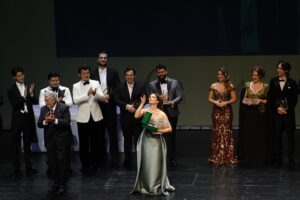
Operalia 2026: The World’s Audition Room Moves to Shanghai
By Rudolph TangThirty-four singers took part. Seventeen appeared on each of the two quarterfinal days, 26 and 27 October, at the conservatory’s 742-seat He Luting Concert Hall, accompanied by pianists Artem Grishaev, Kamal Khan and Nino Sanikidze. Each singer offered selections of their own choice, along with a zarzuela if they wished to compete in the special category devoted to the Spanish form so beloved by Domingo. The semifinal followed on 28 October. The final took place on the evening of 1 November at Shangyin Opera House, with Plácido conducting the Shanghai Conservatory Orchestra for the zarzuela round.
Plácido presided over a jury of twelve that read like an opera world’s all-star recruitment department: Sophie de Lint (Dutch National Opera), Marta Domingo (stage director), Jonathan Friend (casting consultant), Michael Heaston (Metropolitan Opera), Peter Katona (Royal Ballet and Opera), Robert Körner (Wiener Staatsoper), Liao Changyong (Shanghai Conservatory), Erik Malmquist (Bayerische Staatsoper), Isla Mundell-Perkins (Festival d’Aix-en-Provence), Christina Scheppelmann (La Monnaie), Sebastian F. Schwarz (Teatro alla Scala) and Evamaria Wieser (Salzburg Festival and Lyric Opera of Chicago).
Fourteen singers from China, Russia, South Korea, Ukraine, the UK, Kazakhstan, the United States, Spain and Cuba reached the final. Then the winners were announced. Not everybody was happy. The absence of a winner from the host country left many Chinese opera enthusiasts dismayed, though it could equally be taken as evidence of the panel’s independence. Those who failed to reach the final, meanwhile, had other reasons to enjoy their time in Shanghai. Operalia is not necessarily a case of winner takes all. One singer might leave with a Rolex, another with a cheque, and someone else with a job offer. New acquaintances and professional connections can be prizes in their own right.
One of a Kind
Ask the jurors what makes Operalia special and a familiar set of features emerges: the audition, the travelling format, the pressure, the standard of singers and, above all, the opportunities that can follow.
For a young singer, few occasions offer such concentrated access to the people who shape casting decisions at the world’s major opera houses. At Operalia, a performance is heard not by one artistic director or casting department, but by a roomful of influential decision-makers. A singer who catches the attention of one juror may also find their name passed on to colleagues elsewhere. In that sense, the competition functions as an unusually efficient international introduction, with exposure extending well beyond the institution represented by any one member of the panel. As Peter Katona put it, it is “good publicity.”
The competition’s travelling format is another distinguishing feature. Unlike contests anchored to a single city, Operalia moves around the world, rather like a Formula One season. Its recent destinations have included Sofia, Mumbai, Cape Town, Riga and Moscow. Each new host brings a different musical environment, audience and pool of local talent into the picture. The competition is not simply exported from one established opera centre to another; it is repeatedly placed in a new context, gaining a fresh identity with every edition.
But the exposure that opens doors can also close them. A weak performance in front of such an influential jury is unlikely to remain a private disappointment. Katona acknowledged the uncomfortable symmetry: “At the same time, if you fail badly, it also spreads, of course, but that’s life.”
For young singers, this is an early encounter with the pressure of professional opera, where the people listening may also be the people who decide whether they will work again. Sebastian F. Schwarz offered a particularly stark illustration of what awaits them at La Scala, recalling the possibility of a member of the loggionisti shouting “go home, you dog” during or after an aria. It is an extreme form of audience reaction, but one that underlines the unforgiving nature of the profession. A casting director must therefore do more than identify a promising voice. They must also judge whether a singer is ready to withstand the demands of the stage.
The competition’s reputation rests partly on the calibre of its participants over the years. Katona believes that Operalia has consistently attracted an unusually strong field, and that its success should not be measured only by the winners. Looking back at its finalists and semifinalists from ten, twenty or even thirty years ago, he can still recognise many names who went on to build substantial careers. That longer view is important: a competition may produce a winner on a particular evening, but its real influence is better measured by the careers it helps set in motion. Schwarz also pointed to the advantage of having Plácido himself present, with his accumulated experience, guidance and ear for singers.
The jurors are not merely critics handing out marks. They are casting directors, and the possibility of an engagement is never far from the surface. Yet the relationship between a competition result and a professional contract is rarely straightforward. Katona is often more interested in discovering a singer than in identifying the eventual winner. Someone further down the rankings may prove a more compelling prospect for a particular theatre or role. The jury members are looking at the field through different institutional lenses, and the singer who does not fit one house may be exactly what another needs.
An offer, moreover, is not automatically a gift. Once a theatre offers a role, expectations follow: the singer must be able to fulfil the contract and deliver the job. Evamaria Wieser, who runs the Young Singers Project in Salzburg, faces a similarly practical calculation. The festival may hear many impressive voices, but she must select those that fit the roles available in its programme. The best singer in a competition is not necessarily the right singer for a particular production.
Nor does a disappointing result have to mean the end of the relationship. A singer may not yet be ready for a role, or may simply be at the wrong stage of their development. Schwarz suggested that jurors should sometimes be prepared to identify a talent worth watching and inviting them back in two or three years. In opera, timing can matter as much as talent. A voice that is not quite ready today may become a valuable asset tomorrow.
What Jurors See in a Singer
What, then, makes a singer stand out? For Katona, technical polish is only the beginning. He has heard many refined and accomplished performances, but is more interested in whether a singer possesses a genuine personality that can illuminate an entire role. A competition aria is only a few minutes long; a stage performance requires a much fuller artistic identity. The singer must bring an inner life, a mind and a soul to the music, as well as warmth, strength and energy. It is not enough, in his memorable formulation, to be “just a voice on two legs”.
Schwarz approaches the question from the perspective of the theatre each juror represents. The strongest voice is not necessarily the most suitable one. Power alone is no guarantee of a successful casting decision: the singer must fit the particular role, the acoustics of the house and the expectations of its audience. Each juror therefore makes an individual assessment based on the needs of their own institution. This is not a process of finding a universally agreed ideal, but of matching artists to the very different demands of opera houses.
Wieser’s perspective is similarly grounded in the realities of casting. In Salzburg, she is looking for singers who can meet the demands of the roles they are expected to perform during the festival. She was impressed by the development of the young singers she encountered, but the question remains whether that promise can translate into the specific requirements of a production.
The scoring system is simple, and deliberately private. Jurors award points on a scale from five to ten, and the same singer may receive a ten from one juror and a five from another. There is no collective discussion or negotiation over individual marks. Each juror votes independently, and the totals determine the outcome. Katona described the principle succinctly: “points are points.”
This means that a result can surprise even the people deciding it. A few different votes might have produced a different ranking, but the process requires a line to be drawn somewhere. The final order is therefore not necessarily a declaration of an absolute artistic hierarchy. It is the sum of twelve individual judgements, each shaped by a different set of ears, expectations and institutional needs.
That variety was visible in this year’s field. The baritones emerged as the strongest group, with four reaching the final, three of them Chinese. Schwarz described the selection of male voices as a “great luxury”, while also cautioning against reading too much into one year’s outcome. Like wine, the quality and character of a competition field change from year to year.
Shanghai and Operalia
Hosting Operalia places Shangyin Opera House, open since 2019, among the national and royal opera houses that have staged the competition. The venue has developed its own productions, including La traviata, La bohème, Die Zauberflöte, Il Barbiere di Siviglia and Carmen, alongside original Chinese operas. Its approach to opera and classical concerts also reflects Liao Changyong’s insistence on direct sound, without amplification or artificial reverb.
Liao, who won Operalia in Tokyo in 1997, sees the competition as a way to bring high-quality international artistic resources to Shanghai while giving young Chinese musicians a channel through which to engage in international cooperation. For a conservatory and opera house seeking a stronger international profile, hosting Operalia offered an opportunity to put local singers and institutions in the same room as leading figures from the global opera industry.
The host city supplied the essential ingredients: a concert hall for the preliminary rounds, an opera house for the final, an orchestra, an audience and a substantial contingent of home-grown singers. Five Chinese singers competed, and three Chinese baritones reached the opera final. Before the competition, Domingo said that the Chinese contestants “already possess voices capable of taking to the international stage”, according to City News Service.
Wieser’s assessment was based not only on what she heard during the competition but also on her recent experience of young Chinese singers. Over the past two or three years, she has noticed a marked improvement in their quality. A masterclass she gave at the Shanghai Conservatory reinforced that impression: she encountered three young sopranos, each of whom impressed her in turn. Schwarz offered a further indication of how Chinese singers are becoming part of the international opera landscape. At La Scala’s young artist programme, three of the twelve singers are Chinese: two tenors and one bass.
Katona has witnessed the change over a longer period. When Operalia visited Beijing in 2012, he recalled meeting the Chinese tenor Dai Yuqiang, who was then being promoted in London as a successor to Pavarotti. Dai told him that Chinese singers at the time still lacked sufficient access to education and detailed guidance. The picture Katona sees today is very different. Chinese singers are now much better equipped to meet the demands of the international opera world, and he increasingly encounters Chinese singers and musicians working across the globe.
The competition also brought the jurors into contact with another major development in Shanghai’s performing arts landscape: the new Shanghai Grand Opera House, which Katona visited during the week. He was impressed by the scale of the building and its three performance spaces, particularly the one facing the river, with its open window. But impressive architecture is only the beginning. The more difficult task is to build the artistic infrastructure that can make such a venue function as a living opera house.
Ideally, Katona observed, a theatre of this scale would have its own opera company and produce a substantial part of its repertoire in-house. That requires money, expertise, manpower, talent and, just as importantly, an audience willing to fill the spaces. None of these things comes automatically with the completion of a building. His own theatre would be interested in performing there, but the practical and financial obstacles to bringing such projects to fruition are considerable.
The point is worth dwelling on. Shanghai has invested heavily in venues and international events, but the long-term strength of an opera city cannot be measured by the number of impressive buildings or prestigious competitions it hosts. It depends on whether these platforms can support local artists, productions and audiences on a continuing basis. Operalia can bring the international opera world to Shanghai for a week; the challenge is to turn that encounter into something more enduring.
That, in the jurors’ telling, was what Shanghai offered Operalia and what Operalia offered Shanghai: a stage for young singers, a boost to the city’s opera industry and a route into the major houses represented in the audience. The prizes were announced, the points added up, and the competition came to an end. But for many of the singers, the more consequential conversations may only have begun.
Categories
Special Features