Teatr Wielki Warsaw 2026-27 Review: The Mothers of Kherson
Brant & Kolomiiets’ Stirring New Opera Opens Wielki’s New Season
By Alan Neilson(Photo: Krzysztof Bielinski)
Warsaw’s Teatr Wielki opened its 2026-27 season with the world premiere of Maxim Kolomiiets’ new opera “The Mothers of Kherson,” a co-production with the Metropolitan Opera, which has performances scheduled for April 2028. It is a work created as a direct response to the abduction of Ukrainian children by the Russian authorities in 2022, an act the Russian Children’s Rights Commissioner, Maria Lvova-Belova, has denied, claiming it was a temporary measure to keep the children safe. Four years later, it is estimated at least 80 percent of the children have not been returned to their families.
The opening night, attended by the Polish Minister of Culture and the international press, sold out. Owing to the political sensitivity of the opera’s content, security was stepped up at the theater, which led to long queues and a delayed start.
A Well-constructed Libretto with Irritating Elements
It fell to the American playwright George Brant to create a libretto that would, in the words of the Met’s General Manager, Peter Gelb, provide “a permanent artistic testimony to the story of the indomitable women who risked their own lives to save the lives of their children.” Certainly, it is not an easy task, especially given the possibilities for a drift towards propaganda; the line that separates it from art can be a thin one, and if crossed, can undermine a work’s credibility. Fortunately, Brant, apart from one or two minor transgressions, managed to fashion a strong libretto without trespassing too far into that realm. The narrative itself remained true to the accepted facts while allowing for the presence of fictional characters.
The opera begins in August 2022 in the city of Kherson, which had recently been captured and occupied by the Russian army. Life for the civilian population is very difficult. Most of the men are away, serving in the Ukrainian army, leaving the women and the children to struggle with their day-to-day existence, which Brant successfully illustrates through the tensions he creates between the women and their children. When Russian authorities offer the possibility of sending their children to a holiday camp in the Crimea for two weeks, many of the women and children jump at the chance. Months later, and the children have not been returned. The Russian army has been driven from the city, and the children are now trapped behind the front line, and communication with their families has been severed. It is at this point that Maria Lvova-Belova addresses the world’s press, stating that the children can be collected by their families from the camp. The only problem is that it involves a 3,000 km journey in order to avoid the battlefields. Nevertheless, a group of women decide to make the journey. Thus ends the first act.
It was a well-constructed act in which the narrative is clearly relayed. Its characters are neatly fashioned with strong, individual personalities that provide the drama with depth and nuance. There is Kateryna and her daughter Lilia, both of whom are strong, positive characters, and although they may squabble among themselves, are proactive and energetic. It is Kateryna who is the driving force behind finding the children. She did not actually want her daughter to go to the Crimea, but Lilia insisted. There is also the sympathetic, optimistic Dasha and her daughter Olena, both of whom are good-natured but with less forceful personalities. Ohla is an old, wheelchair-bound woman who looks after her granddaughter as her own daughter struggles with cancer. The three women form the main focus of opera. It is their stories that are played out on stage.
Act two is essentially an account of their journey in an old delapidated coach from Kherson through Ukraine and Poland to Belarus, where they take a plane to Moscow and then travel by road to the Crimea. It is a journey fraught with dangers and difficulties, not least due to the occasional explosion from bombs, but also from border guards and bureaucrats that rob them and hinder their progress at every turn. It is a journey that proves too much for Ohla, and she dies in her attempt to find her granddaughter, Inna. Kateryna is one of the lucky ones, and after her interrogation at “Camp Friendship,” is reunited with her daughter Lilia. Dasha, however, never finds Olena; unfortunately, one digit of her daughter’s identification number has been altered and therefore does not correspond to Dasha’s paperwork. Olena was not allowed to leave with her mother.
Overall, Brant displayed a confident hand in managing the dramatic tensions and momentum, which successfully maintained the audience’s interest and sympathies. The final scene, in which mothers and their children were reunited while others, both mothers and children, were left standing alone, still hoping to find each other, was a suitably moving conclusion.
However, Brant was not immune from occasional passages that were little more than crude propaganda, which jarred with the general tenor of the work. The most notable example being a description of the Polish people as the bus crossed the border from Ukraine, where the coach driver shouts to the women:
“Here, kind souls greet us with open arms,
Just as they’ve welcomed millions of our countrymen,
Bless their generous hearts,
And their hatred of the Muscovites”
The dialogue between the characters up to this point had been natural and believable. The negative statements about Russia, its people, and its army flowed naturally from the situation in which the characters found themselves. This example, however, sounded contrived and appeared to have been introduced into the conversation solely to emphasize the author’s commitment to the cause of Ukraine. There were other examples, such as Kateryna’s observation, “Our last safe haven, vicious Belarus is next.”
More damaging was the treatment of everything Russian and Belarusian. It was wholly negative. There was no nuance. Border guards were vicious and aggressive, treating the women with contempt and brutality. They stole from them and made them pay bribes. Not a single guard cast even a sympathetic look towards the frightened and distressed women. They were not even loyal to their own country, using their positions to better themselves illegally. The interrogation scene in which Kateryna fights to prove Lilia is her daughter was almost farcical. It started well; the Camp Principal was suitably aggressive and totally unsympathetic, but when Kateryna took out her mobile phone and started to livestream the scene, he capitulated immediately and groveled pathetically without dignity, stripping himself of all authority. It was quite a shock to see how little power this bureaucrat held or how weak the security surrounding the camp was. It is understandable to portray Russians in a negative light, given the Russian invasion of Ukraine and the ongoing destruction of the country. But this is theater. This is art. To make it so blatantly black and white is to strip it of emotional depth.
Although irritating, these failings were not fatal. The libretto was strong, well structured, engaging, and successfully highlighted the plight of the Ukrainian women and their children. Secondary characters such as the teacher Tetyana Borisova and Vitaly, Kateryna’s husband, were also neatly drawn and incorporated into the drama. Moreover, it provided the necessary forms for Kolomiiets’ numbers, consisting of moving choruses, monologues, and duets, interspersed by largely convincing dialogue.
Kolomiiets’ Easily Accessible Score
Kolomiiets produced an eclectic score that moved convincingly between tonal and atonal passages to form a convincing backdrop to the onstage drama, albeit one that had more than a touch of the generic, not that it detracted from the effect. His use of electronic sound mixed with the orchestra, with notable contributions from the brass section, worked well to create a disturbing atmosphere, riven with rising tensions and anxieties, in which the drums often suggested explosions. Of course, there were calmer, less frantic moments, which Kolomiiets sensitively reflected through his employment of lyrically sensitive, smoother melodies.
At the heart of the score were the large choral pieces, which were often infused with traditional folk melodies. Playing a crucial part in defining the nature of the opera, they were used to define the close communal experience that existed among the people of Kherson, which, with their strong, uplifting singing, also created a shared bond with the sympathetic audience.
The monologues that pepper the score were wide-ranging, covering many, often extreme emotions. Ohla’s optimistic first act monologue was particularly pleasing with its blend of defiance and hope, which was sensitively related to rebirth, to the return of nightingales and sunflowers outside her apartment window, where at present a Russian soldier, known by the population as a ‘Z,’ stands guard, and who eventually is shot dead by a bullet through his eye. There were also other strong pieces, such as the duet for Lilia and Olena: a delightful lullabye that captured an island of love within the increasingly dangerous environment of Camp Friendship.
Wysocha’s Imaginative & Visually Strong Direction
The director, Barbara Wysocha, opted for a straightforward telling of the narrative. There were no tangential subplots that she felt the need to explore; everything was clearly focused and thus very easy to follow. From the outset, she successfully created the dangerous environment in which the women lived. The set, designed by Barbara Hanicka, was divided into two levels. On the lower level, the women. On the upper level images of bombed buildings were projected to produce a chlostrophobic feel as the women were penned in, trapped by the violence. The set also allowed for the close intimate interactions between the women and the children to be developed and observed. The use of close-up images of their facial expressions projected on the level above enabled the audience to more easily gain an undertsanding of their characters, their emotions, and their relationships.
It was not just the opening scene that worked well. Many of the scenes were exceptionally well-presented, none more so than those featuring the coach that the women used for their journey. A large blue coach that had seen better days trundled onto the stage. The women got on, the door closed, and off it went. It travelled through the night and day across misty countryside and through war-damaged towns. It was all very convincing. The use of videos to create a moving background gave the impression that the coach was actually moving at speed. Suddenly, boom! A bomb explodes. But the coach continued. At the Belarusian border the bus opened into two parts so that all women could be seen, and the guards could march up and down the aisle, checking their documents and stealing from them.
The costumes, designed by Julia Kornacka, were realistic throughout. The women, who were clearly struggling to make ends meet, were dressed in drab, functional clothes that were generally clean and presentable. The Russian minister for children was, however, presented in fine clothing. Border guards were costumed in appropriate uniforms. The teacher was in formal, teacher-like clothing and so on. The fact that the costumes were largely unmemorable was a testament to their success.
A Fully Committed Cast
All the singers produced well-sung, committed performances and responded sensitively to the text, the music, and each other to create a dramatically compelling piece of theater.
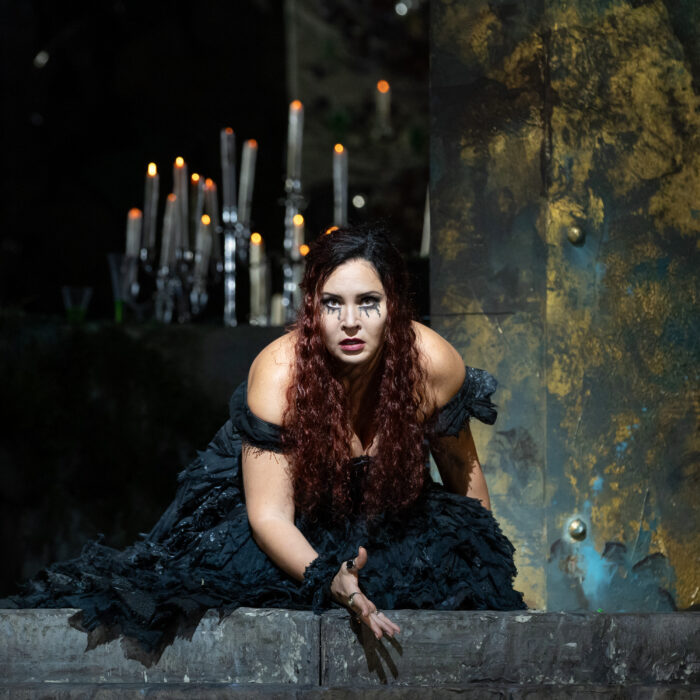
Soprano Izabela Matula was a forceful and clear-headed Kateryna, who was determined to find her daughter Lilia at any cost. It was, however, not a one-dimensional portrayal. She was prepared to accept the blame for allowing Lilia to go to the Crimea in the first place, despite having serious doubts and her attitude towards her husband was not very understanding. She readily complained about him and immediately started to nag him when he returned from the fighting, showing little concern for his safety and the trauma that he was probably suffering. It was an emotionally powerful and realistic interpretation, which she reinforced with a versatile, expressive vocal performance, that expertly captured her anxieties, fears, and hopes.
Her friend Dasha was played by soprano Kamila Dutkowska, who was a naturally optimistic character. Even in the final scene, when her daughter is not returned to her, she does not give up hope. Her sensitive phrasing, the tenderness with which she was able to imbue her voice, and her long, aching lines captured her personality perfectly.
Their two children, Lilia and Olena, were played by soprano Hanna Sisnowska-Bill and mezzosoprano Weronika Wojkowska, respectively. Both crafted convincing, pleasingly defined readings of teenage girls. Their relationship with Inna, the young child that they protected was sensitively developed, so that their separation during the concluding scenes was deeply upsetting. Both sang with a youthful vibrancy and softness which was illustrated beautifully in the duet “Sleep, my little rabbit” that they sang to comfort little Inna.
The two girls attract the unwanted attentions of two camp counselors, who offer them “promises for favors.” Played by tenors Valerii Zadorozhnyi and Prezemyslaw Cierzniewski, they managed to tread a line that mixed their acceptable behavior with threats of sanction and violence.
Kateryna’s put-upon husband, Vitaly, was immediately greeted with hostility by his wife when he arrived back from the fighting, who responded in kind, blaming Kateryna for Lilia’s disappearance. Baritone Andrei Bondarenko did his best with what was a fairly one-dimensional character. Vocally, he was secure and forceful with an aggressive edge.
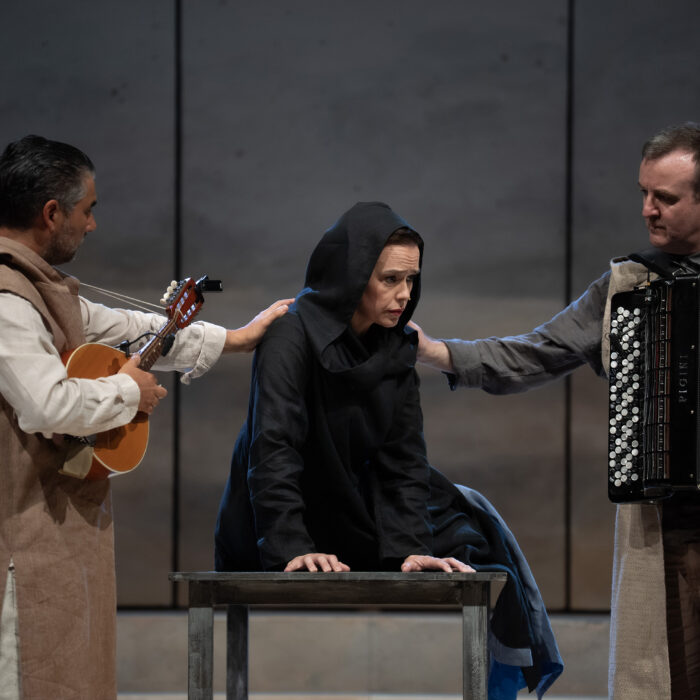
Mezzosoprano Malgorzata Walewska produced a splendid interpretation of Ohla, the old, wheelbound grandmother who struggled to provide for her grandchild, Inna, and terminally ill daughter. Nothing appeared to dampen her spirits. Her singing was expertly molded to reflect her declining years while at the same time adding defiance, hope, and thoughtful reflection to her presentation. Her relationship with the soldier who stood under a willow tree outside her apartment was cleverly developed. She only observed him from afar, but it became very personal. Each morning, she threw sunflower seeds so that they landed on him. She hoped for his death so that when he rotted into the earth, sunflowers would grow. In her struggle to reach Inna in Crimea, she succumbs to the harsh conditions and dies. She never finds Inna, and Inna disappears into the depths of Russia, cut off from everything and everyone she knew.
Baritone Ólafur Sigurdarson possesses an expressive voice with plenty of character, which he used to develop a strong portrait of the coachdriver that took the women to the Crimea. He was a caring, supportive, and decent man with a touch of humor, who went out of his way to help the women. His relationship with Ohla, in particular, which was gentle, playful, and caring, was very touching and captured the decency of the human spirit even under the most dreadful of conditions.
The children were lured away from their homes by their teacher, Tetiana Borysowa, who sold the idea of a two-week break in Crimea to the children and their parents. Mezzosoprano Elissa Pfaender, cast in the role, produced a reading that depicted her as a strict, unsympathetic, and wholly unattractive woman. Following the recapture of the city by the Ukrainians, she flees to Russia. At the station while waiting for the train, she bumps into Kateryna, but on this occasion she was very anxious, which Pfaender captured by coating her voice with a nervous insecurity.
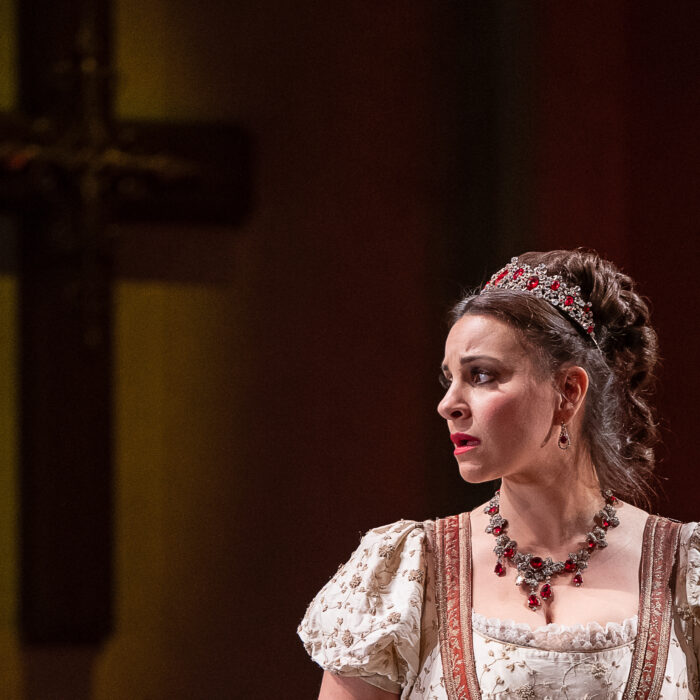
Soprano Katarzyna Wietrzny made a brief appearance as the Russian government minister Maria Lvova-Belova, facing the media to declare herself innocent of the charges of abducting the children. In what was an excellent performance, she convincingly presented a pleasing visual impression, in which the falsity of her pleading was clearly carried in the voice.
Tenor Tadeusz Szlenkier made for a bullying camp principal whose interrogation of Kateryna was suitably vicious and relentless. His expressive voice served him well! However, his sudden conversion to a weak, cowardly man, although vocally credible, proved to be dramatically unconvincing.
There were a number of other minor roles that elicited solid performances. Mezzosoprano Jadwig Postrożna as Halyna, the supervisor at the mill, was suitably demanding; tenor Adrian Domarecki as the indoctrinated Ukrainian student Kostya took the opportunity to show off the pleasing tone of his voice; tenor Wojciech Parchem as a Belarus Border Guard and tenor Tomasz Madej as an airport security official were both suitably aggressive and dismissive of the women’s concerns; and baritone Tomasz Rak gave a convincing portrayal as the rescue organizer.
The role played by the Chorus of Teatr Wielki cannot be understated. The chorus master, Lukasz Hermanowicz, oversaw a brilliant performance. The strength, commitment, and energy that was injected into the presentation of every choral number could not fail to rouse the audience.
The conductor, Keri-Lynn Wilson, produced an emotionally compelling performance from the Orchestra of the Teatr Wielki, in which her endeavor to bring the full force of the women’s suffering to the fore was wholly successful. It was not only in the uplifting choruses that one could hear the people’s determination to succeed; it was something that wove its way through the entire piece: through Ohla’s wonderful aria, Kateryna’s confrontation with the Camp Principal and Dasha’s resolve to one day find her missing daughter. Even in their suffering, the underlying sense of hope was always present. It was also a carefully crafted performance that was beautifully attuned to the singers; at no point were the soloists drowned out by the enthusiasm of the orchestra.
So, is “The Mothers of Kherson” good enough to hold the stage once the war in Ukraine is over and a settlement has been reached? Probably not, and not just because the narrative is tied so closely to specific events. Unfortunately, the reality of the opera world is that very few new operas have a life beyond the initial scheduled run, and although Kolomiiets’ opera has many fine scenes with plenty of strong musical pieces, there have been many new operas that were musically more exciting and dramatically more engaging that have never been revived. Unfortunately, “The Mothers of Kherson” is likely to suffer a similar fate. However, excerpts, particularly the choral numbers, may well survive as concert pieces, as could an orchestral suite, if Kolomiiets has the inclination to compose one.