Opera Meets Film: Recalling Cinematic Legacies, Pt. 2: Rigoletto
By John VandevertThere are certain films which have received considerable cinematic attention by directors. While beloved operas like Bizet’s ‘Carmen’ are among the most popular choices—its first silver-screen presence being the silent film, ‘Gypsy Blood‘ (1920), others are equally as beloved. Leoncavallo’s ‘I Pagliacci’ had its first cinematic presence in 1915, Offenbach’s ‘The Tales of Hoffman’ had its in 1923, and Verdi’s darling, ‘La Traviata,’ had its start in 1936.
In this four-part series, we’ll explore four operas and their various film adaptations, taking into account how they relate and differ from each other. Part one explored the under-performed but not unknown opera, ‘Halka‘ (1854) by Polish composer Stanisław Moniuszko (1819-1872). The opera was cinematically adapted three times but it is the archival reconstruction of the film from the first and second by the Polish National Film Archive which has secured the opera’s cinematic immortality. However, other operas have not been so lucky. Within the historical development of cinematic adaptations of opera, many only received minor attention, if that. Works like Lukas Foss’ English opera, ‘Griffelkin‘ (1955), Manuel Moreno’s Spanish opera, ‘El gato montés‘ (1916), and Bedřich Smetana’s Czech opera, ‘Dalibor‘ (1868), only got one chance on screen. Even celebrated operas like the great Gershwin opera, ‘Porgy and Bess’ (1935), and Mozart’s ‘Così fan tutte’ (1790), are victims to such a treatment. Finding out what this means will have to wait.
What makes his operas particularly interesting among the films which have received considerably more attention is the fact that Verdi’s operas were among the earliest chosen in early 20th-century opera-cinema adaptations. Moreover, in the post-WWII period, Verdi operas were popular choices but interest waned by the 2000s, and alternatives by Puccini, Bizet, and Mozart were chosen, concurrent with the continual musical presence of Wagner. All this to say, the adaptations of ‘Rigoletto’ may not be as long as ‘Carmen’ nor as well-known as ‘La Boheme’ and ‘Tosca,’ but they deserve to be remembered regardless. Let’s take a look at the many faces of Verdi on the silver screen!
A Quick Overview
Okay, let’s begin with a quick overview of Verdi on screen and the cinematic treatment of ‘Rigoletto.’ From what I understand, the earliest film adaptation of Verdi’s operas was the Italian silent-film, ‘Otello‘ (1906). Thereafter, the American silent-film, ‘Aida‘ (1911), was made, followed by the Hungarian silent-films, ‘Masked Ball‘ (1917), and, ‘Rigoletto‘ (1918). These four operas can then be considered among the earliest of Verdi’s operas to get cinematic treatment. The next opera to enter the Verdian cinematic universe was ‘La Traviata’ via George Cukor’s sound film, or talkie, ‘Camille‘ (1936), and with this, the gates opened to include many other Verdi operas. The ‘Rigoletto’ story traverses the shift from ‘moving picture’ to ‘talkie’, but has its feet firmly in the latter. The lines between opera adaptation and filmed opera are mostly clear, but here, we’ll consider both as under the umbrella of film adaptation.
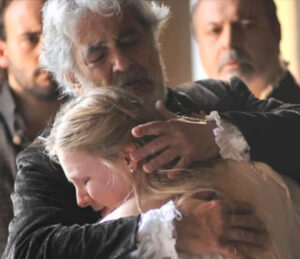
Following its silent-film phase, Verdi’s ‘Rigoletto’ received many cinematic adaptations, being both non-opera films and more conventional filmed productions. The non-opera films span many countries, namely Italy (1941, 1946, and 1956), the US (2003), and Canada (2006), whilst stage productions range in geographical origin. A little more digging, however, and one finds that there are other cinematic adaptations and filmed productions left out of the historical record, and open-source platforms ought to be double-checked. The 1993 family-friendly, and seemingly well-beloved, film, ‘Rigoletto,’ told the story but modified it towards more personal triumph. There is a momentary inclusion of music from the opera in the 1987 film, ‘Wall Street,’ as well as in the film, ‘The Spider’s Stratagem’ (1970), by Bernardo Bertolucci. The 2011 production, ‘Rigoletto from Mantua,’ was possibly one of the closest realizations of Verdi’s opera, and while there are other filmed stage productions (2004, 2019), I will only focus on the five non-opera films.
It’s interesting to note that opera-based musicals in 20th-century Italian cinema were greatly popular. As Carlo Celli and Marga Cottino-Jones note, Italian pre-WWII cinema was full of melodrama and musicals, and there was strong effort to maintain the trend. Other opera-based films were made, among them M. Costa’s ‘Mad About Opera’ (1948), Camillo Mastrocinque’s biopic, ‘Life of Donizetti‘ (1947), and Gallone’s film. The name, Gallone, should be remembered. Why? Well, for starters, he created the much-lauded Verdi biofilm, ‘Giuseppe Verdi‘ (1938), along with a slew of other opera-related projects including the biopic, ‘The Young Caruso’ (1951). According to Celli and Cottino-Jones, the three most popular opera melodramas were all from 1953 (and bel canto hallmarks of the period): ‘Verdi: King of Melody,’ ‘Puccini,’ and, ‘Aida.’ They all also starred famous singers of the day. One could fill another article with all of Puccini’s merits, including the film, ‘Before Him All Rome Trembled‘ (1946). For Verdi, specifically, he was a recurring element of Italy’s post-war cinema as seen in the lauded film, ‘Seven Hills of Rome‘ (1958), starring the American tenor, Mario Lanza. Years later, Verdi was seen again in the historical film, ‘1900‘ (1976), where death and music were linked.
Verdi’s Many Rigolettos
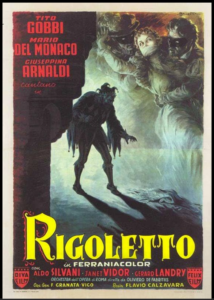
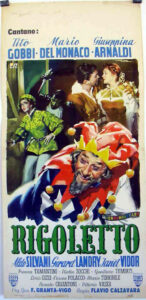
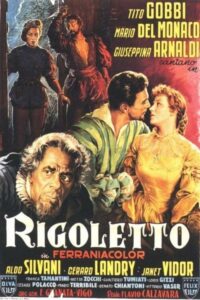
The first non-opera film seems to have been Mario Bonnard’s ‘The King’s Jester,’ or Il re si diverte (1941), followed thereafter by Carmine Gallone’s ‘Rigoletto’ (1946). Ten years later, Flavio Calzavara’s film, ‘Rigoletto and his Tragedy,’ or Rigoletto e la sua tragedia (1956), would continue the trend. These films have many like characteristics, one such being the similar use of heightened fictional drama to their stories, although both stay generally true to the architecture of Francesco Maria Piave’s original libretto. Both the 1941 and 1956 films share actors, but only in two cases. Aldo Silvani (1891-1964) and Renato Chiantoni (1906-1979) participated in both films, but while Silvani’s first appearance was fairly minor but second was the title character, Chiantoni’s roles were both minor. Unlike the others, Gallone’s film had prominent Italian singers of the day, including Titto Gobbi, Mario Filippeschi, Lina Pagliughi and Anna Canali, the former a famous collaborator with Maria Callas in the 1953 recording of ‘Cavalleria rusticana.’
After the 1970s, Verdi’s ‘Rigoletto’ would cool slightly but his presence on screen transformed considerably. Not only was some of his non-operatic works like Waltz in FM used in films (The Palermo Connection, 1990), but following Jean-Pierre Ponnelle’s internationally-acclaimed 1982 filmed production, ‘Rigoletto’ made its way back into the public zeitgeist once more. It should also be remembered that the 1980s saw novel cinematic takes of Verdi’s operas, namely Franco Zeffirelli’s ‘La Traviata’ (1982), ‘Otello’ (1986), Dario Argento’s ‘Terror at the Opera’ (1987) and Claude d’Anna’s ‘Macbeth’ (1987), continuing the post-war trend of operatic melodramas. Regarding ‘Rigoletto,’ the next cinematic telling would be Leo D. Paur’s 1993 film, a radically sanitized, and child-friendly, take on the tragedy, and while it does count as an adaptation, it’s so far from the original material I hardly see it as as an adapation. Verdi’s presence on screen in the new millenium began with an unexpected choice, namely an animated fantasy music, ‘Aida of the Trees‘ (2001), directed by Guido Manuli, and while inspired by Ghislanzoni’s story, instead ends in loving triumph.
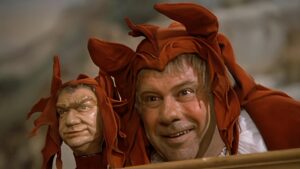
The final two adaptations this article will include are both English-based, and created by North American directors. The first, Curtiss Clayton’s ‘Rick‘ (2003), starred some of the United State’s most high-profile actors and actresses including Sandra Oh, but it went generally unnoticed. The second was of Canadian origin. Rob Swales, ‘Rigoletto…in Bluegrass‘ (2006), was an independent film taking ‘Rigoletto’ and modifying it to become a story of a bluegrass folk musician instead. Both films take rather different approaches, but collectively show that adaptations can deviate from the source material but have very different impacts. While ‘Rick’ failed to keep what made Verdi’s opera legendary through explosive dramatics and uncontrolled mania, Swales’ film took the alternative approach, although the unpolished nature of the production makes it difficult to take seriously. However, it’s an endearing project!
Where is Verdi Today?
The use of Verdi as source material for film adaptations seemed to have slowed considerably since the 2000s. We have explored the adaptations of other operas like Shoshtakovich’s, ‘The Nose’ (2020), and Mozart’s ‘The Magic Flute’ (2008). There’s been recent uses of Wagner in blockbuster films like ‘The Substance’ (2024), but has Verdi received any new adaptations? The answer seems to be no. While Woody Allan’s film, ‘Match Point‘ (2005) continued a trend of using music from Verdi’s operas, there doesn’t seem to be any corollaries to Bonnard and Gallone within the 21st-century. Part of the auteur, or New Hollywood, movement of the 1970s, William Friedkin directed a new version of ‘Rigoletto’ back in 2015 for the Maggio Musicale Fiorentino Theatre after many heavy-hitting Italian bel canto productions. But these aren’t film adaptations, are they? The inquiry remains, are there any recent adaptations of Verdi operas? With a new energy emerging towards adaptations of opera themes, among them Tom Ford’s ‘Cry to Heaven‘ and the ever-controversial ‘Maria,’ I firmly believe it’s time for a new adaptation of legendary operatic works. Can our directors follow in the footsteps of Zeffirelli and Rosi I have my doubts, but maybe we need good ol’ patience.
Watch