Opéra de Monte-Carlo 2025-26 Review: Orfeo ed Euridice
By Robert Adelson & Jacqueline LetzterOn January 28, the Opéra de Monte-Carlo presented a rare semi-staged performance of Gluck’s “Orfeo ed Euridice” in the version he prepared in 1769 for Parma. Written for the wedding celebrations of Ferdinand, Duke of Parma, and Archduchess Maria Amalia of Austria, this revision substantially reworked the original 1762 Vienna score. Gluck compressed the opera’s three acts into a single, uninterrupted “Atto d’Orfeo,” which formed the final portion of the triple bill “Le feste d’Apollo.” The Parma version also omits the ballet that concludes the Vienna original.
The one-act structure was only one of several changes. The title role, originally composed for the alto castrato Gaetano Guadagni, was transposed upward to suit the soprano castrato Giuseppe Millico. Because the Parma court orchestra was smaller than its Viennese counterpart, Gluck also simplified the orchestration, eliminating distinctive instruments such as chalumeaux, cornetti, and English horns. This reduction is especially evident in the aria “Chiamo il mio ben così,” where the echo effects are produced solely by offstage strings and flute.
Despite its historical significance, the Parma version was not revived until 2014. Since then, it has gained admirers for its intimate scale, practicality in concert performance, and particular appeal to sopranos.
Carlo Vistoli Replaces Cecilia Bartoli
The role of Orfeo was originally to be sung by Cecilia Bartoli, who withdrew due to illness just two days before the performance. With Bartoli scheduled to appear at the opening ceremony of the Milan Winter Olympics on February 6, vocal conservation was likely unavoidable. This was the second last-minute illness-related substitution at the Opéra de Monte-Carlo that week; only days earlier, Daniel Scofield had replaced the indisposed Matthias Goerne in “Die Walküre.”
Bartoli was replaced by countertenor Carlo Vistoli, who—by remarkable coincidence—was performing “Orfeo ed Euridice” at the Teatro Regio in Parma, with the Monte-Carlo date falling on one of his rare free evenings. The substitution was nevertheless complicated: the Parma production used the 1762 Vienna version, requiring Vistoli to adjust to different keys. (Why the Parma version is not performed in Parma itself remains an intriguing question!)
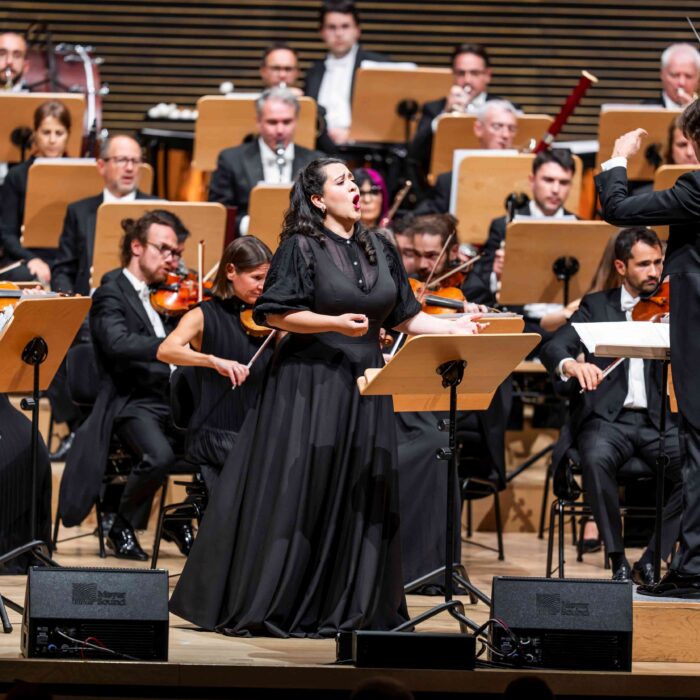
Vistoli proved a compelling Orfeo. His voice carried with ease and presence equal to that of the female sopranos, and his restrained, inward acting avoided the gestural excess often used to accompany Orfeo’s extended laments. “Chiamo il mio ben così” was delicately shaped, its final verse sung pianissimo and capped with an elegant ornamental cadenza. In “Deh placatevi con me!”—sensitively accompanied by harpist Marta Graziolino—he combined urgency with lyrical warmth.
The most striking interpretive choice came in the final aria, “Che farò senza Euridice.” Witten in a major key rather than the expected minor, the aria has long been criticized—already in the eighteenth century—as insufficiently tragic. Capuano launched the opening ritornello at an unusually brisk tempo, charged with nervous, almost manic energy. Vistoli treated the aria as a kind of mad scene, a counterpart to Euridice’s preceding “Che fiero momento, che barbara sorte!” Only in the final verse did he slow the tempo, suggesting emotional collapse rather than consolation.
Mélissa Petit was superb as Euridice, combining expressive singing with vivid dramatic presence. Madison Nonoa brought buoyant energy to Amore, though her role was curtailed by the omission of the opera’s final scene (see below).
Musical Direction and Chorus
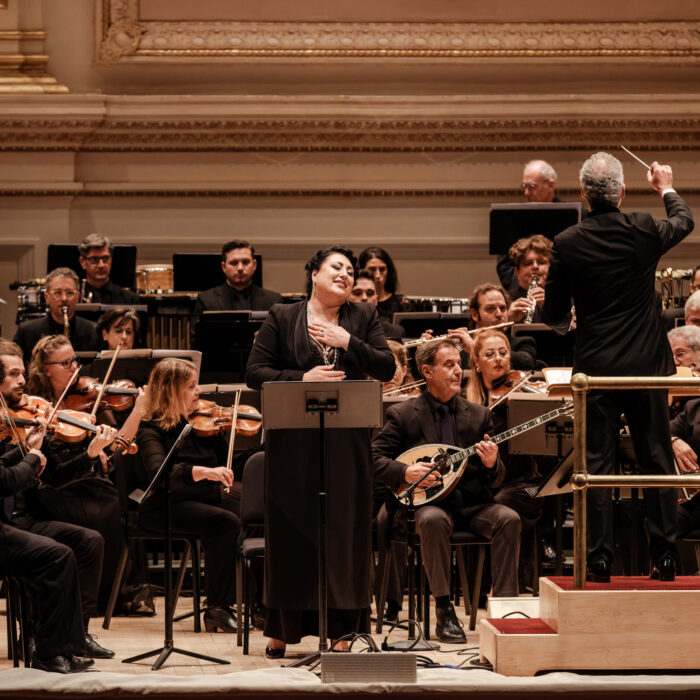
Gianluca Capuano led the period-instrument ensemble Les Musiciens du Prince with keen attention to the sharper edges of Gluck’s score, favoring generally brisk yet highly flexible tempi. Departing from the Parma version, he interpolated several ballet movements from the 1774 Paris revision, including the “Dance of the Furies” and the celebrated “Dance of the Blessed Spirits,” the latter beautifully shaped by flutist Pablo Sosa del Rosario.
The substantial choral parts were entrusted to Il Canto di Orfeo, whose singers also took on significant dramatic roles. Under Capuano and chorus master Luca Scaccabarozzi, the chorus was encouraged to shout individual words in the infernal scenes, heightening the visceral menace of the underworld.
A Mise en Espace Overwhelmed by Video
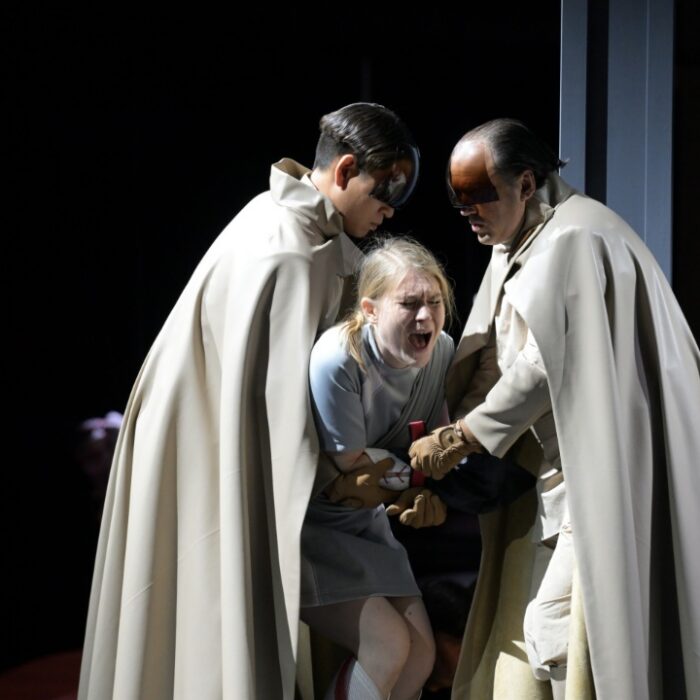
The performance was billed as a mise en espace—a semi-staged presentation without full sets or costumes—rather than a concert. The singers followed the staging by Christof Loy, originally created for the Salzburg Festival, with video projections by the digital design company D-Wok as the sole scenic element.
The orchestra played onstage instead of in the pit, with singers moving in front of, behind, and among the musicians. Given the strong acting of all three principals, it was unfortunate that the projections proved so dominant. A stream of constantly shifting images—turbulent seas, giant butterflies, and Renaissance-Baroque Italian architecture—covered the entire back wall, repeatedly drawing attention away from the performers and the music. At several points, the action was literally halted as a projection screen slowly rose or descended, its mechanical noise intruding on the musical flow. In Gluck, where dramatic power depends on momentum and focus, such interruptions were especially damaging.
The most persistent image was a solar eclipse—something one is compelled to stare at yet instinctively warned against, much like Orfeo’s fatal glance at Euridice. Though conceptually clever, the symbol was either too fleeting to register clearly or so omnipresent that it ultimately blunted its own effect.
The Happy Ending Rewritten
Most surprising was the omission of the lieto fine. Instead of Amore’s intervention restoring Euridice and preventing Orfeo’s suicide, the performance ended after “Che farò” with a return of the opening funeral chorus. The orchestra let the final chord fade to an almost inaudible al niente, after which the lights were extinguished, leaving the opera to close in darkness and tragedy.
Bartoli defended this alteration by arguing that Gluck and his librettist, Ranieri de’ Calzabigi, had bowed to convention to satisfy the royal audience, and that she preferred an ending more appropriate to a work of our own time. The result was undeniably powerful, though it recalls the nineteenth-century practice of cutting the final moralizing chorus of “Don Giovanni” so that the opera ends with the Don’s damnation—a practice that is generally understood today as removing an important layer of meaning.