Monteverdi-Chor Hamburg 2026 Review: Mozart’s ‘Coronation Mass’
By Mengguang Huang(Photo Credit: Claudia Höhne)
To be fair, the artistic boundaries of sacred music have been giving the church a headache since the Renaissance. One only has to recall Josquin Desprez and his peers, who cheekily built entire masses around secular tunes — sometimes even seductive ones — to understand why the clergy were constantly reaching for their smelling salts. By the time the Age of Opera arrived, the temptations from outside the sacred had only grown more tempting. The late 18th century was a period where the boundaries between the celestial and the theatrical were porous — a reality probably no composer navigated with more wit than Wolfgang Amadeus Mozart.
Salzburg Foundations: Clarity and Festive Brilliance
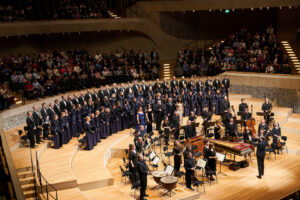
This daytime Monteverdi-Chor Hamburg concert, under the baton of Antonius Adamske, opened with the youthful “Veni Sancte Spiritus,” K 47, which functioned as a concise, confident overture. The Berlin-based lautten compagney provided a soundscape of exceptional transparency and energy. Their playing was crisp and relaxed, yet immensely breathable. Every sonic layer was distinct: from the silk-like, energetic rolling of the strings to the vigorous drive of the bass section, topped by brilliant, golden brass and highly controlled timpani. The Choic, together with occasional additions from two soloists, maintained their signature high standards, opting for an articulation that was brief and decisive. Every syllable was tucked away cleanly; the rhythmic definition was sharp, creating a sonic world of high granularity.
This momentum carried into the “Coronation Mass,” K 317. Composed in 1779, this work stands as a pinnacle of Mozart’s Salzburg output, perfectly embodying the tonal brilliance of C-major festive music. The opening Kyrie was unambiguous and firm, featuring a succinct, convincing duet between soprano Johanna Kaldewei and tenor Virgil Hartinger. In the Gloria, the ensemble truly hit its stride. The vocal quartet, with Kaldewei, Hartinger, mezzo-soprano Geneviève Tschumi and baritone Henryk Böhm, exhibited a remarkable degree of sonic fusion. Meanwhile the lautten compagney was in full throttle. The strings provided an energetic rolling accompaniment while the brass added a magnificent, golden sheen to the overall sound. The chest organ playing and harpsichord accompaniment from Adamske himself were consistently lively and supportive. The Credo that followed was relatively concise, with a dignified structure that felt notably more propulsive than the more somber settings typical of the era. After the brief Sanctus and Benedictus, the Agnus Dei served as the first solo for soprano Jeanine De Bique in her Elbphilharmonie debut. Her breath control was formidable, featuring exquisite piano entries and a sophisticated grasp of the text’s psychological praying. While her vocal projection was somewhat understated, requiring the audience to listen with heightened intent, the instrumentalists accompanied her with extreme sensitivity, ensuring that the gentle and sublime character of the movement remained intact.
“Davide penitente” — The Sacred Drama Unfolds
Following the interval, the program shifted to “Davide penitente,” K 469, a work that exemplifies Mozart’s pragmatic and ingenious nature. Repurposing the monumental but unfinished Mass in C minor, K 427, probably for a Viennese benefit concert, Mozart transformed liturgical gravity into undeniable drama. The transition from the C-minor depth of the Kyrie (now “Alzai le flebili voci”) to the more operatic additions was handled with immense nuance. Kaldewei took center stage in the aria, “Lungi le cure ingrate,” delivering the highly operatic lines with technical polish and grace. Her interaction with the orchestra was seamless, though, given the exuberant and fiery energy radiating from the lautten compagney, one felt the soloists could have afforded to inject even more spark and theatrical daring. Nevertheless, the subsequent duet between the two sopranos was a high point of vocal chemistry with effortless elegance.
Hartinger navigated the warm, lyrical lines of “A te, fra tanti affanni” with poise, though his delivery was occasionally hampered by a slightly muffled vocal production. In the seventh chorus, “Se vuoi, puniscimi,” the choir explored wide-reaching and dramatic dynamic contrasts — only in the most hushed passages did the musical tension flicker momentarily.
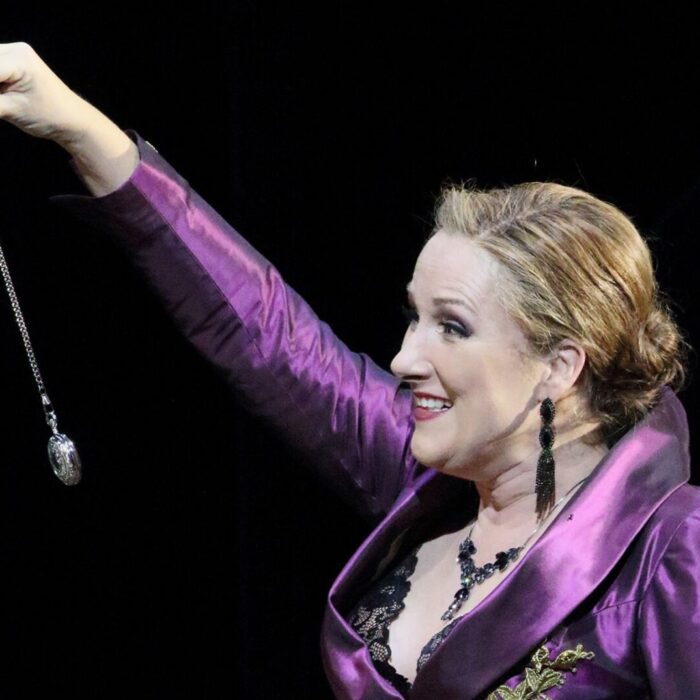
Then came the eighth section — an original addition by Mozart to this largely recycled work. This was the aria “Tra l’oscure ombre funeste.” This was De Bique’s moment of triumph. She handled the low register with a perfect blend of composure and majesty, sweeping away any earlier hints of understated projection. As the piece transitioned into the technically demanding coloratura and final cadenza — moments that felt naturally and brilliantly operatic — she delivered with stunning precision and flair.
The concert concluded in a blaze of golden light with the final C-major chorus. As the last notes faded, the brevity of the program left the audience with a distinct sense of longing for more. In tracing this journey from the youthful, festive brilliance of Salzburg to the pragmatic, operatic ingenuity of his Viennese career, the performance celebrated the enduring allure of a composer who arguably understood the human voice better than any other.