Opéra National de Paris 2025-26 Review: Rusalka
By David SalazarThe Opéra National de Paris is in the midst of a revival of Robert Carson’s incredible production of “Rusalka.”
Coming-of-Age
The production itself is minimalist in its set design. The opening scene features a mirror effect with a bed hanging over the stage. On ground level, there’s a central pool and we see four figures asleep alongside it. Sleep becomes a major motif throughout the production. Sleep is both a literal manifestation of our consciousness’ ignorance toward the world operating around us, but it is also the moment in which we access our subconscious and thus our cravings and desires. It is this inner conflict that is at the core of Carson’s Rusalka, a coming-of-age narrative about an innocent girl, who through the plumbing of her deepest fears, will come to take ownership over her own sexual nature to get what she most desires.
The bed provides a major visual anchor for this conflict. It is the place that we most associate with sleep, but it is also the place we most associate with sex and it is this dichotomy that Carson perfectly balances throughout.
The first actions we see in this opera are the awakening of the three child-like nymphs who jump up, play in the pool, and have all kinds of fun. Born in the water, these children never seemingly grow or leave it. They enjoy this environment and make it their playground.
But when Rusalka awakens, we see that her sights are set on the world above, the bed hanging over all of them. She clearly wants out. Clad in white, she and her sisters are one with the whiteness of the world around her – innocent to the darkness that will come later.
Her father, clad in a black suit, walks on stage but not directly onto this set, indicating that he has access to a world his daughters don’t. When Jezibaba appears, she too is elevated from below the stage with a blaze of fire exploding onto the stage. When she acquiesces to Rusalka’s pleas, the walled set opens up, revealing a black void; the bed is lowered, the walls returns and now we are in a bedroom. In my view it felt more akin to a hotel room, which I feel, given the transitory nature of that space, was more appropriate for the themes about to unfold.
The Prince arrives, dressed identically to Rusalka’s father. Rusalka dresses herself in a gown, and all seems ready to proceed like a fairy tale. Consummation is about to take place.
Except, here Carson makes his first major mark on the story. Rusalka, overwhelmed by the Prince’s sexual advance, runs away. She’s scared and confused. She wants to scream, but can’t. Rusalka remains innocent and will have to come of age to find her happiness.
This thematic exploration gets taken up in the ensuing act where Rusalka’s sense of self is literally split in two. When the curtain rises on Act two, the stage is split in two with each side meant to reflect the other like a mirror. As people enter, their actions precisely match those of their dopplegangers, furthering this notion. Rusalka stands off stage, stuck in the middle, watching all of this from a distance. When she steps onto the stage, the other immediately becomes occupied by the foreign princess, clad in the same white dress. Later on, the Princess will remove her gown and reveal a short black dress that mirrors Jezibaba’s own attire. Rusalka will pull off her gown to reveal this same black dress. But as the scene plays out with the Princess seducing the Prince through not-so-subtle sexual innuendo, it becomes clear that Rusalka can’t keep up. Even when she rushes to the opposite side of the stage, forcing the Princess onto the other side, the Prince notes Rusalka’s coldness and lack of sexual fire. The Princess represents what Rusalka must become to win over the Prince, a notion she seems unable to comprehend to this point.
Rusalka’s confusion around her sensuality is best expressed during the Act two ballet. Rusalka falls asleep on the bed and as she dreams men and women rush onto opposite sides of the stage – mirror images of one another. Initially the dance is proper and distant, almost expressing Rusalka’s relationship to the Prince. But then they cross over onto each other’s sides, mixing it up and finding their dance partners. At first, it’s all romance. Then it turns violent. The men attempt to possess the women. The women fight back. The conflict continues and the apex of the nightmare, the women seem to give in. An orgy ensues. Rusalka awakens from the nightmare, frightened, confused, with no idea what to do.
When Act two draws to a close, the stage breaks open, revealing a void that seemingly sucks her in. It’s in this darkness that she finds herself in Act three. When Jezibaba appears, the bed is once more hanging, but it’s a zenithal view. Where it looked up at the start of the opera, here she is now looking down, emphasizing her displacement. Roses litter the space in a callback to Act two where roses were placed around the hotel bed, suggesting a sexual awakening that never comes for her. Here the roses surround Jezibaba’s bed and later on we will see the witch and Rusalka’s father emerge from her home together, implying their relationship and given the attires, suggesting what Rusalka must become to get what she wants.
Sure enough, the final scene of the opera returns us to the hotel room where Rusalka seduces the prince, seemingly coming to terms with herself as a sexual being. The opera ends with the two jumping into the bed, ready to finally reach the climax the two have desired but deprived one another from to this point. “Le petit mort” seems adequate here as an ample metaphor given that the entire text of their final duet revolves around Rusalka telling the Prince she can only give him death and him begging her for it. Before this sexual consummation, Rusalka closes the door on her father’s repeated cries of “beware;” she is finally a human independent of her overbearing father. Her coming-of-age is complete, even if the ending leaves things ambiguous.
In charge of the musical forces was Japanese maestro Kasushi Ono. His approach to the opera’s opening notes was cautious, mysterious, the tempi feeling expansive, but the sound malleable, operating on extremes of intensity. It set up the tenor of the entire night and his approach. Tempi tended to be a bit slower but the pacing was consistent and solid. Ono and the orchestra were in constant dialogue with the artists, the balance almost always impeccable. Even in moments where there was a disconnect, the conductor adapted quickly to ensure that the soloists were at ease. The orchestra sounded impeccable with a strong balance throughout. The hall and this specific production favor the orchestra, but Ono’s ability to ensure the success of the singers was tantamount in this production.
Nowhere was this most apparent than with the opera’s central figure.
Brimming With Passion
There is a tremendously glorious irony at the heart of Rusalka. Throughout the opera, characters remark on Rusalka’s coldness, her lack of humanity, and in the case of this production, lack of fiery passion and sensuality. But in reality, the titular character’s music and essence embodies all of these things and never was this better interpreted than by soprano Nicole Car, who by the end of the evening received an ovation so all-embracing, that even she seemed stunned.
But she deserved her flowers because in my experience, this was the most complex and potent portrayal of the eponymous heroine I have experienced in an opera house.
From the moment she awakens, to the moment she fell into bed with the Prince, Car held the audience captive. Throughout those opening moments, her looks upward expressed an intense longing. Her singing throughout the opening exchange with her father was wrought with desperation, the voice climaxing on several high notes with tremendous flexibility. Her singing brimmed with confidence and fullness of sound. Right off the bat, I knew we were in the best of hands.
This continued on during the iconic “Song to the Moon” where the soprano, on the ground for most of it, wove one delicate line after another, managing her voice despite some imbalance with the orchestra. Even as the larger ensemble pushed in its intensity, she held her ground, her voice creating an overarching crescendo throughout the aria to impeccable effect at its climax, her sound roaring through the space, Rusalka’s longing at its fullest. This was furthered during the ensuing exchange with Jezibaba, wherein Car, really dug into Rusalka’s agony, the begging at its most aggressive.
After Rusalka ascends to the human realm, she is silenced and the audience is thus deprived of hearing Rusalka’s voice and thus longing for it during its absence. Nonetheless, Car remained as arresting as ever and in her initial scenes with the Prince we could feel the confusion over her feelings. As he attempts to kiss her at the close of Act one, she ripped herself away, her hands circled over her mouth as if trying to scream. We come back to this very position at the start of the second Act as Rusalka is made to be an audience member to the drama unfolding before her, her dream turned into a nightmare. Again, Car did her utmost to keep Rusalka at the center of things, leading to (more later) some inspired drama when another singer took centerstage.
Near the end of Act two, Rusalka’s voice returns in an exchange with her father for a passion brimming with anxiety and anger. The tempo here was on the slower side, but it allowed Car the bandwidth to articulate the passages with greater aggression and build it, the high notes at their most pointed, expressing Rusalka’s torment and fury all at once. It’s an incredible piece of music, but one that I have often taken for granted due to how swiftly it passes you by. Here, the slower tempo and Car’s intense commitment vocally and physically allowed me to truly immerse myself in this moment.
Act three begins with another aria for Rusalka. Car delivered the purest of piano singing throughout and allowing you to see a gentler side of Rusalka. Stuck in a black void, Car’s interpretation delivered a sense of resignation that I had never heard in any other interpretation. During her ensuing with Jezibaba, during which she begs to be free, there was a harsher edge to her singing that only intensified as she retorted that she refused to sacrifice her beloved.
And in that final scene, wherein Rusalka finally (in this production) assumes to her sexuality and seduces the Prince, Car’s voice was at its most luxurious, the lines polished, the high notes blossoming in the space.
Car stands out as an incredible artist. A singer of the highest order whose voice pours out with seeming ease and flexibility, her high notes pristine from start to finish. But her vocalism is married to superlative stage presence and interpretation. In a year of incredible individual performances, Car’s Rusalka stands out as one of the finest I’ve experienced thus far.
Peaks & Valleys
While Car shone, the rest of the soloists were a mixture of hits and misses.
The undeniable hit and perennial scene stealer was soprano Alisa Kolosova who was suitably presented as Rusalka’s doppleganger, the Foreign Princess. Kolosova, who had no time to rehearse onstage or with the orchestra ahead of her first performance (she has an additional one on May 18), was every bit as passionate as Car, making it truly feel like a battle of vocal heavyweights in Act two. From her very first note, Kolosova’s soprano injected the auditorium with a tidal wave of sound, paired with physical sensuality as she seduced the prince. The beauty of this moment dramatically is that without a voice, Rusalka is no match for the Princess whose main weapon in winning over the Prince AND the audience, is her instrument. I have never felt that this narrative idea was so perfectly exemplified on stage than in this instance. Car had such an impact throughout the first Act that being deprived of her was torture. But for the moments she was onstage, Kolosova’s raw vocal intensity, coupled with her commitment to the character’s seduction, made me forget Rusalka and want to hear more from the Princess.
Tenor Sergey Skorokhodov’s voice never quite sounded comfortable in the Prince’s extremes of range. While the middle voice carried through amply and the tenor displayed an elegance of phrasing and legato line, he often sounded overpowered by the orchestra and his voice rarely cut through the texture and into the hall. In Act one, the highs often sounded nasal and disconnected from the rest of the instrument. In Act two, there was a greater ping, but he was overpowered by Kolosova’s titanic sound. But it was in Act three where the struggles were most apparent. While Car soared over the orchestra, it was clear that Ono was pulling the ensemble back to facilitate Skorokhodov’s descent into the lower extreme and the D flats that initiate the duet’s iconic melody during which the Prince begs for death. While Skorokhodov managed the first iteration of this passage quite beautifully, the second calls for a high C that provides an intense emotional release for the line and shifts the intensity in a new direction. As this line built, so did the orchestra and you could sense that the ensemble was preparing to support the tenor as he made the leap for the high note. But when the note came, the tenor barely made it, the orchestra’s surge covering him and covering for him in what was far from cathartic.
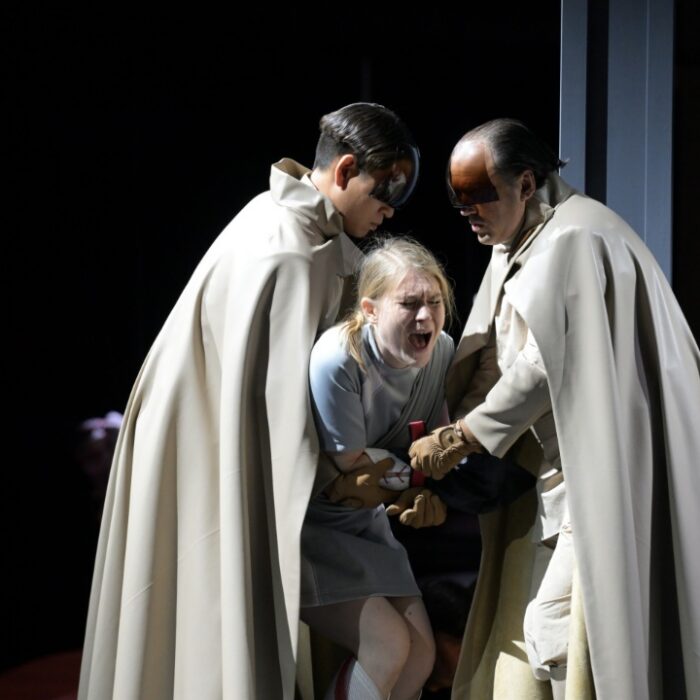
As Rusalka’s father, Dmitry Ivashchenko had a similarly uneven night. Despite possessing a luxuriously potent instrument that managed the hall’s production’s challenges quite well, intonation was unsteady with the bass often sounding flat. This was most noticeable during his Act one confrontation with Nicole Car, but especially during his glorious Act two aria “Běda! Běda! Ubohá Rusalko bledá,” wherein his smooth legato phrasing and booming high note were off-set by errant pitch and a general disconnect with the orchestra. He did make up for it with a sturdy stage presence, particularly in the final scene as he threatened the Prince’s lackeys.
Jamie Barton’s night got off to a rough start. Her voice sounded a bit dry and lacking in resonance in the space during her initial scene and her high notes came off as forced and not particularly easy on the ear. But Act three was a different story, with the sound rounding out and her prickly vocalization giving the character a more sardonic edge during her encounter with Rusalka.
Seray Pinar and Florent Mbia were a solid duo as the Prince’s retinue. Pinar’s voice projected beautifully in the hall, particularly in the third Act as she expressed the fear of her character. Mbia’s baritone was notably elegant in his Act two exchanges with Pinar.
As the trio of nymphs, Margarita Polonskaya, Maria Warenberg, and Noa Beinart sang gloriously in their two major scenes. Act one’s playfulness was beautifully accented by them kicking around in the water. It was contrasted with some sublime legato singing in their Act three scene, each singer getting a chance to showcase the beauty of their sounds before coming together for one of the most musically arresting moments of the entire evening. In both scenes, the trio played off one another perfectly, their sounds blending and complementing one another wonderfully.
Despite the shortcoming throughout the rest of the cast, Car and Carson’s production were a marriage made in heaven. This is one of the finest “Rusalka” performances I have had the honor to witness.