Opéra de Monte-Carlo 2025-26 Review: Die Walküre
Daniel Scofield Commands the Stage in Wagner’s Epic Work
By Robert Adelson & Jacqueline Letzter(Credit: ©OMC – Marco Borrelli)
With its performances of “Das Rheingold” in 2025, the Opéra de Monte-Carlo launched an ambitious four-year project to present Wagner’s “Der Ring des Nibelungen” in a new production by Davide Livermore, featuring the period-instrument ensemble Les Musiciens du Prince.
Livermore’s Staging
One of the more striking contradictions in contemporary opera is the frequent pairing of historically informed musical performance with resolutely hypermodern staging. Livermore’s “Walküre” exemplifies this tension: the visual world consists almost entirely of large-scale, technically dazzling video projections created by his digital design company, D-Wok.
Each act opens with a projected scene of one of the principal characters as a child, seated at a school desk and writing a phrase on a sheet of paper. The sheet is then folded into a paper airplane and thrown toward the audience, providing the cue for the music to begin. Before Act one, young Wotan writes “Who’s afraid of the big bad wolf?”—a reference to Siegmund and Sieglinde. Before Act two it is child Wotan again, who with his “Let’s play war,” announces Wotan’s confrontations with Fricka and Brünhilde and Siegmund’s combat with Hunding. Prior to Act three, child Brünnhilde writes “Let’s play at flying,” just before the “Ride of the Valkyries.” This framing device hints at an interpretation of the opera as a child’s fantasy game. At the close of the work, amid the ring of fire encircling the sleeping Brünnhilde, child Wotan reappears to write, “What will we play now?”
The paper airplanes morph into projections of a World War II–era aircraft. During the opening storm music of Act one, the plane struggles through a violent tempest before being struck by lightning and bursting into flames—a viscerally effective opening. The wreckage of the aircraft then dominates the scene of Hunding’s forest dwelling and remains present, either physically or via projection, through much of the opera. The same airplane also appeared at the bottom of the Rhine in Livermore’s “Rheingold,” though its symbolic meaning remains elusive.
Aside from the airplane, the other recurring image is that of the ornate but empty Salle Garnier of the Opéra de Monte-Carlo. First appearing when Wotan evokes the grandeur of Valhalla, it later serves as a backdrop for much of Act three. Its significance is unclear: is it meant, as in some of Robert Carsen’s productions, to function as a mirror held up to the audience?
The presence of child versions of the main characters becomes a central element of the staging, with character doubles—and sometimes triples—used to expand the temporal dimension of the drama. Brünnhilde is frequently accompanied by silent actresses portraying her as both a child and what appears to be a statue of herself. Siegmund and Sieglinde are likewise represented by mute child doubles, and Wotan is occasionally shadowed by a physical alter ego. The characters’ costumes suggest a vaguely Second World War era, although Hunding wears the traditional animal pelt and the Valkyries are clad in their breastplates, winged helmets and carry spears.
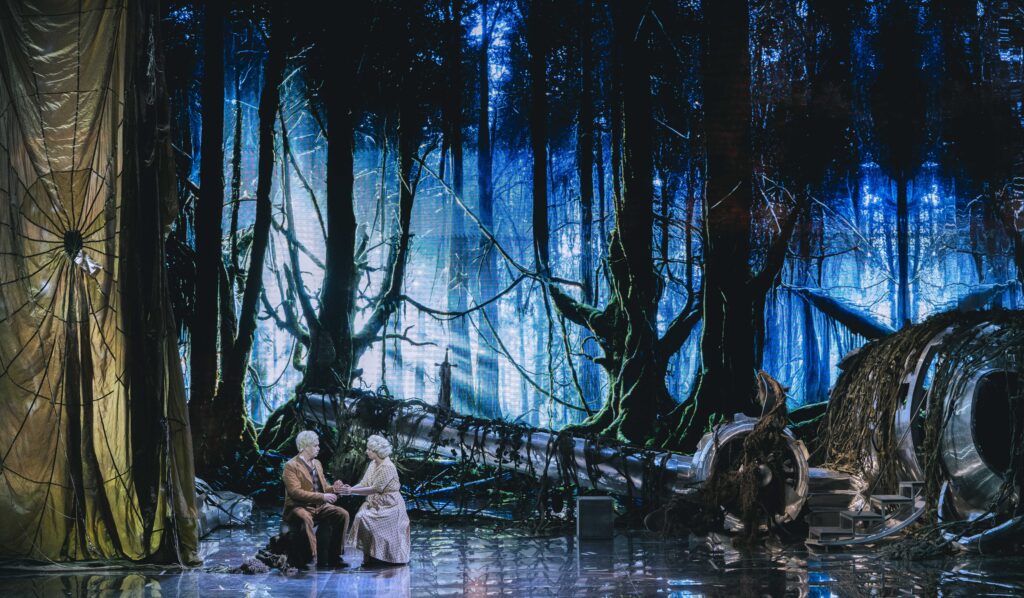
©OMC – Marco Borrelli
Daniel Scofield’s Last-Minute Substitution Leads a Strong Cast
The production was originally to feature Matthias Goerne as Wotan, but he withdrew at the very last moment before opening night. His replacement, American baritone Daniel Scofield, was a role debut—yet nothing in his performance suggested an emergency substitution. Although his only prior experience with Wotan was as cover for Christopher Maltman at the Teatro San Carlo in Naples in 2023, Scofield appeared in Monaco as an artist already in full possession of the role. His vocal security, stylistic assurance, German diction and dramatic intelligence placed him immediately among today’s most compelling interpreters of Wotan. He commanded the stage with apparent ease, tracing the god’s vast emotional trajectory—from imperious self-confidence and volcanic rage to shame, resignation, and profoundly human paternal tenderness—with striking coherence and depth. His incisive rhythmic delivery gave bite to passages such as the Act three confrontation with Brünnhilde, where the repeated “gegen mich doch” (“yet against me”) phrases crackled with tension. The final “Leb’ wohl!”(“Farewell”) was shaped with such vocal nobility and emotional inevitability that it felt not like a debut performance, but like the emergence of a Wotan destined for the world’s major Wagner stages.
Soprano Nancy Weissbach offered a thoughtful and nuanced portrayal of Brünnhilde. In her first appearance in Act two, she appeared bright-eyed and youthful; as the drama progressed, both her acting and vocal weight deepened accordingly. While some high notes—such as her intonation of the Siegfried leitmotif in Act three—were less centered than ideal, her middle and lower registers were consistently compelling. Particularly striking was her delivery of “Hier bin ich, Vater: gebiete die Strafe!” (“Here am I, father: pronounce now my sentence!”) where vocal intensity and dramatic conviction aligned powerfully.
Soprano Libby Sokolowski and tenor Joachim Bäckström gave moving performances as the doomed incestuous lovers Sieglinde and Siegmund, portrayed here as grey-haired figures in late middle age—a choice that lends their tragedy an added poignancy. Wilhelm Schwinghammer’s darkly resonant bass made for a formidable Hunding. Mezzo-soprano Ekaterina Semenchuk was scenically convincing as Fricka, especially in her confrontations with Wotan, though her diction stood out as less clear.
A First Staged Period-Instrument Ring
As a musical experiment, Wagner on period instruments is not unprecedented. Simon Rattle led the Orchestra of the Age of Enlightenment in “Das Rheingold” at the BBC Proms in 2004, and in recent years Kent Nagano has been performing the “Ring” operas with Concerto Köln. However, these were all concert or semi-staged performances. The Opéra de Monte-Carlo appears to be the first company to mount fully staged performances of Wagner’s “Ring” using a period-instrument orchestra.
Under the direction of Gianluca Capuano, “Die Walküre” unfolded with unusually brisk tempi—surely among the fastest in recent memory. As a result of this quick pacing, the dramatic tension never weakened. The principal advantage of the period instruments seemed to be a better balance between pit and stage, allowing the singers to project without forcing. Les Musiciens du Prince played with virtuosity and precision, their plangent woodwinds and gut strings with sparing use of vibrato combining to form an unexpected palette of colors. There were numerous distinguished solo contributions among orchestra members, including those by Robin Geoffrey Michael (cello), Francesco Spendolini (clarinet) and Bernhard Roethlisberger (bass clarinet) and Thibaud Robinne (Stierhorn, the instrument Wagner specified to represent Hunding’s summons to battle, played from a box above the stage).
One historically authentic aspect of Wagner’s sound world that remains difficult to replicate outside Bayreuth is the unique acoustic effect of the covered orchestra pit at the Festspielhaus. It is striking that at the very festival that claims guardianship of the Wagnerian tradition, no attempt has yet been made to explore Wagner’s orchestral sonorities using period instruments. In the meantime, the Opéra de Monte-Carlo’s ongoing “Ring” project offers the most compelling alternative currently available.