Händel-Festspiele Halle 2026 Review: Rinaldo (Double-Feature)
Two Productions Highlight Handel’s Masterpiece From the Past to Modern Day
By Mengguang Huang(Photo: Anna Kolata)
The 2026 Händel-Festspiele presented a unique double-feature of Handel’s breakout 1711 masterpiece, “Rinaldo.” By showcasing two radically different formats—traditional Italian puppetry and a metatheatrical re-contextualization at Oper Halle—the festival offered audiences a rare opportunity to compare two staged productions. While one production embraced the “primitive” theatrical tools of the past to unlock the opera’s raw, historical energy, the other over-conceptualized the work to the point of dramatic confusion.
Back to 1711: The Raw Vitality of Handel’s “Rinaldo” on Marionette Strings
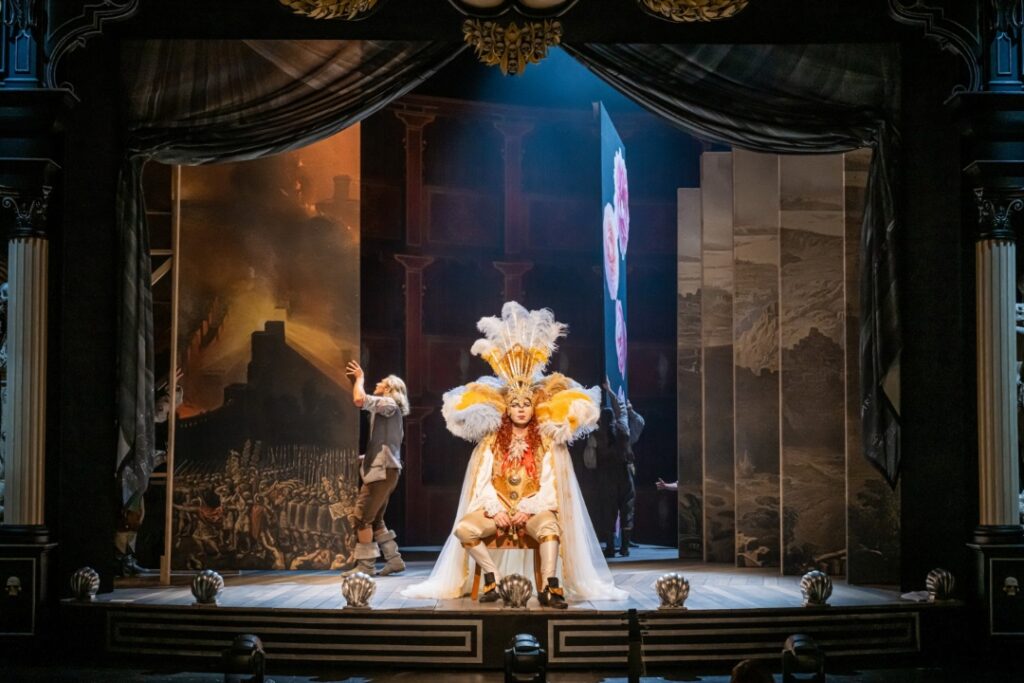
The artistic collaboration between the lautten compagney BERLIN and the Compagnia Marionettistica Carlo Colla & Figli yielded a striking game of theatrical forms. Staged at the historic Goethe-Theater Bad Lauchstädt 1802—Germany’s only completely preserved theater from the Goethe era—its original stage machinery and compact dimensions provided a perfectly scaled venue. As traditional Italian puppetry collided with baroque opera, flesh-and-blood singers withdrew to upper gallery, dubbing for the stylishly dressed marionettes. With its rustic edge and primitive vitality, this engaging production of “Rinaldo” transported the audience back to 1711, when the work first conquered London, and when opera and popular entertainment existed in alignment.
Visually, the stage space was physically constrained by the very mechanics of marionette operation, as characters could only maneuver along two or three horizontal tracks fixed to the ceiling. Although their movements were restricted, the puppets remained communicative: highly identifiable costumes, stylized gestures, bodily directional changes, and even subtle facial expressions. The operators were clearly masters of their craft; except for a few slightly superfluous movements during one of Armida’s arias in Act two, the stage movement of the marionettes was brilliant, aligning perfectly with the demanding music. Even during virtuosic coloratura passages, they seemed to sing with apparent authenticity! Consequently the puppets appeared as life-size. The illusion of scale was maintained so flawlessly that the audience only fully sensed the trick of perspective at the final curtain call, when the singers took the stage alongside their puppet avatars.
The stage sets were equally efficient. Whether depicting Jerusalem under siege, the lush grove of Almirena’s garden, or the calm sea at the beginning of Act two, the scenery remained vividly illustrative. Enhanced by smoke and lighting effect, the narrative architecture required no effort to grasp. Within the limited physical stage depth, a series of receding flat-set layers elegantly created a striking sense of perspective, with grand atmospheric depth.
On a musical level, the lautten compagney BERLIN under Wolfgang Katschner had to grapple with acoustic conditions, that suffered somewhat from an unfortunate lack of focus. This imposed a relatively dry, direct sound reminiscent of a rehearsal room. Woodwind instruments, particularly the oboes, resulted in rather severe overlapping tones. The brass, castanets, and timpani sounded lively but occasionally too explosive. The brightest spark belonged to the basso continuo team, which remained vibrant and rhythmically crisp. It was deeply regrettable, however, that for the sake of shortening the runtime, the dazzling, extensive harpsichord solo section in Armida’s Act two aria, “Vo’ far guerra,” was almost entirely omitted.
(Photo: Anna Kolata)
Cast Highlights
Faced with the daunting task of coordinating with both the orchestra and the precise choreography of the puppets, the vocal soloists delivered an energetic & heart-felt performance. Nicolas Tamagna’s Rinaldo proved immensely flexible, capturing the shifting facets of his character with vivid immediacy. He demonstrated outstanding breath control during the lyrical sweetness of the grieving “Cara sposa” in Act one, displayed a resolute steadfastness in the heroic aria “Venti, turbini,” and carried this vocal energy fluidly into other stormy displays of Acts two and three, matching the physical movements of the puppet flawlessly.
Danae Kontora as Armida possessed a brilliant high register with immense power. She conveyed a chilling sense of psychological oppression, projecting the sorceress’s dominance—particularly when she manipulated Argante by playing with her outer appearance as Almirena, and later, when she faced her true love for Rinaldo. Johanna Falkinger’s Almirena was soft and agile, demonstrating fine control over long phrases, and her alternating singing with Kontora in the Siren duet at the opening of Act two was seamlessly executed.
The countertenor Johannes Wieners as Goffredo produced a tone that was fascinatingly androgynous, yet his vocal projection remained resolutely secure, capturing the stately image of the Christian leader. While Florian Götz (singing Argante and the Mago cristiano) and Benno Schachtner (Eustazio) were granted relatively less stage time, they delivered consistently stable and stylistically assured performances throughout the evening.
(Photo: Anna Kolata)
A Fragmented Spectacle of Metatheatre: Handel’s “Rinaldo” at Oper Halle
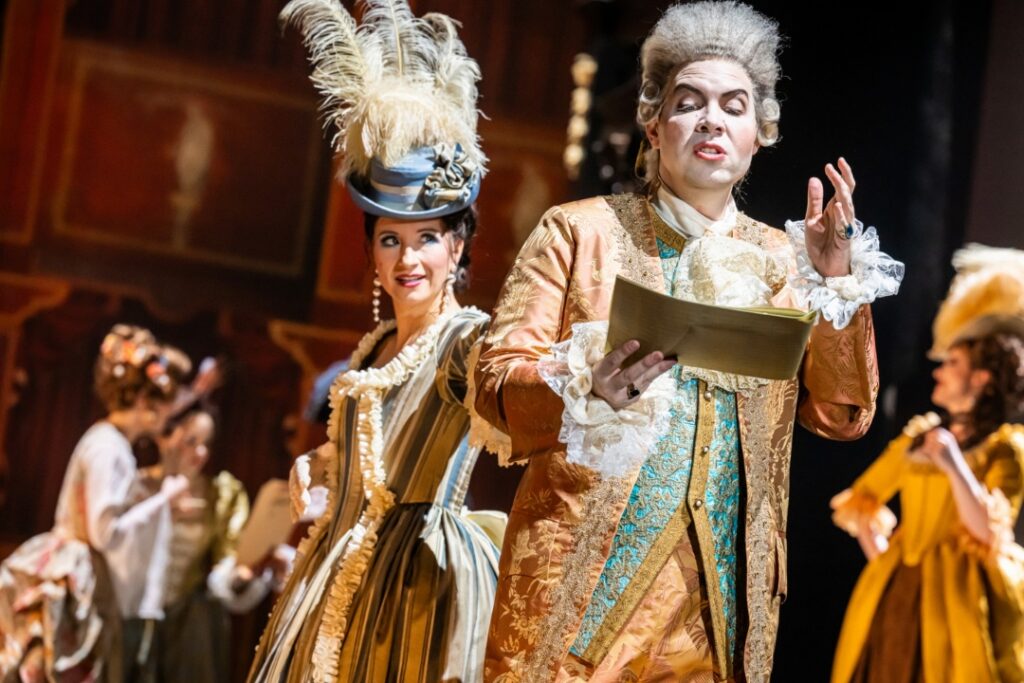
In contrast, Oper Halle delivered an audacious re-contextualization of the breakout 1711 version. Director Walter Sutcliffe shifts the main narrative axis toward the operation politics of the opera house itself. The result is a metatheatrical experiment that strongly evokes Florian Leopold Gassmann’s “L’opera seria” (1769)—a witty “opera about opera” focusing on the volatile friction between composers, impresarios, stars, and patrons. Yet, unlike Gassmann’s biting satire, this Halle staging subtly re-imagines the characters: Rinaldo is explicitly styled as a flamboyant castrato superstar recalling the cinematic image of “Farinelli” (1994). Goffredo and Eustazio shed their knightly armour to become the theater’s dramatist and composer (Handel himself), while Armida, Almirena and Argante portray the company’s competing singers.
However, this structural adjustment introduces issues: by domesticating what was originally a fast-paced, high-stakes epic into a localized backstage drama, the production considerably bleeds its theatrical momentum. For example, the crusade’s opening sequence—originally a string of battle-ready, sword-clanking arias—is reduced to a stagnant boardroom dispute over music scores. Throughout the evening, the deliberate changes for the libretto’s original entrances and exits creates confusion. Armida appears on stage earlier than dramatic musical entrance set to her, and Rinaldo shares the stage with Almirena shortly after her supposed abduction by Armida. Key plot devices are also repurposed: the second-act Siren scene, designed to seduce Rinaldo, is transformed into low-tier starlets flirting with wealthy opera patrons. While the overarching framework survives, the legibility of the specific plot lines degrades to the point where the original texts often confuse with the stage actions.
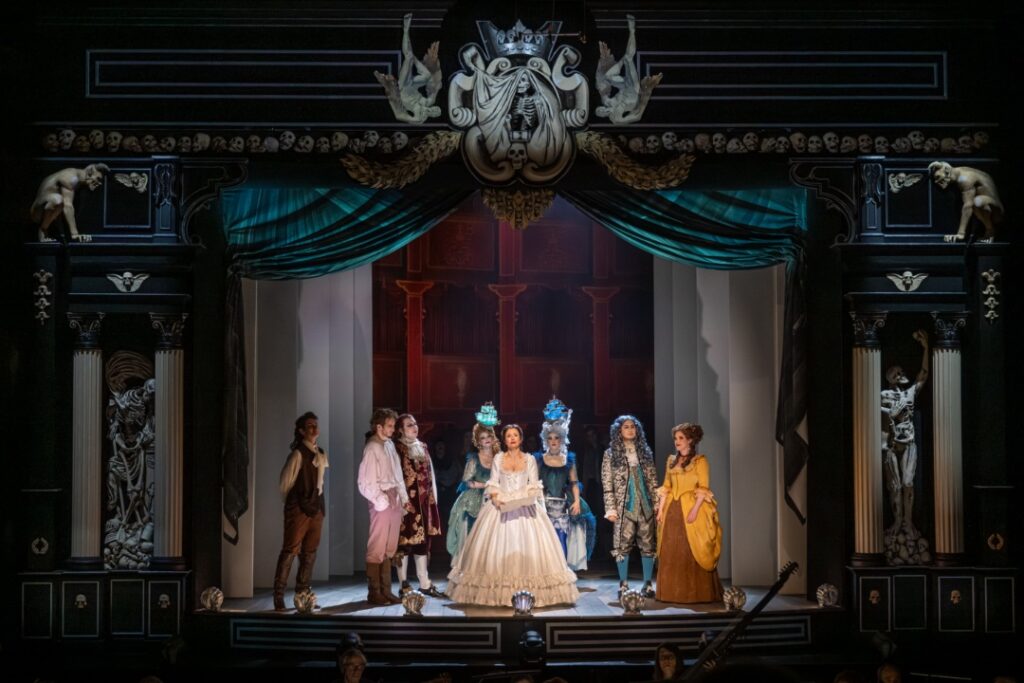
Visually, this opera house framework is demonstrated within Hartmut Schörghofer’s architectural set. The stage cleverly rotates between the front-facing position and the exposed side boxes position, occasionally accompanied by digital projections. The opera stage facade itself, marked by stark black-and-white stone contrasts, memento mori alcoves, and a chilling row of skulls at the crest, injects an ecclesiastical gravitas. This sombre monumentality stands in stark contrast to the highly stylized, sumptuous costuming.
(Photo: Anna Kolata)
Vocal Performances
Within this restructured universe, the vocal performances largely anchored the evening. The countertenor Christopher Lowrey delivered a meticulously crafted reading of the title role. Navigating the emotional spectrum of love, grief, and determination with convincing vocal power, his performance reached an explosive zenith during his virtuosic Act one closer. Yulia Sokolik’s Goffredo was recast with a welcome air of authority, contrasting with the original libretto’s ambiguity, while Constantin Zimmermann’s Eustazio successfully channeled the intellectual weight of a composer. Together, their journey to find the Christian Magician was transformed into a consultation with a senior musical authority. Among the antagonists, Ki-Hyun Park’s Argante was treated with a delightfully absurd touch, projecting an over-the-top exaggeration both in his entrance and his romance advances toward Almirena.
Among the women, Franziska Krötenheerdt beautifully preserved Almirena’s core, steadfast fidelity in love, yet proved delightfully fierce when combating with her rival diva behind the scenes. Her stunning vocal delivery offered some of the most radiant moments of the evening, providing a brilliant foil to Vanessa Waldhart’s Armida. Waldhart left a striking impression, her dangerous, cutting vocal timbre convincingly suiting Armida’s psychological volatility, though her character arc was slightly hampered by the relatively conservative musical direction assigned to her.
In the pit, conductor Michael Hofstetter and the Händelfestspielorchester Halle offered a safe, remarkably cautious reading. While Handel’s rich orchestration gave the individual sections plenty of space to shine, the basso continuo was executed securely but lacked spark-igniting moments. The primary dissatisfaction lay in a persistent, rhythmic conservatism that flattened the score’s vital contrasts. This tempo crisis peaked during Waldhart’s furious Act two closer, “Vo’ far guerra, e vincer voglio,” where a sluggish tempo robbed the aria of its show-stopping potential; even the harpsichord failed to seize one of the most celebrated and rare solo opportunities in entire baroque opera history.
Compounded by Oper Halle’s relatively dry acoustics, which failed to offer the orchestra the bloom it required, this “Rinaldo” remained a conceptual, yet ultimately sluggish affair, that fails to capture the wild energy and raw tension of preparing for the 1711 London premiere as the director claims to present.